
Altoona native climbs Mount Kilimanjaro
Trending
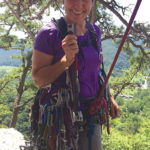
Courtesy photo / Laura Kustaborder said she and her boyfriend, Jamie Billings, prefer traditional climbing. They work with harnesses, ropes and carabiners -- metal loops with a hinged side.
When Altoona native Laura Kustaborder told friends she was planning to climb Mount Kilimanjaro toward the end of last year, co-workers said, "Oh, it's just a hike."
Kilimanjaro is the highest mountain in Africa, but the co-workers were right -- the mountain requires no technical equipment like ropes, ice axes or crampons.
Still, it was a long hike, and more importantly for Kustaborder and her boyfriend, Jamie Billings, who both reside in Pittsburgh, it meant climbing into rarefied air, just short of 20,000 feet.
Functioning at high altitude like that can be a challenge, and Kilimanjaro inflicted a severe case of altitude sickness on Kustaborder.
But the mountain also conferred exhilaration when they reached the summit at dawn Dec. 30 and looked out from "the roof of Africa" to see the sun rise, she said.
Adventurist
As a kid, Kustaborder was "mostly a nerd who read Nancy Drew" and frequented the library -- although she went to historic places with her family and liked hiking, biking and the outdoors.
But after she graduated from the University of Florida, became a physician's assistant and went to Saipan as an employee of the diplomatic corps, she broke out.
"The travel/adventure bug hit me hard," Kustaborder said.
It began with triathlons, open-ocean swim competitions, marathons and other events, during a career that included stints in Japan, Russia and West Africa.
Her outlet for adventure underwent a permutation after she moved to Pittsburgh in 2010, and friends introduced her to a presentation in the city by the Banff Mountain Film Festival, where she saw videos on climbing, leading her to tell herself, "I need to meet the people that do this."
She felt too shy "to waltz into a climbing gym" and introduce herself, but fortuitously, she met Billings on a dating site around then.
"He was already a climber," she said. "The rest is history."
That history has included Kilimanjaro, for which she prepped by climbing 12,280-foot, semi-technical Mount Adams in Washington state, using an ice ax and crampons.
Her history has also included highly technical rock climbing, with ropes and lots of gear on cliffs, including New River Gorge and Seneca Rocks in West Virginia.
She's still a novice in both the big mountain and rock-climbing categories, learning from the more-experienced Billings and other competent friends.
There's risk, but the pair minimize it through training and strict adherence to safety rules, according to Kustaborder.
It's not about courting danger but about seeing the beautiful places of the world, Kustaborder said.
"Are you ever going to read about me in a climbing magazine?" Kustaborder asked rhetorically. "Absolutely not."
It tested her limits, but Kilimanjaro, the highest peak that requires no ropes or special gear, is not in the same category as the really big mountains of the world, according to Kustaborder.
"You can't put K2 (the second highest peak) in the same
sentence with Kilimanjaro," she said.
Everest 'out of question'
She doesn't plan to advance to those much higher and more hazardous mountains.
"Everest is out of the question for several reasons," she said.
"Both of our mothers would kill us," she said.
It would also be "wildly expensive."
Still, Kustaborder is "very driven," Billings said.
Her Kilimanjaro preparation included a Pittsburgh tradition: donning a backpack and climbing the stairs of the 36-story Cathedral of Learning on the University of Pittsburgh campus once a week, Billings said.
"You want to shoot for 12 ascents" per session, he said. "It's hot and miserable."
Kilimanjaro
Kilimanjaro was a long slog.
They arrived in Tanzania Dec. 23, took a jeep ride Christmas eve and began their hike.
She and Billings went with two friends from Pittsburgh.
The tour company provided a guide and two assistants, plus a cook and 30 porters, who carried clothing, sleeping bags and sleeping mats and prepared meals and set up tents for the climbers. They met four others, who became friends.
The key was to take it slow, "so you didn't get winded," Kustaborder said.
The daily hikes varied between 2.5 and 6 miles.
To acclimatize to the ever-decreasing oxygen content, they would hike to a high point, remain 15 minutes, then come back down part way to sleep.
The guides were attentive, frequently checking the climbers' eyes and frequently asking questions to determine their reaction to the altitude.
They were so solicitous it became annoying. But Kustaborder became sick anyway.
Her symptoms included clumsiness, loss of balance, a "horrible" headache and nausea.
It wasn't life-threatening, but she felt horrible, she said.
Her companions helped.
They figured she was under-hydrated and low on sugar, so they forced her to drink.
A guide took her pack.
It felt intimate, like they were all family members, she said.
She wanted to quit but didn't.
"One foot in front of the other," she said.
All the groups climbing various routes converged on a final camp, creating an ocean of tents with hundreds of people before the summit push.
That final push began after the guides woke them at 11 p.m. and after they had tea, coffee and a snack. "All you (could) see is a sea of headlamps," she said.
They came off the mountain New Year's eve.
Cliffs
Rock climbing is a "mind-over-matter thing," Kustaborder said.
There are "sports" climbs with anchors already in place and traditional climbs that require the climbers to attach removable anchors as they go into the cracks and crannies of the wall.
The couple prefers traditional climbing.
They work with harnesses, ropes and carabiners -- metal loops with a hinged side.
Billings often leads.
Kustaborder is learning to lead.
The lead climber has the hardest and most dangerous job, because he can fall the farthest, even if the climber below him belays or clinches his rope promptly -- the distance he's climbed above the nearest anchor, plus the length of rope that he has dragged up past that anchor.
Climbers below the lead fall almost no distance, provided the lead climber belays promptly.
Kustaborder focuses on her breathing to keep calm and on her options for the next move.
She tries to be confident and not to think of the possibility of falling.
"Easier said than done for sure," she said.
She tries to remain aware of her surroundings. She likens it to riding a bike, where you look ahead, not at your front tire.
"The part I love about it is working through things that are challenging," she said.
You don't want adrenaline, Billings said.
"Adrenaline gets in the way and makes you sloppy," he said.
He seeks "hyper-focus."
He wants to be calm and balanced, alert for the next foot hold or hand hold, where to place the next anchor, in an unfolding plan.
Kustaborder has practiced taking the lead, a "pretend" lead, using a second rope.
"You're safe," she said. "It just kind of gets you in practice putting in the gear," she said.
She fell once doing it at Seneca Rocks.
She was about 200 feet up.
She reached out and got her foot onto a little ledge and her foot slipped.
It took her breath away, but her belayer caught her quickly, and she didn't fall far.
The fall was mostly "a pendulum swing," plus a little stretch of the rope, she said.
"I fell onto my gear and it held me," she said. "It gave me confidence to know my gear placement was good."
Still, she began sobbing, and Billings had to talk her through to the top, as she continued to sob.
At the top, it's exhausting if it's been a hard climb, Kustaborder said.
Still, it's exhilarating to conquer the fear, if you felt it, and it's breathtaking to take it all in from the top, she said.
"I'd rather be crazy than boring," Kustaborder said.