
Highest honors: World War II veteran John F. Homan awarded France’s Legion of Honor
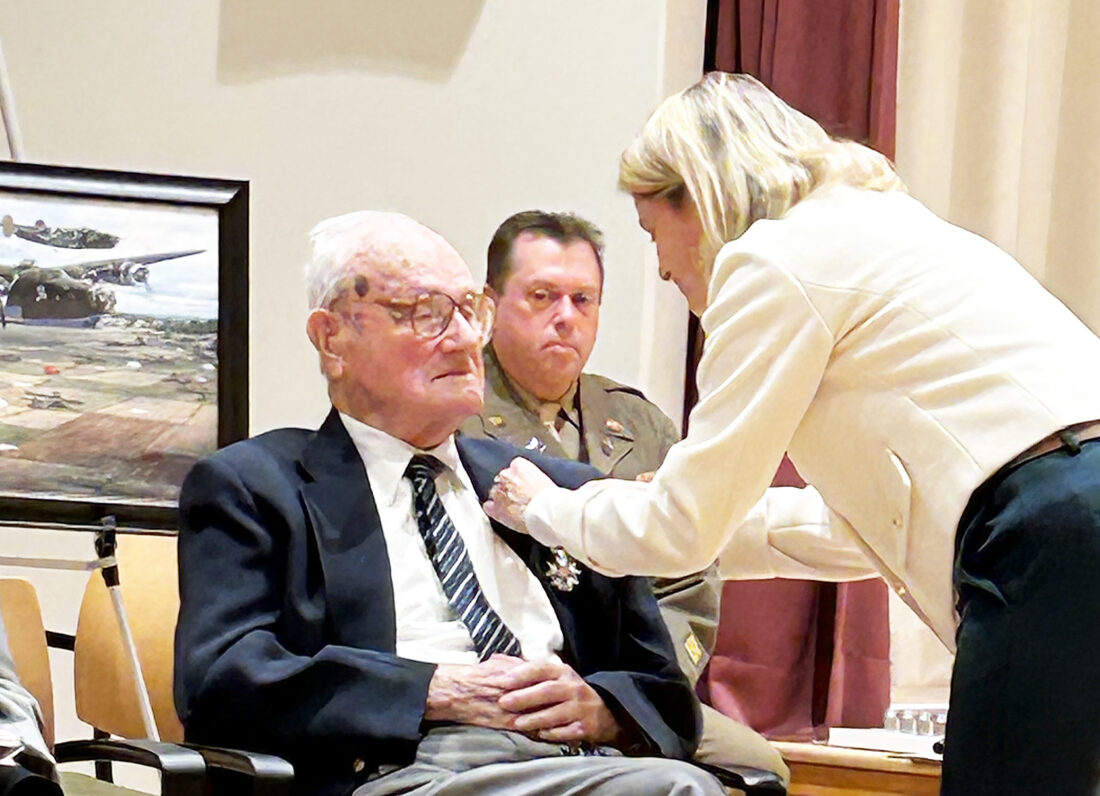
A central Pennsylvania WWll veteran has joined the ranks of such notables as Gen. George Patton, President Dwight Eisenhower, chemist Louis Pasteur, aviator Charles Lindbergh and more recently, chef Julia Child and filmmaker Steven Spielberg as a recipient of France’s highest honor.
John F. Homan, who will turn 102 in a few weeks, and lives in State College, has received the French Legion d’honneur (Legion of Honor) medal, which is the country’s foremost civil and military award. Homan’s award recognizes the heroism he displayed as a B-24 co-pilot flying 34 combat missions in 1944 which helped contribute to the liberation of France.
He received the recognition in a ceremony Wednesday at the Foxdale Retirement Village where he lives, attended by a French government official, Homan’s family members, family members of Homan’s crewmates, WWII re-enactors and community members.
In presenting the award Consul General of France Caroline Monvoisin recalled the “bonds of cooperation” between the United States and France dating back to the American Revolution. She said Homan and other veterans like him unselfishly gave of themselves to a shared goal of democracy.
“We have stood together throughout our shared history,” she said. “He served in a country that wasn’t his own … and we owe (him) our deepest gratitude.”
Homan accepted the medal on behalf of himself and “all 10 of our crewmembers.”
“I hope I can live long enough to carry out all of these compliments,” he said. “Congratulations also to the people in the grounds crew who worked all night when we brought back the planes all beat up. It was their job to get them ready for the next day.”
His daughter, Kimberly Homan, talked about how her father downplayed his role in combat and spent his time after the war working hard to provide for his wife, Irene, and their three children. He taught his children to love many outdoor sports such as fishing and ice skating and to share his love of boating.
“He always insisted he wasn’t a hero as others did the same missions as he did,” she said.
Local historian Jared Frederick, an associate professor of history at Penn State Altoona, helped to organize the ceremony for Homan. Frederick has spent a lot of time with him, co-authoring the veteran’s memoir entitled “Into the Cold Blue: My World War II Journeys with the Mighty Eighth Air Force.”
Frederick said during the ceremony that he never had the chance to meet his two grandfathers, who both took part in WWII. His work with Homan has blossomed into an enduring friendship that is still going strong today.
“This process has not only procured for me a co-author, I’ve gained a dear friend,” he said.
Homan’s missions included many flights across active French battlefields in both the Normandy and Lorraine campaigns. He remembered a campaign over Normandy that took three days and cost the lives of 18 crewmen and two planes. The first two days of bombings proved unsuccessful but the third day helped Patton’s troops push through to their objective.
His crew delivered food and supplies for Patton’s troops and the French civilians after the liberation of Paris. Homan recalled in his memoir resupplying Patton’s troops near Orleans south of Paris in a series of flights called “Operation Truckin.'” The planes landed on an airstrip that they had heavily damaged by bombs months before,
They were only 10 miles from the front lines. French citizens freed from German occupation came out of their homes and helped to unload the planes.
“They conveyed warm wishes and bartered with battlefield souvenirs,” Homan wrote. “Lugar pistols were particularly popular.”
The Legion of Honor
According to the French Embassy’s website, Napoleon Bonaparte created the Legion of Honor in 1802 to recognize outstanding military or civil service. There are five categories, with the top listed as chevalier or knight. Any American veteran who risked his life fighting in French territory during WWII qualifies to become a Knight of the Legion of Honor, according to the website. The veteran must have fought in one of the four major campaigns to liberate France — Normandy, Provence, Ardennes or northern France.
Eric Montgomery, who spoke at Wednesday’s ceremony, has helped 64 WWII veterans receive the Legion of Honor award. He learned about the application process and started helping veterans in 2014 after he became impressed by the service of his great uncle Amin Isbir, who was killed on D-Day, according to a story in the Pekin (Ill.) Daily Times.
Montgomery worked with Frederick to help Homan obtain the Legion of Honor award.
‘My most terrifying day’
The Legion of Honor isn’t the first prestigious citation Homan nas received.
One of the most harrowing stories in the book details Homan’s involvement in what was code-named Operation Market Garden, which led to his receiving the Distinguished Flying Cross.
The mammoth Allied operation was detailed in the book, “A Bridge Too Far,” by Cornelius Ryan and a 1977 film by the same name. The mission that occurred in September 1944 failed for a variety of reasons but it aimed to end the war by Christmas of that year. The plan was for combined Allied forces to seize a number of bridges in the Netherlands. But they underestimated the will of the German troops to continue fighting, according to Homan’s book.
Homan’s crew’s mission was to drop supplies to U.S. paratroopers who had landed the day before and ran into German infantry in the area. The enemy was still there on Day Two when Homan and his crew took off with more than 250 other B-24s.
Almost immediately one of their engines was damaged by an unknown object. Then enemy gunfire peppered them and shot down planes around them. They tried to find the drop sites and made three passes to identify the right spots.
They finally made the drops and headed back home all the while under heavy fire. Soon their hydraulic system got hit as well as their number four engine. The cockpit seemed to fill with smoke, although it was really atomized hydraulic fluid, and the crew was sure their plane was on fire, Homan wrote in his memoir.
Then their radio operator yelled that he’d been hit and while one of the crewmen tried to give him some aid, Homan and his co-pilot put the plane into a dive to maintain air speed.
“This act required instant precision,” Homan said in his book. “If we placed too much power on one side of the aircraft, maintaining balance would have been tricky.”
The plane leveled off but they were only 50 feet off the ground. They slowly added power and reached treetop level. Eventually they were able to maintain altitude.
“Our recovery from this critical descent was something of a miracle,” Homan wrote.
They set a course for a British airfield for emergency landings. When they had made their dive to maintain air speed, crewmen flying other planes with them had reported them as shot down when they got back to base.
“Many of our comrades thought us dead or captured,” Homan wrote.
Their landing would be fraught with peril because the plane’s left tail fin had been shot off. Because they had no hydraulics, they had to manually crank down their wheels and flaps and they prayed that the cranks wouldn’t become stuck “or our goose was cooked,” Homan wrote.
The worst moments came when they approached the field and saw a flaming B-24 on the right side of the runway, which meant they’d have to land on the left side. They didn’t know their left tire had been shot out and when they landed it fell apart.
The plane went into a skid and slid off the runway with Homan gripping the controls as tight as he could. They thought if they added power it would push them in the direction of the burning aircraft. Homan and his crew could only hang on as the plane shuddered and hurled them across the terrain.
“‘Come on! Come on!,’ we collectively hollered,” Homan wrote. “All were worried that leaking fuel would turn us into a blackened pile of ash at any second. Everything was out of our hands.”
As soon as the plane stopped, the crew jumped out and ran as far away as possible for fear that the plane would blow up. They later found out that the radio operator received only minor injuries and that even though the Operation Market Garden as a whole had failed, 80% of the supplies they and others had dropped had reached the paratroopers. The campaign came at a high cost. According to Homan’s book, of the 252 B-24s assigned to resupply troops, 130 were hit by enemy fire.
For his efforts, Homan was awarded the Distinguished Flying Cross.
“The medal hangs in my office as a vivid reminder of my most terrifying day,” he wrote.
Artist Larry Selman attended the ceremony and said he was so moved by the book that he painted a rendering of the plane called “Jo” as it was described in the book.
A kindred spirit
Another speaker at Wednesday’s ceremony, John Dalgleish, is the son of bombardier John Dalgleish, who was a crewman on Homan’s missions, including that scary flight for which Homan received the Distinguished Flying Cross. The younger Dalgleish said listening to Homan’s daughter talk reminded him of how his father was closemouthed when he got home from the war.
“My father’s service was something he never spoke about,” he said. “Their book finally gave me an understanding of my father’s service.”
The first time the son saw his father’s WWII medals was in 1978, the day the younger Dalgleish was commissioned into the Army as a 2nd lieutenant. His father went and got his WWII medals.
“In that silent moment, he pointed to the first lieutenant bar and said, ‘I still outrank you,'” he said.
The son wasn’t the only Dalgleish in attendance. A grandson of the bombardier, also named John Dalgleish, was at the ceremony and spoke about his tour of duty in the Army in Afghanistan, serving 65 years after his grandfather in the same division.
The grandson carried a bag that contained two remnants that his grandfather had carried home from the war. One was a small piece of metal, which father and son haven’t been able to identify but believe it could be part of a plane. The other was a piece of tubing that belonged to a hydraulic system.
The bombardier’s son reminded the audience that crews like the ones Homan and his father belonged to braved conditions that aren’t issues today such as unpressurized cabins and freezing temperatures when they took to the skies in their B-24s. When they returned from war they “rebuilt families and communities” in the same heroic manner that they’d fought the war, he said.
“They were the greatest generation we have ever seen,” Dalgleish said.