
Close-knit flock: Hollidaysburg’s Underhill Farm breeds rare Leicester Longwood sheep
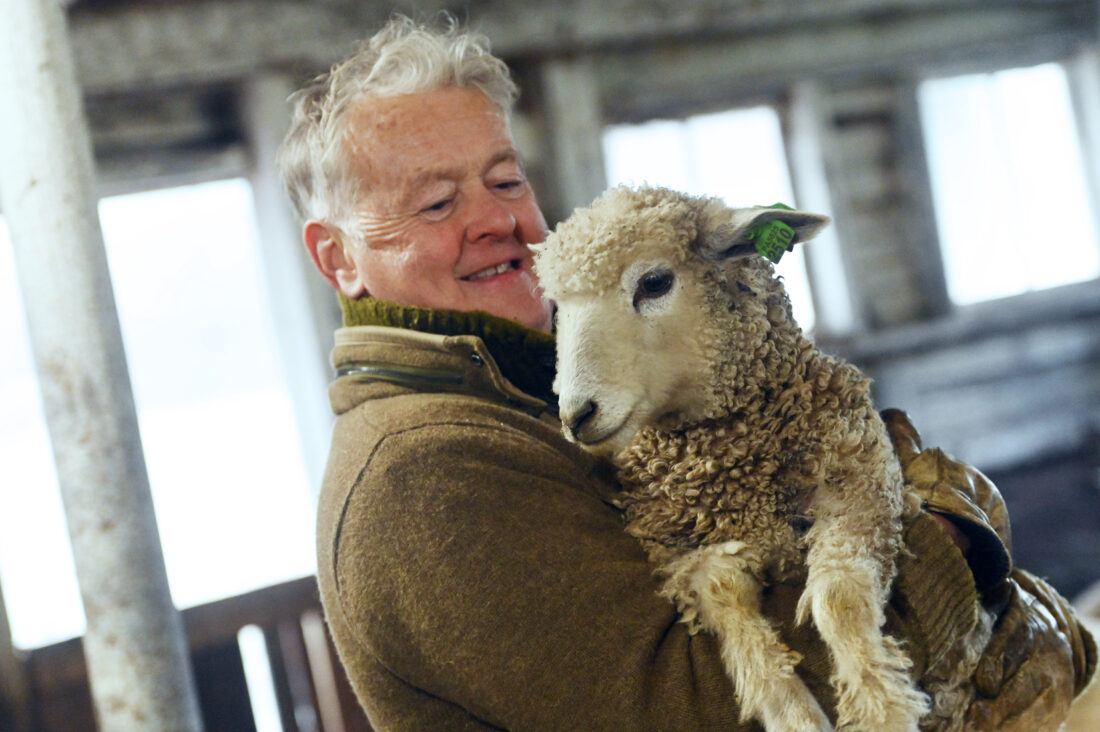
Mirror photo by Patrick Waksmunski / William Churchill holds a Leicester longwood sheep.
HOLLIDAYSBURG – In 2008, Underhill Farm purchased a small flock of Leicester Longwool sheep from the Colonial Williamsburg Foundation in Virginia.
In October, the farm returned the favor by sending Oz, a 3-year-old ram, back to Colonial Williamsburg’s breeding program.
The transfer is important to the longevity of the breed considered threatened by the Livestock Conservancy because there are fewer than 1,000 animals registered annually.
“We purchased Oz so we can broaden the genetics in our flock,” said Kevin Crossett, Colonial Williamsburg director of corporate affairs.
“Although Oz’s pedigree dates to the Colonial Williamsburg Foundation, his genetics were not closely related to any of the ewes that we are currently breeding,” Crossett explained.
The ram is a descendant of the flock Underhill Farm got in 2008, said Fred Stowell, who owns Underhill Farm along with Will Churchill.
When Colonial Williamsburg began looking for a ram for this year’s breeding season, they turned to Underhill’s breeding lines and chose Oz.
Oz was born at the Hollidaysburg farm and his move to Colonial Williamsburg brings the journey full circle.
“We were honored that Colonial Williamsburg called us and took one of our sheep back,” Churchill said.
Underhill Farm has rich history
The history of Underhill Farm, located in Frankstown Township just east of Hollidaysburg, dates back to the late 1830s. Since the early 1950s, it’s been a family sheep farm, with Joseph Stowell, Fred’s father, purchasing the farm in 1956.
Fred Stowell and Churchill took over the farm when they purchased it in 2008.
Stowell, a retired barber, and Churchill, a retired elementary school teacher, started raising Corriedale sheep and Angora goats they had obtained from Stowell’s father and brother. They started to sell yarn in 2002.
In 2006, when Churchill and Stowell went to a wool and sheep festival in Maryland, they met Elaine Shirley, president of the Leicester Longwool Sheep Breeders Association.
Interested in the long, extremely lustrous fleece found on the longwool sheep, they were approved to purchase a flock of Leicester Longwools – five ewes and one ram.
Today, Underhill Farm raises Leicester Longwools – 32 ewes and eight rams – and Angora goats – 18 does and three bucks – and the wool and mohair is sent to mills, including Lazy Meadows Alpacas and Fiber Mill in Hughesville, to make yarn.
“Underhill Farm gave us raw fleeces from their animals and we processed it into yarn for them,” said Mike and Elizabeth Longstreth, owners of Lazy Meadows Alpacas and Fiber Mill.
The process starts with washing the fiber to remove as much lanolin as possible, the Longstreths said.
Once it’s dry, the fiber goes through a variety of steps, such as picking to pull the fibers apart; dehairing to separate out any coarse fibers/short fibers and vegetation.
The fiber is then carded and prepared for the spinner.
“We spin singles and then ply them together,” the couple said. “The customer gives us the size of yarn they want and the number of singles they want plied together. In this case, they asked us to give them a two-ply worsted yarn, so it’s heavier yarn.”
Underhill Farm produces a high quality fiber that is very nice to spin and work with, they said, noting it’s a “great farm and great shepherds.”
When the yarn is finished by the Longstreths, it returns to Underhill Farm, where “we wash it and I dye it,” Churchill said. “We like to have it in natural colors: white, black, gray and a lighter gray.”
Underhill Farm yarn is sold at a farmer’s market in Huntingdon and at fiber festivals from March to October throughout Pennsylvania, New York, Ohio, Virginia and Maryland, Churchill said.
Online sales haven’t worked out so well.
“People want to see it and feel it, people want to see your products,” he said.
Altoona native Rosemary Jorden Best is a loyal Underhill Farm customer.
“I love supporting local businesses,” she said. “When I saw Will and Fred a few months ago at a show, I commented to Will that I love to buy from them because it’s ‘farm to needle.’ The fact that they raise the sheep and goats, shear on site and personally hand-dye the wool is so unique.”
Best said Underhill Farm’s yarns are “exceptional and wonderful to knit with. The pieces that I create from their yarns are not only beautiful, but they will last for years and years because they are one hundred percent natural fibers.”
Best, who owns Gossamer Thread Studio, said she uses Underhill Farm’s yarn to hand-knit hats for her small business.
Elizabeth Marecki Alberding of Hagerstown, Md., is also a fan of Underhill Farm’s yarn.
“Their yarn is gorgeous, the colors are fabulous and the guys are great,” she said.
Alberding said she met Stowell and Churchill at fiber festivals in Frederick and Hagerstown, Md.
“They work with you,” she said. “I asked for a custom color and they were able to dye the color I needed.”
If they are unable to dye the shade requested, they suggest a color that might work better, she said.
“It’s the best yarn I have ever worked with,” Alberding said. “I have made shawls, blankets, scarves, sweaters and vests.”
Anyone interested in the yarn is welcome to stop at the farm this weekend for a special sale, slated to run from noon to 5 p.m. Dec. 13-14.
In addition, appointments can be made to visit the farm to see the yarn. More information can be found at https://www.underhillfarmpa.com/.
Neither Stowell, 78, nor Churchill, 74, have any plans to retire.
“We will keep going until we can’t do it any more or can’t travel to the festivals,” Churchill said.
Mirror Staff Writer Walt Frank is at 814-946-7467.