
Group pushes organ donor registration
Trending
As a little kid, Anna Fetter's son Jason would help their adult neighbor, who had cerebral palsy and other handicaps as a result of a near drowning, defending the man from ridicule by other neighborhood kids.
Then at age 7, during a swimming lesson at Shawnee State Park, Jason himself drowned, although he clung to existence in the hospital for days afterward.
Confronted with the need to decide whether to donate Jason's organs, Fetter considered her son's helpful nature, including the kindness he'd done for their neighbor, and chose in the affirmative -- encouraged by the unusually extended viability of the boy's organs after brain death and by the prospect of Jason's kidney renewing the life of an eight-year-old potential recipient.
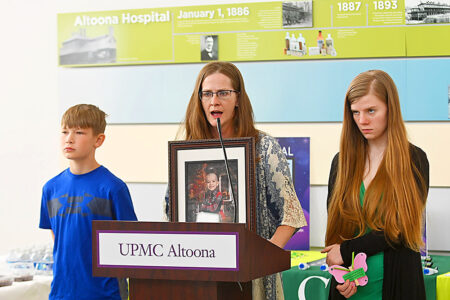
On Tuesday, as she's done for years, Fetter, of Bedford, worked with the Center for Organ Recovery & Education as a donor spokesperson -- this time at an event to mark Donate Life Month at UPMC Altoona.
"Donor families are the heroes of the donation process," said Colleen Sullivan, CORE's director of public affairs and donor family services, in the hospital lobby after the event.
CORE works with hospitals in April to encourage people to register as donors, either when they renew their driver's licenses or else with a visit to the CORE website, core.org, where the effort takes less than 30 seconds, she said.
Less than half of Pennsylvania residents are currently signed up, even as more than 100,000 people in the U.S. are waiting for organ donations -- including 7,000 in Pennsylvania, she said.
That does not count the many waiting for donations of corneas or tissue, she said.
Sullivan recommends that people register immediately, through the CORE website, while it's top of mind.
"Don't wait," she said.
In cases where organ donation is possible, hospitals call CORE, as required by law, Sullivan said.
The organization screens for suitability and contacts the families, she said.
"It's a very emotional situation," she said.
The conversation is easier when the person who's died has already made the commitment, she said.
"It takes the burden off the families," Sullivan said.
When the potential donor hasn't made that commitment, the CORE representatives try to persuade families by pointing out that organ donation provides an opportunity to "leave a legacy," she said.
Their loved one, can in a sense, "live on through others," she said.
That was expressed by someone related to a cornea donor in Erie who said, "At least someone who needed it can now see blue sky and green grass," Sullivan said.
The CORE representatives also point out to the families of potential donors that such an opportunity is available only to "a very small fraction" of people," because less than 3% of deaths result in viable donor organs, she said.
That is because donors need to be on a ventilator when they die, or in the case of cardiac death, have been on a ventilator within the past 90 minutes, she said.
While the conversations can be difficult, they also give the family a chance to talk about their loved one, which can help the cause, she said.
In the aftermath of donations, recipients are always urged to thank the donor family, Sullivan said.
Some donor families respond, and subsequently develop ongoing relationships with the recipients and their families, she said.
"There are many beautiful stories," including donor families who regard recipients as extensions of their own families, she said.
Conversely, some donor families prefer not to have that sort of relationship, she said.
Among the barriers that can discourage potential donor signups is the belief that health care providers won't work as diligently to save their lives, Sullivan said.
It's a myth that she attributes to lack of information and education.
Organ donation is considered only after all other lifesaving efforts have been tried, she said.
Jason was Fetter's hero even before he was born.
When she was pregnant with him, she was a single mom and a high school dropout, but his coming birth inspired her to re-enter high school, get her degree and make a better life for herself -- and him, she said.
He proved to be a cheerful, spunky kid, not only in the way he defended and befriended the non-verbal neighbor, but in how he interacted with his baby brother Charles, she said.
They'd play with matchbox cars, and Jason would make ramps and other features "to make it all the better," Fetter said.
He would share his cereal, she said.
He was a teacher's pet, though not one other kids held in contempt, she said.
He was unable to say "no" when asked to do something, she said.
His death happened 10 years ago, and she still misses him, but the signs and the effects of the decision she made have all pointed to her having made the right one.
"God does not need our organs," Fetter said in a text exchange following the event. "Leave them here on earth, where they can be used."