
The end of an era: East End United Methodist church closure leaves congregation looking for answers
Trending
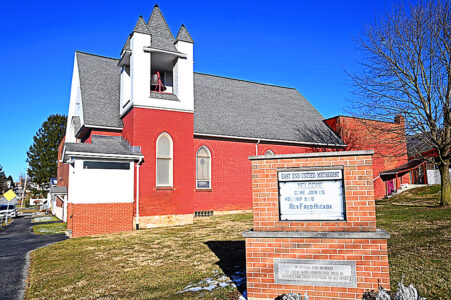
After 128 years as an anchor of the community, East End United Methodist Church held its final service Dec. 31, 2023, following a months-long battle against an aggressive mold problem. Now, parishioners have begun the search for a new church.
"I started going about nine months before I was born," Leonard "Lenny" Alwine said. The Altoona native, now 71, has been a regular parishioner at East End his entire life, serving as lay preacher and two-decade chairman of the administrative council.
The mold was discovered well after it had taken root, Alwine said.
In early August 2023, unbeknown to any of the congregants, the drain in the irrigation moat at the rear of the church became clogged, leading to rainwater seeping into the building's foundation for more than two weeks until it was detected.
"Nobody knew that, because it was summertime and the kids programs we usually held weren't (using the building) because school was out," Alwine said.
When the mold was found, it was already too late. Despite the church members' best efforts, the mold had set in.
At first, it was contained to the basement, but Alwine said he knew it was only a matter of time.
"The room where the most water had come in we called the Peacemakers -- where they would make the quilts and stuff for the nursing home -- well that material in there was all wet and smelly," Alwine said. "I tried wiping the walls down with Clorox and stuff, but it was just too much."
The church rented large, commercial dehumidifiers to address the rampant humidity and removed several tons of water-damaged material in September, but it did little to stem the progress of the mold.
"We spent, between the machines and hauling it all out, a little over $5,000," Alwine said.
The East End administrative council turned to the Methodist conference for help.
"Unfortunately, you have to buy your insurance on the building through the United Methodist Conference, so that's where we started having some fighting," Alwine said. "We were paying over $1,000 a month for insurance and they said it wouldn't cover flooding."
According to Alwine, this setback put East End in a "bad place to be," since they didn't have the funds to cover the repairs out of pocket.
Including labor and materials, the administrative council was quoted a price of about $50,000 to completely eradicate the mold, which was slowly spreading upward through the church.
"They said this mold problem is now in that piano on the stage, in the drapes on the stage, these surfaces and the walls, anything wooden and the kitchen ... because it was in the air and everywhere it settled," Alwine said.
According to East End treasurer Larry Edwards, the mold problem struck at exactly the wrong time. Since the COVID-19 pandemic, the church had seen a decrease in Sunday attendees.
"Like many other churches, we lost a fair number of our congregation from COVID that never came back," Edwards said.
And since the overall attendance had been gradually decreasing in the past decade, this led to a "dramatic" loss of income for church coffers.
"We lost around 40% of regular attendees," Edwards said. From its peak of 200-plus in the early 20th century, Sunday service in 2023 only drew about 20 parishioners, he said.
Uncertain future
By November 2023, the financial situation at East End looked bleak, Alwine said. Without the cash reserves, or insurance payments to treat the mold, the church was in an uncomfortable position.
"We called a meeting of all the active members, 17 showed up, and voted 17 to close, zero to stay open, which was a very hard thing to do," Alwine said. "Of the 17 that were there, most of them had been members for 40 to 70 years, since they were all the older people like myself."
The vote came as no surprise to Alwine, as church administration had kept the members informed of the progress of the mold and subsequent fundraising efforts.
"It was like cutting off your leg or something, it hurt, but what do you do, you have to face reality sometimes," Alwine said.
Church officials decided Dec. 31 would be the final service, in order to get through the Christmas season. According to Alwine, more than 50 people showed up for the farewell service, many of whom traveled from across the state to say goodbye to their childhood church.
"It was a lot of kids who went here, but moved out of town when they couldn't find work," Alwine said. "It was a very bittersweet, sad service."
To close out a 128-year history of giving, the administrative council decided to give the remaining church funds to several local charities.
Pastor Fred Hickok, who was contracted with East End through June 2024, has now been relocated to Jaggard First United Methodist Church and Fairview United Methodist.
The fate of the church is uncertain, since Methodist conference policy dictates that any closed church reverts back to conference ownership and no plans regarding the future of the building have been announced.
"It's in their hands now, it's up to them what to do with it ... you just thought they might have helped with something rather than nothing," Alwine said.
The remaining church members have now disbursed, trying to find a new home on Sundays. Alwine attends Juniata Church of the Brethren, and is getting used to the new congregation. "You don't think about having to look anywhere else, but suddenly you have to look somewhere else," Alwine said.
The group of East End expats still meets up for dinners, recently gathering to celebrate Valentine's Day.
"Because we were all together for so long, we were a family, and it was like having your family house burn down -- you can't go back anymore," Alwine said, "but you still like the people ... and we still plan on having get-togethers."
Mirror Staff Writer Conner Goetz is at 814-946-7535.
Church history
East End United began when two young women, Wave Mason and Ettie Speer, arrived in Juniata in 1895 looking to start a Sunday school program for the exploding youth population in the area. At the time, Altoona was undergoing rapid expansion under the auspices of the Pennsylvania Railroad.
They started meeting in an unused log schoolhouse located in what is now Rosehill Cemetery, with Sunday school classes regularly exceeding 130 pupils.
At this time, Pastor S.S. Hough of the United Brethren Church asked the pair to turn the Sunday school program into an official mission church under the United Brethren banner.
According to an official account of East End's history, "Hough was worried that those 130 kids would be lost and he knew that 70 of his church members now lived in the area."
In 1904, a plot was purchased to construct the new church building at a cost of $3,600, with an additional $500 for stained glass windows.
Children from the Sunday school class were asked to "do chores and do without candy or riding the street cars to school" to raise funds for the building expenses.
The cornerstone was laid in 1905, with the first service held the following year. At the same time, the newly dedicated East End United began self-sufficient operation, and no longer served as a mission church for United Brethren.
In the following decades, the church grew, adding a parsonage, basement kitchen, education building and second paved parking lot across the street.
An Allen organ was installed in the sanctuary in 1973, alongside a choir loft mural painted by Tyrone resident Ronald Bloom.
East End United merged with Pleasant Valley UMC in 2001, creating a larger, shared congregation.
Source: East End United Methodist Church administrative council history subcommittee