
Showcasing Northwestern’s new Ryan Field
Trending
Good stories are almost always about people, but the big story tonight with Penn State playing at Northwestern will be about the place.
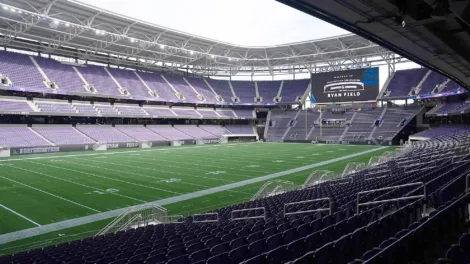
New Ryan Field, a 35,000-seat, on-campus stadium, makes its debut with the game.
It cost $870 million to build -- the most expensive college football stadium ever, all privately funded. So, expect a focus before and during the game on the premium seating, the proximity of seats to the playing surface and the steep setup of the standing-only student section.
Thanks to early media tours and reports, it seems Northwestern has found a sweet spot for its program. It's cozy -- OK, small, especially compared to Beaver Stadium -- but probably the right size for a program that does not have a deep tradition or consistently strong support.
Watch for offerings from the sideline reporter, along with walk-though videos on the concourse as well as some aerial or done shots. It's an approach and storyline that happens whenever a facility like this opens.
It's predictable, and largely an informational for a facility and program. While blue-and-white fans might endure the messaging in this instance, they'll probably be embracing it when it happens when renovated Beaver Stadium gets its time in the spotlight next season.
Jones' judgment
Steve Jones, Penn State's longtime play-by-play man, saw New Ryan Field in February when the men's basketball team was in Chicago. He got a tour with his Northwestern counterpart, Dave Eanet.
When Jones works the game, it'll be the 65th different stadium where he's called a Penn State football game.
"Give Northwestern credit. Between their basketball arena and this, they understand who they are," Jones said.
The visiting radio booth will be in a good sideline location. Jones knows location is not a concern for those listening to his work with Jack Ham and Brian Tripp, though.
"Almost everywhere in the Big Ten is good," Jones said. "We've been in places with bad vantage points before. Our broadcast booth was behind home plate for the Pinstripe Bowl in Yankee Stadium -- good for baseball but not as much for football.
"Nobody cares about your issues. But it doesn't mean there aren't tough places to do it. In the end, it's your job to figure it out."
Peacock performance
Last week's Peacock/NBC broadcast crew (Dave Flemming and Matt Cassel) for Penn State vs. Wisconsin produced a better performance than either team on the field. They were consistent, informative, strong and timely.
Flemming, who was under the radar and maybe underappreciated at ESPN, and Cassel, who seems better in the booth as opposed to a halftime or sideline reporter role, were both comfortable questioning play calling and time management in a way that some of their colleagues generally do not.
In addition, Flemming's repeated (and accurate) references to Penn State's Rocco Becht as the most experienced quarterback in college football helped tell a piece of the story in a way that probably merited a little bit of attention.
Best of all, the broadcast's production team offered timely graphics about how long it would be since Wisconsin won a conference road game or since it had won at Penn State.
Too often, those things get shared in passing or not at all. Those numbers were a big part of the story, and the broadcast shared them appropriately.
Stuffed sideline
Yes, the sideline space at Beaver Stadium is tight -- there's just not a lot of room between the playing surface and the start of the seating area for fans -- but there are also too many people on the sideline who have no reason to be there.
Watching a game from home really makes the crowded conditions obvious. The fact that many people with a credential dangling around their neck are neither working media nor athletics or team personnel is troubling.
In the get-every-dollar-you-can world of college athletics, it's no surprise that donors, hangers on and who knows who else get escorted to the field during the game.
There are just too many people down there, though, and it feels unsafe for the players, at times.
With a few less of those people there, fans in person and watching from home would have a better chance of seeing field-level advertisements, too. It seems the money hungry folks would support such an approach.
Notable
■ Penn State's loss might not have been good for the team or die-hard supporters, but it certainly boosted attention and traffic for media and social media outlets to analyze, debate and
discuss what happened.
■ Belated kudos to CBS for its coverage of the end of Iowa's victory over Michigan. The network had all the necessary angles of the game-winning touchdown and shared them in a timely manner. That's the kind of thing broadcast partners should deliver for viewers on a regular basis.
■ My sense is Wisconsin's late-game penalties were more about its lack of discipline than the crowd noise inside Beaver Stadium last week. It's loud in the stadium, and sounded loud for those watching at home, but it still seems the sound in the stadium is either inconsistent or over the top.
■ Man, Dr Pepper and State Farm do good work with their college football advertising campaigns. Funny, timely and still working to move the respective products. If all game broadcasts were that good, the sport would be even stronger.
Sampsell covers the broadcast end of Penn State football for Gameday. He can be reached at stevesampsell@gmail.com