
Versatile LaVar Arrington wears many hats
Trending
Of all the lingering images from the Oregon-Penn State football weekend, the one that seems most meaningful and remains most striking for me happened nearly eight hours before kickoff.
That's when former All-America linebacker LaVar Arrington showed up as the guest picker for ESPN's College GameDay.
It was Arrington at his best, figuratively wearing many hats -- former player, father, program champion, media member, fundraiser, cheerleader -- and at the same time literally wearing just one hat -- the one touting his Penn State linebacker-themed brand.
Arrington was also wearing a T-shirt promoting the Penn State athletic department's paid content site and brought along cans of a beverage brand with a financial connection to the athletic department.
The combination was not exactly a NASCAR driver's fire suit adorned with colorful sponsor logos, but the outfit, and especially the appearance overall, was not far from it.
Arrington was there to sell, period.
He's part of the ever-growing, money-soaked environment that has altered the business of college football.
After an unruly name, image and likeness (NIL) effort for a couple of years, college athletic programs can now legally pay $20.5 million per year to athletes -- with football players getting the bulk of that money at schools like Penn State.
Players can also collect more than that (which is already above and beyond the support they get for room, board, fees and tuition) with marketing deals.
The environment might more closely align with the NIL ideal but it's more than just the most visible players who're getting paid.
College football players are making serious money these days and folks like Arrington, or maybe especially Arrington, are working to find ways to get them even more.
That's just how the sport operates these days. If you're going to be successful in that situation, you have to work hard, consistently, to keep the funds flowing.
Arrington's TV appearance last week allowed him to help do that. While he was there for what's usually one of the most-watched segments of the show, ostensibly to share his picks for a handful of games, his presence was also a little more strategic.
Solid Saturday
Belated kudos and thanks to NBC Sports. Last week's game broadcast was solid from start to finish -- a broadcast worthy of the game.
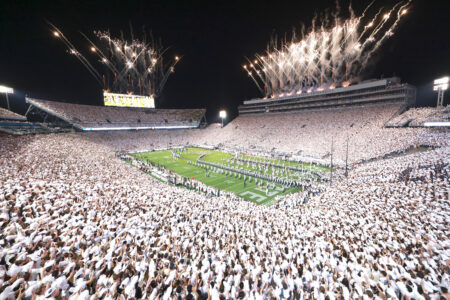
While NBC amped up its tools for covering the game, moving to 14 cameras from 10 for a usual game, and adding drone cameras for those sweeping wide-angle visuals of an all-white Beaver Stadium, it was a combination of talent and tools that made the broadcast so strong.
NBC was clearly prepared, and the top-to-bottom practice run the broadcast team conducts each Saturday afternoon certainly helped. At the same time, they were ready as action played out and necessitated timely commentary and replays.
Noah Eagle met the moment with his play-by-play work, analyst Todd Blackledge was fair with both teams, offering praise and questions when appropriate, and reporter Kathryn Tappen made the most of her on-air time in a role that often does much more than what viewers see.
Especially nice was the broadcast's use of sound. There was enough ambient noise to sense the energy while the talent was still audible. Plus, NBC caught the jeers from the Penn State crowd when they happened and referenced how the stadium came to life when the game was competitive late.
Since NBC has started covering the Big Ten Conference, some of its weekly matchups have been ho-hum affairs and a slightly smaller amount have been needle movers like Oregon-Penn State.
Still, no matter how competitive or meaningful the game, NBC's broadcasts have been solid, which makes it perhaps the Big Ten's best broadcast partner in terms of serving fans.
Notable
– Intentionally or not, coach James Franklin has used two postgame news conferences to introduce necessary benchmark words about his program into the media landscape in recent years. The first was "elite," years ago after a home loss to Ohio State. It's been a measuring stick ever since. After the Oregon loss, Franklin added "factual" with this quote about the team's struggles in matchups with Top 10 teams. "It's really not a narrative. It's factual. It's a fact."
– The sponsors whose logos rotated on the big screen above the home team entrance in the south tunnel of Beaver Stadium had to be pleased with their visibility during the White Out broadcast. Their white logos showed up well in high definition amidst the students wearing white.
– ESPN's motto -- Serve Sports Fans. Anytime. Anywhere. -- falls short when it does not list opposing networks or outlets that are airing college football games. It happens with listings of other sports too. It's petty and, again, not a service to fans.
– The College GameDay crew looked good in all-white last week. It was a nice touch, something different and simple, for the broadcast.
Sampsell covers the broadcast end of Penn State football for Gameday. He can be reached at stevesampsell@gmail.com.
Worth watching
Clemson at North Carolina, Noon Saturday, ESPN
Vanderbilt at Alabama, 3:30 p.m. Saturday, ABC
Boise State at Notre Dame, 3:30 p.m. Saturday, NBC
Miami at Florida State, 7:30 p.m. Saturday, ABC