
James Franklin needs flexibility for variety of topics
Trending
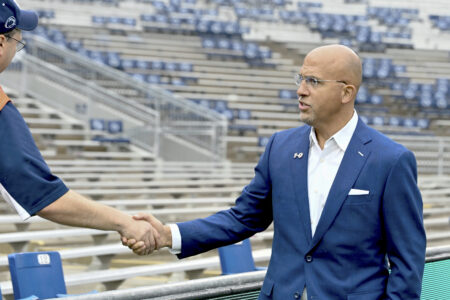
Coach James Franklin does a lot of talking each week, with two media sessions (midday Mondays and after practice Wednesdays), an appearance at the Quarterback Club and his Thursday night radio show.
In addition, broadcast partners get time with Franklin before games, and there are occasional individual sessions with national media members who visit campus as well as guest spots on podcasts, radio and TV shows.
That's a lot of time, and potentially a lot of topics.
While the coach offers a party line about focus and talking only about each week's opponent, that's both silly and unlikely to happen.
Sure, he can slough off big-picture questions not about an opponent during his local media sessions, but that's not what happens in those other interactions.
He's one of the nation's most highly paid and successful college football coaches. He's also a vice president of the American Football Coaches Association -- and he'll be the group's president next year. He's previously spoken about his desire to be the first Black coach to win a national championship.
He's clearly an appropriate and knowledgeable voice about big-picture matters in the sport.
So, it's a little disingenuous when he suggests he can only focus on questions about the Nittany Lions' opponent during a given game week. He's certainly capable of multitasking, or he would not be leading the successful program he's headed for more than a decade.
There was a prime example of all this in the week leading up to the FIU game.
During his Monday media session, Franklin initially chafed when a question was about the Southeastern Conference moving to a nine-game schedule. He cited that focus-on-the-opponent mindset, but then answered the question completely and well.
A couple days later during his weekly radio show (in theory an on-brand endeavor), the first question from the host was about the transfer portal and Franklin gladly answered without fretting about the game two days later.
It was an interesting juxtaposition. It was also a good precedent.
It's OK for Frankin to lean into such questions and be a vocal leader for the sport -- no matter who the team's playing on a given week.
Press position
Media members sat on the west side of Beaver Stadium for decades -- until the press box was moved to a suite on the east side of the stadium this season. It's on the northern end of the east side.
The move, which will be permanent, puts the media behind the Penn State team bench instead of looking at it from across the field. It also offers an upgrade in terms of amenities and comfort from the antiquated accommodations on the west side of the stadium.
From Penn State's perspective, though, the press box offers a little bit of a challenge.
It's somewhat tighter quarters, offering less seating for those
covering games. Overall, the capacity has dropped by about
80 seats -- so things could get tight for big games.
Notable
– After two weeks of the season, it's clear replay reviews remain consistent in terms of their speed (too slow) and inconsistent in terms of their value (they may not add much). Blame it on the folks conducting and operating replays, not the technology. After all these years with replay review, it just seems we're still not to the point where it offers a helpful, quick way to improve games in a consistent manner.
– It might not happen as soon as this week, but ESPN's College GameDay is missing something without Lee Corso, and a path exists for Fox's Big Noon Kickoff to someday draw better ratings. The latter show will always lead directly into a game -- and some big games at that -- which usually helps ratings. Still, Big Noon's self-imposed problems in terms of the perceived trustworthiness of its on-air talent will not make a ratings growth spurt easy.
– As much as big-budget athletic departments have bloated in recent years, the same seems to be true with TV broadcasts -- and especially studio shows. At NBC, "B1G College Countdown" has four people on the main set, a couple individuals on side sets and three on-camera analysts on site each week. And that does not include the play-by-play team. That duo (Noah Eagle and Todd Blackledge) might be the best in the business but, man, that's a lot of other people to get airtime before a broadcast and at halftime.
– You have to feel for CBS Sports. A few seasons ago, the network was in the midst of a decades-long relationship with the Southeastern Conference and its 3:30 p.m. games on Saturdays were often some of the most-viewed of any week. The network had big-budget teams and big-time matchups. After ESPN made its deal with the SEC, though, CBS partnered with the Big Ten Conference. Their on-air team does a good job, and it's always nice when Penn State gets a late-afternoon Saturday kickoff. Unfortunately, the network gets more than its share of weak matchups, it seems. This week it's USC at Purdue. It's hard to make that compelling for a big audience.
Sampsell covers the broadcast end of Penn State football for Gameday. He can be reached at stevesampsell@gmail.com