
Formula 1 leaders agree to make engine design changes
Auto Racing
PARIS -- Formula 1 leaders have agreed to an engine design change for 2027 that will slightly increase internal combustion output.
F1 started the year with big changes including a 50-50 split in power between a traditional engine and the onboard battery pack, but driver criticism was immediate.
Governing body the FIA said it met with teams and F1 officials in an online session Friday and that the changes were agreed in principle.
"The measures agreed in principle today for 2027 would see a nominal increase in internal combustion engine (ICE) power by (tilde)50kW alongside a fuel-flow increase and a nominal reduction of the energy recovery system (ERS) deployment power by (tilde)50kW," the FIA statement said.
The changes, it added, will be "intuitive for drivers and teams."
After just three grands prix this season, tweaks were made that slightly curbed the influence of the electrical power. They answered driver criticism by promoting pure driving skill over electrical recharging, especially in qualifying.
Last weekend's Miami Grand Prix was the first under those changes. Sunday's race was one of the most wide open in recent F1 history with drivers from four different teams leading before Kimi Antonelli took his third win of 2026 for Mercedes.
F1 has used V6 engines with electrical hybrid power since 2014 and an increase in the amount of electrical power has forced drivers to adjust. Timing the electrical boost and recharging is the key to tactical racing. Four-time world champion Max Verstappen loathes it so much he's questioned his future in F1.
The FIA said Friday's session began with a review of the changes put in place before Miami.
"The conclusion from the deployment of modifications in Miami, designed to improve safety and reduce excessive harvesting, was that they resulted in improved competition and were a step in the right direction," it said.
"Evaluation of the Miami package is ongoing with a view to the introduction of further adjustments at future events."
Next on the calendar is the Canadian Grand Prix on May 24.
IndyCar confusion
INDIANAPOLIS -- IndyCar officials hope this week's rule change on the push-to-pass button creates more intrigue in Saturday's Indianapolis Grand Prix.
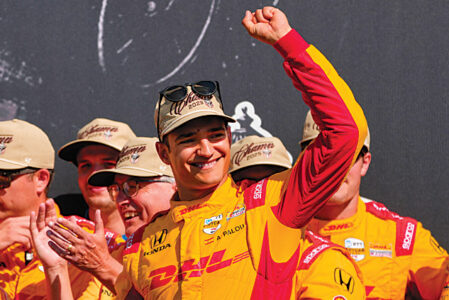
Whether it works will depend on how fast three-time defending race winner Alex Palou and the other starters adapt -- and, naturally, how much risk they're willing to take on the first lap of the race.
The move comes in the wake of last month's software failure at Long Beach, where a dozen drivers illegally used extra turbo boost during a midrace restart. That led series officials to make the modification that allows drivers to use their push-to-pass on all restarts once the race has started and they've reached the alternate start-finish line in Turn 11 on the first lap. An early push will result in a penalty, even if there is another malfunction.
And that's caused confusion in Gasoline Alley.
"If I push it and it works because someone else does a mistake, it's my fault? Yes?" Palou asked, jump-starting a minutes-long debate among the top five drivers in the standings. "I didn't read the rule, sorry."
Drivers will still get 200 total seconds of green-flag racing to give their cars a boost of about 60 horsepower throughout the race, though the button is not supposed to be operable until they pass the alternate start-finish line, potentially making the race into Turn 11 as harrowing as the first turn of the race. Then drivers can allocate their turbo boost however they choose around Indianapolis Motor Speedway's 14-turn, 2.439-mile road course.
The change essentially eliminates a possible repeat of the 2024 controversy that cost two-time series champ Josef Newgarden a season-opening victory at St. Petersburg when officials determined he used push-to-pass on a restart.
At Long Beach, nearly half the field took advantage of the software error. Others insisted they weren't even aware the push-to-pass button was working on the restart.
Honeycutt prevails
WATKINS GLEN, N.Y. -- Kaden Honeycutt won the NASCAR Craftsman Truck Bully Hill Vineyards 176 at The Glen on Friday with Connor Zilisch second.