Carlos Alcaraz completes career tennis Grand Slam
Australian Open
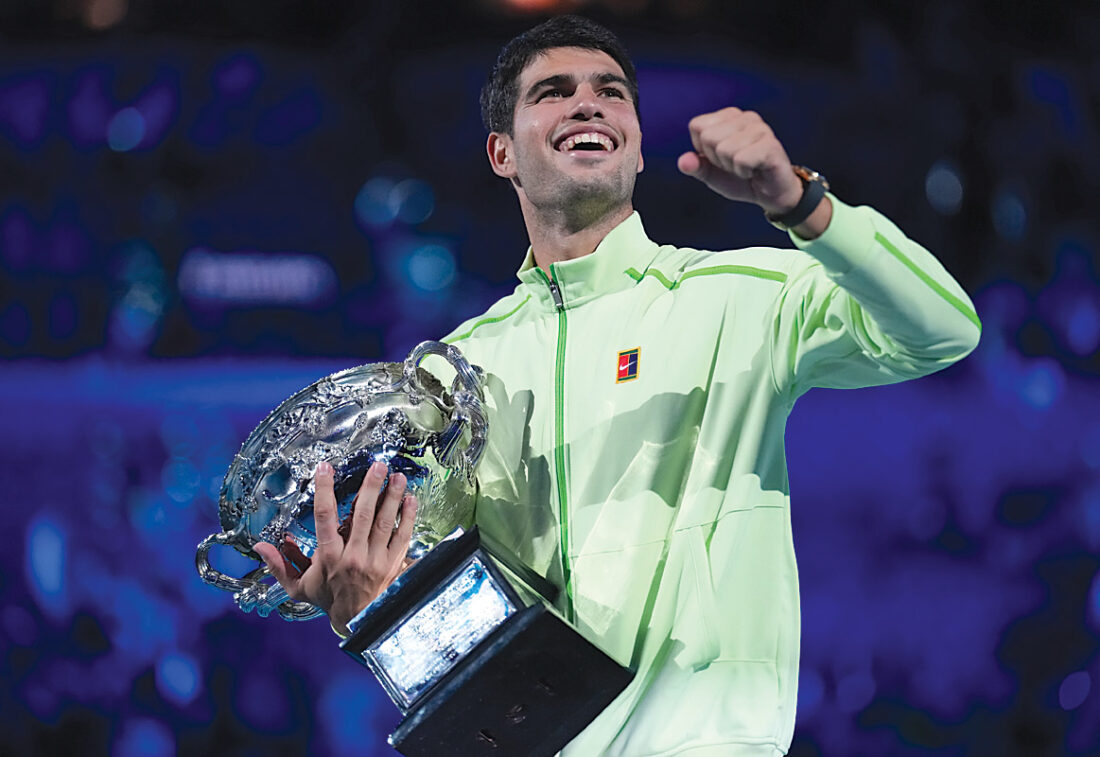
The Associated Press Carlos Alcaraz holds the Norman Brookes Challenge Cup after defeating Novak Djokovic of Serbia in the men’s singles final at the Australian Open tennis championship Sunday.
MELBOURNE, Australia — Carlos Alcaraz had Novak Djokovic across the net from him and Rafael Nadal watching from above in Rod Laver Arena.
His inspiration, and his idol.
Alcaraz had visions of this as a kid — not entirely long ago, in the scheme of things — so there was no better time to show them what he’d learned from watching the two all-time greats, or borrowed from their aura.
He had a comeback, four-set win over Djokovic and walked away from the Australian Open final Sunday as the youngest man ever to complete a career Grand Slam — that’s winning all four of the tennis majors.
At 22 and 272 days of age, he’s considerably younger than Nadal (24) and Djokovic (29) were when they achieved that milestone, lowering a mark that Don Budge set in 1938 when he was a couple of days shy of his 23rd birthday.
No sooner had he completed the career Slam — adding his first victory in Australia to his two each at Wimbledon, Roland Garros and the U.S. Open — than the question was posed about a run at the calendar Grand Slam. That’s all four major titles in one season, something no man has achieved since Rod Laver in 1969.
“Those are big words, to be honest,” said Alcaraz, the two-time defending champion at Roland Garros. “You know, I just want it to be one at a time. Right now next one is French Open. I have great memories in that tournament. I feel really special every time that I go there.
“I don’t want to put myself in a really pressure position to have to do it, but you know, it’s going to be great. Right now I will try to be ready … to play a good tournament in the next Grand Slam.”
A set down after Djokovic’s opening salvo, Alcaraz channeled the legends and changed up his game to upset the rhythm. It worked. He’s now the only man to capture seven major titles before his 23rd birthday.
Alcaraz and Jannik Sinner have dominated the majors since Djokovic won the last of his 24 Grand Slam titles at the 2023 U.S. Open, with one or the other winning the last nine.
Sinner was aiming for a third consecutive title in Australia, but lost in five sets to 10-time Australian champion Djokovic in the semifinals.
There were many who questioned the decision when Alcaraz and long-time coach Juan Carlos Ferrero parted ways after the young Spaniard won the last U.S. Open, and who doubted his chances of being ready to win a first title in Australia.
Samuel Lopez stepped up to head the team, and Alcaraz admitted the pre-season had been “a roller coaster for me emotionally.”
“A lot of people were having doubts about my level in this tournament,” he said. “Every year that I came here to Australia I was thinking about getting the trophy (but) couldn’t go further than quarterfinals.”
In 2026, he said he arrived at Melbourne Park “hungry for more, ambitious for getting the trophy, and being strong mentally enough, not hearing anything or any words” from critics.
“And then just playing good tennis in this tournament means a lot, means the world to me,” he said, “and it is a dream come true for me.”
With his latest bid for an unprecedented 25th Grand Slam singles title stymied, Djokovic could at least joke about the 16-year age gap between himself and Alcaraz.
“Well, first time I played him, he was, what, 11 or 12 years old?” he said, smiling. “No, he was, I think, 18 or 19. You could already see that he’s destined for great things.
“He has improved physically, mentally, game-wise. I mean, he’s constantly looking to innovate himself and his game, which is exactly the kind of mentality that needs to be nurtured for a champion.”
Asked about the potential for Alcaraz to be ranked among the greats of the sport, Djokovic said the career Grand Slam is “a testament to his already stellar career.”
“Of course, already a legendary tennis player that made already a huge mark in the history books of tennis,” he added. “Everything is possible in his case, no question about it.”
Rybakina beats Sabalenka
MELBOURNE, Australia — The extreme nervous tension. The adrenalin. Elena Rybakina felt it all as she stood at the baseline on match point, relying on one of the best tools at her disposal to clinch the Australian Open title.
“Even maybe (my) face didn’t show, but inside it was a lot of emotions,” Rybakina recalled of that ace, cooly and matter-of-factly served, that gave top-ranked Aryna Sabalenka no chance of extending the contest.
The 26-year-old Rybakina clearly isn’t one for euphoric, jubilant celebrations, as tennis rivals and observers noted in her run to the Wimbledon title in 2022.
After ending any lingering doubts that she’d ever be able to add another major title with a 6-4, 4-6, 6-4 win Saturday over the world No. 1, her reserved and understated reaction was again a defining feature.
Expect to see more of it — the winning part, not demonstrative celebrations. It’s her secret to success.
Within three months, she has won the WTA Finals, beating Sabalenka to collect a record $5.2 million in prize money, and, more importantly in tennis terms, added another of the sport’s four most treasured trophies.
The No. 5 seed has shrugged off any doubt that she’s a top contender for the biggest titles with a run that included second-week victories over No. 1 Sabalenka, a four-time major winner and four-time runner-up, No. 2 Iga Swiatek, a six-time major winner, and No. 6-ranked Jessica Pegula.
“Of course, they’re tough opponents, and they have great results, and for so long they are at the top and its stable,” she said. “Yeah, it’s a lot of tough matches I had here — I’m glad that the opportunities which I was getting during the match, I managed to take it.”
She’ll return to No. 3 in the rankings next week.
Rybakina’s resurgence is coming off a 2025 season that was interrupted by the monthslong suspension of her coach by the WTA and up-and-down form.
Rybakina has been working with Stefano Vukov since 2019. Most recently, she said, clear communication has been the key in preparation and competition.
Her support team give her the information — there’s an almost unending stream of technical and tactical advice from the coach’s box during her matches — and she processes it in real time and works it out on court.
National Sports

Justin Rose sets new scoring record at Torrey Pines
Sports at a glance: NASCAR’s Clash moved to Wednesday
WINSTON, SALEM, N.C. — A bomb cyclone over North Carolina forced NASCAR to push its preseason exhibition to ...

Arizona Cardinals hire Mike LaFleur as head coach
Hoops du Jour: NBA: LeBron All-Star streak continues
LeBron James is an All-Star again, extending his record streak of selections. James was a pick for the 22nd ...
Carlos Alcaraz completes career tennis Grand Slam