
Wandering bears seen as good sign for species
Outdoors
Trending
On a warm night in mid July, Brandan Smith heard a sound outside his house in rural Coshocton. Curious, he opened his door and walked outside. As his eyes adjusted to the dark, he saw a large, hulking figure in his driveway, rummaging in the bins and boxes he'd readied for trash pickup the next day.
"I immediately turned around, went back inside the house and slammed the door," Smith recalled. "That image of something huge spooked me. And it just kind of dawned on me: It's a bear."
Certain that no one would believe him unless he had proof, Smith grabbed his phone, gathered his courage and went back outside to capture a video.
"Sure enough, the bear was still there, eating garbage," Smith said. "I'd just gotten done cleaning out the deep freezer, and it was into the old freezer-burned ice cream."
According to Smith, the bear seemed completely unbothered by his presence, even though he was only about 25 feet away. Unsure what to do, Smith called the police. Then he watched the bear ransack his trash pile until a police cruiser arrived half an hour later and scared it off with a spotlight.
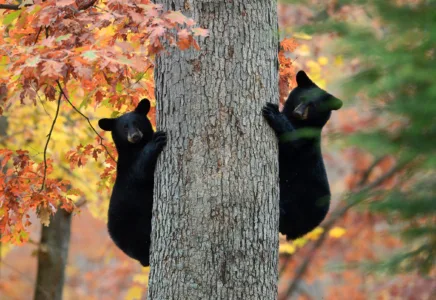
After virtually disappearing from the Ohio landscape in the mid-1800s, black bears could be making a comeback. More than 1,500 bear sightings have been reported to the Ohio Department of Natural Resources (ODNR) since 2022. While the majority have been spotted in rural areas near Ohio's borders with West Virginia and Pennsylvania, black bears have been seen in 69 of Ohio's 88 counties, and some have wandered into more populated areas, including near Pataskala in Licking County in 2025.
According to the Ohio Division of Wildlife's 2026 Ohio Black Bear Monitoring Report, the number of confirmed black bear sightings gradually rose in the 1990s and 2000s, then plateaued during the 2010s, then sharply increased starting again in 2022.
"On average, over the past 10 years the Division of Wildlife has received 239 black bear sighting reports per year," the report stated. "In 2023, 260 sightings were reported in 49 counties. In 2024 we received 370 sightings in 55 counties. Sightings were the highest on record in 2025 with 537 sightings in 69 counties."
And based on local accounts, bear sightings are likely under-reported. Anyone who sees a bear can report it to the division of wildlife via ODNR's online Wildlife Reporting System or by calling 1-800-WILDLIFE (945-3543).
ODNR advises people who encounter bears not to approach them. If you see a black bear, remain calm and slowly back away. Do not run or climb trees, which can trigger a bear's instinct to chase. If a bear approaches, try to look large by lifting your arms, and clap or shout to scare the bear.
Before the arrival of early American settlers, black bears were common in Ohio. But in the early 1800s, the state's newly arrived residents began aggressively felling forests to make way for farms and settlements. They also trapped and killed bears that preyed on their crops and livestock. The arrival of the timber, iron and coal-mining industries only accelerated the destruction of the woodlands where black bears resided.
In 1803, forests covered about 95% of the state of Ohio. By 1900, only 10% of the state was wooded --but by then, the bears had been gone for half a century. Habitat loss and unregulated hunting had driven black bears from a region they had populated for millennia - the same fate faced by other large mammals in Ohio, including bison, elk, cougars and wolves.
Starting in the 1930s, occasional reports of black bear sightings began surfacing in Ohio, according to the ODNR Division of Wildlife. Reports became more regular in the 1990s, and the division of wildlife began tracking black bear observations across the state in 1993. The division soon collected enough evidence of bear activity that the state of Ohio changed the status of the species from "extirpated" to "endangered" in 1995.
Bear sightings gradually increased over the following decades and appeared to level out in the 2010s. Then, in the 2020s, the division of wildlife recorded a notable uptick in bear sightings. Of the 4,793 bear sightings the division recorded since it began collecting data in 1993, nearly a third occurred between 2022 and 2025.
According to ODNR Wildlife Biologist Katie Dennison, "West Virginia and Pennsylvania have seen a lot of growth in their bear populations. That means the bears are starting to naturally expand to Ohio."