‘Driving force:’ Bill Anderson lauded for work on Little Juniata
-
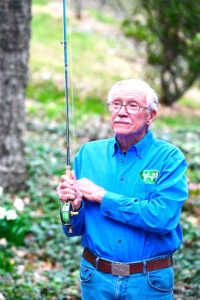
- Mirror photo by Patrick Waksmunski Bill Anderson practices casting as he checks out his rod and reel ahead of the trout season opener.
-

- Mirror photo by Patrick Waksmunski Bill Anderson ties a fly during a class that he teaches in his Skelp home.
-
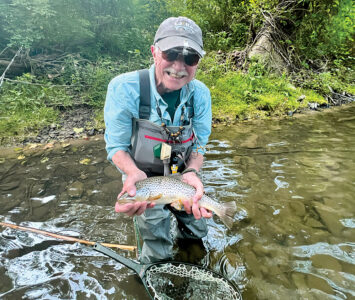
- Courtesy photo Bill Anderson shows off a fish he caught on the Little Juniata River.
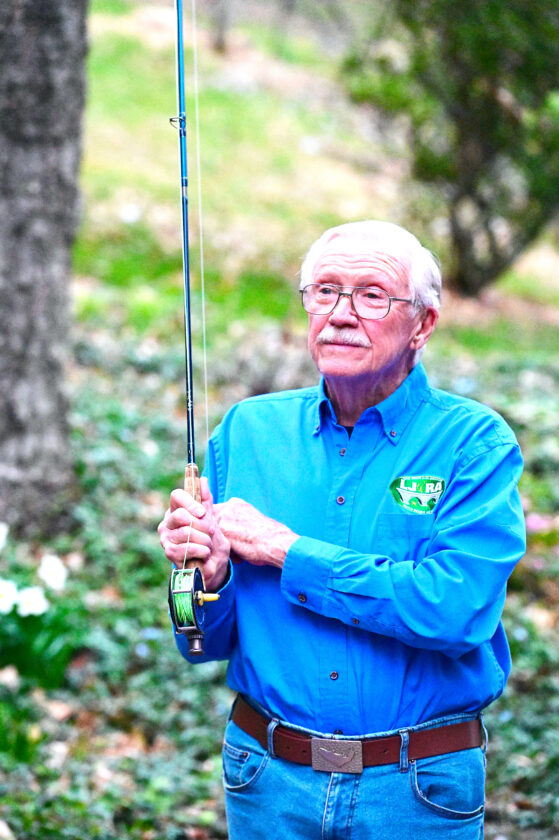
Mirror photo by Patrick Waksmunski Bill Anderson practices casting as he checks out his rod and reel ahead of the trout season opener.
Anyone who has ever fished or enjoyed the Little Juniata River has one man and one association to thank, said Lee Pryor, a director of the Little Juniata River Association.
That man is Bill Anderson, who is the “driving force” responsible for fundraising hundreds of thousands of dollars for projects that have improved the Little Juniata’s stream banks over time, Pryor said.
Anderson, the association’s chairman and president, has also led efforts to establish more than five miles of public fishing easements, turning private land public for recreational purposes, Pryor said.
Under Anderson’s leadership, the association’s membership has grown from about 12 members to over 800 local and regional members, Pryor said, noting the association continues to add new members all the time.
When Pryor grew up in Birmingham, a small village next to the river bank, the Little Juniata was heavily polluted, he said.
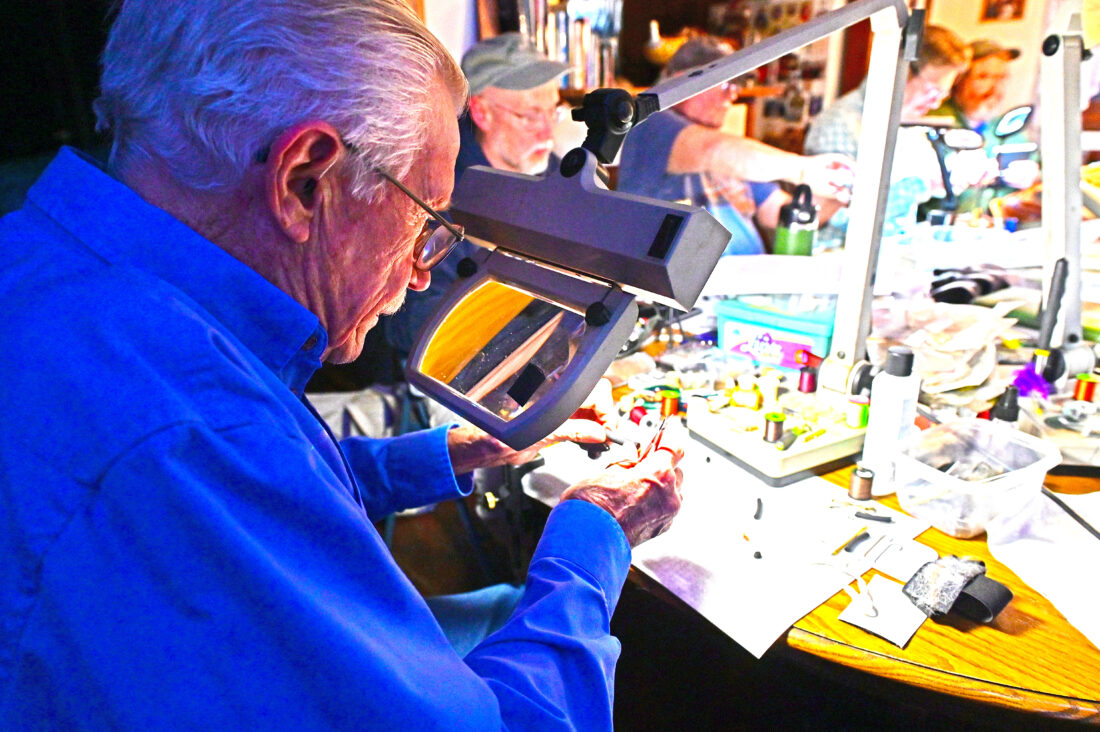
Mirror photo by Patrick Waksmunski Bill Anderson ties a fly during a class that he teaches in his Skelp home.
Then in the 1970s, with the advent of improved sewage processing, the river “started to come back” and trout were once again seen in the river, Pryor said.
But in 1998, a mysterious spill occurred, he said.
“Some unknown chemical had destroyed aquatic insect life in the river that resulted in the starvation of the trout,” Pryor said, noting it was at that time when a group of people got together to form the Little Juniata River Association.
Their mission was solely to monitor the river’s comeback and make sure it didn’t happen again, he said.
After a while, their meetings became less frequent and the association became dormant, Pryor said.
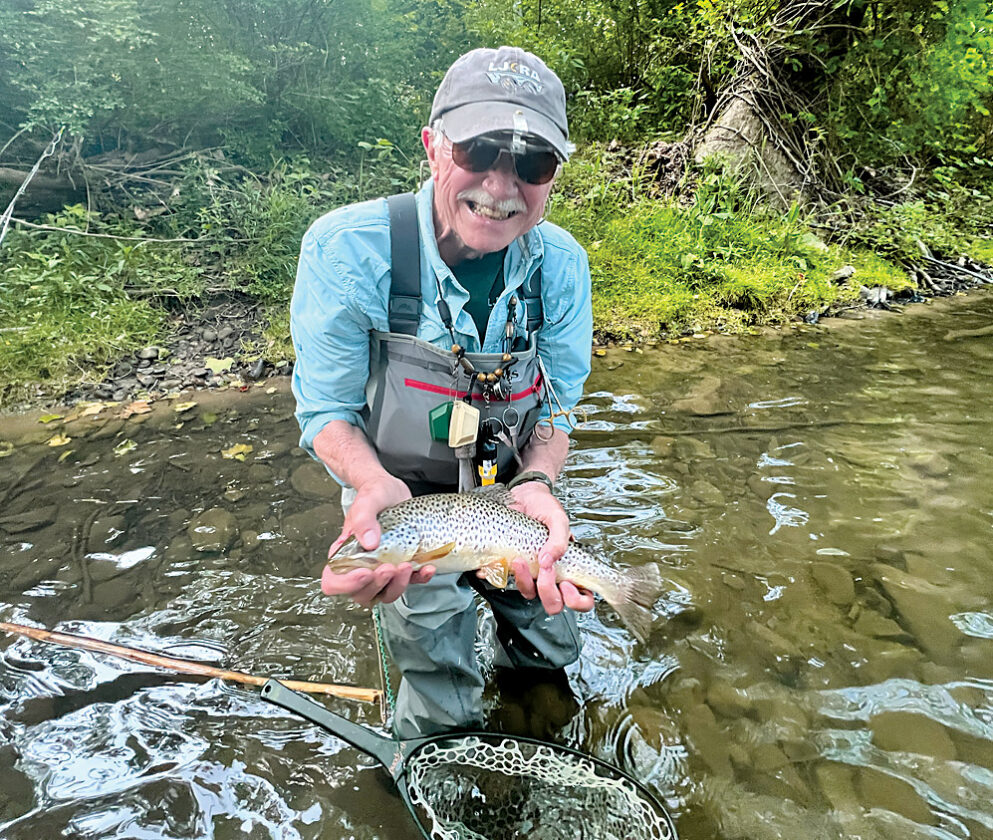
Courtesy photo Bill Anderson shows off a fish he caught on the Little Juniata River.
That’s when Anderson stepped in as the association’s president, Pryor said.
Anderson said he helped form the association in 1998 but became its chairman and president when he retired in 2005, adding the association’s mission now is to monitor, improve and protect the Little Juniata River and its watershed.
Today, the Little Juniata River Association is “one of the most accomplished fishery organizations in the country,” Pryor said.
Through their work, the Little Juniata River has been designated a Class A wild trout hatchery, Pryor said.
Since the river is self-sustaining and fishable year-round, there’s really no impact by Saturday’s state trout season opener other than more people being out, Anderson said, noting the Little Juniata River is “one of the premier flyfishing and troutfishing streams in central Pennsylvania.”
“I would say it’s the best, but of course, I’m (biased),” Anderson said, adding the river is one of the top three or four trout streams in Pennsylvania in terms of its trout population.
There are other fish in the river, but no one really knows it for that or fishes for them, Anderson said, noting the river is essentially a wild brown trout stream.
Passion for outdoors
Anderson, 80, grew up in Wilmington, Delaware with a passion for hunting and fishing.
At about 6 years old, he started fishing for catfish and carp with his uncle at Nonesuch Creek in Delaware, which no longer exists because Interstate 95 was built right through it, Anderson said.
“They filled it in so it is nonesuch now,” he said with a laugh. “There is no such creek, but I started there.”
By age 10, Anderson would regularly take his fishing rod and walk to the Brandywine River, which flows straight through the middle of Wilmington, he said.
“In those days, I would leave in the morning and come back at dark. My mother didn’t worry about me,” Anderson said. “Now you’d have a missing person report out for you.”
In 1963, Anderson graduated from Wilmington High School and later, in 1972, graduated from the University of Delaware with a degree in business and mechanical engineering.
Anderson was the first person in his family — both his mother’s side and his father’s side — to graduate from high school, let alone college, he said.
In 1968, he married his wife, Carol Ann, who was a physical education teacher in Wilmington public schools.
“She came home one day and said there was a new gym teacher with her,” Anderson said, noting the teacher, Tom Crawford, was from Pennsylvania and wanted to go duck hunting with him.
“I was a fanatic duck hunter at that time,” Anderson said.
Anderson took Crawford duck hunting in Delaware, and Crawford brought Anderson back to Sinking Valley, where the two hunted for deer and turkeys and went fly-fishing together.
“We’ve been the best of friends ever since,” Crawford said.
In 1975, Crawford and his wife, Pam, moved back to Blair County to start their own business.
By 1978, Anderson and his wife had two sons — Tim “Toby” and Luke — and they were looking for a new place to live.
Having visited Blair County before, Anderson knew about the area and decided to seek out a job opportunity here, he said.
Soon after they moved, their daughter, Betsy Moyer, was born, Anderson said, noting Carol Ann became a stay-at-home mother while he worked for SKF, a bearing manufacturing company that used to operate in Altoona.
They initially rented a house in Sinking Valley but later built a house in 1982 along Hobbit Hollow Road, where they’ve lived ever since, Anderson said, noting he now teaches people how to build fly-fishing lures every Tuesday at his house.
Toby Anderson, 46, passed away suddenly in October 2020 following a massive stroke; Luke Anderson lives near Bellefonte with his family; and Moyer lives in Washington state with her family, Bill Anderson said.
Of his three children, only Moyer has a genetic tendency for fishing, Anderson said.
“Fishing is just aquatic hunting from my point of view, and you either have a gene for it or you don’t,” Anderson said, adding the appeal of fishing comes from the random reinforcement of unpredictable rewards.
“It’s very much human psychology,” he said. “To be randomly reinforced is extremely compelling, and when you’re fishing, you never know what you’re going to catch.”
Anderson said he still enjoys fishing with Crawford and the association’s local members.
Crawford said it’s nothing for the two of them to go out on a boat and catch between 100 and 150 fish in a day.
“He’s pretty easy going,” Crawford said of Anderson’s personality. “We kind of have the same philosophy in life, which is you don’t curse the darkness, you light a candle.”
River protector
Anderson was a national finalist for the 2014 Field & Stream “Hero of Conservation” award and was the winner of many environmental and conservation awards for his work preserving and improving the Little Juniata River, according to his biography on the association’s website.
Dr. Bert Altmanshofer, a Duncansville podiatrist, said he appreciates Anderson’s dedication and passion for the Little Juniata River.
“It’s kind of amazing what this guy has done,” Altmanshofer said.
Anderson has written articles about fly-fishing and the Little Juniata River for regional magazines and is also the author of “Trout Boomer and the Little ‘j’ — The story of a fly fisher and his love for the Little Juniata River.”
Anderson said he was always an avid reader and wanted to write a book.
In fact, when he was in fifth grade, Anderson set out to read every book in his school library.
“Then I realized they were bringing them in faster than I could read them,” he said, adding he gave up and started a more modest goal of reading all the books written by certain authors.
“I had a goal to write a book at some point, and I realized from my reading that the most interesting books were written by people who lived the experience and had something to write about,” Anderson said, noting it seemed logical to write about his love for the Little Juniata River.
In 2012, Anderson wrote his book, which was self-published in 2014, and sold over 1,000 copies — way more than his wife expected, he said.
He would still be selling the book if not for his publisher going bankrupt during the COVID-19 pandemic, Anderson said.
“I lost my printing availability,” he said, noting he’s been working on a revised edition and plans to get another publisher within the next year or so.
The first 40 pages are autobiographical and tell the story of how he came to Blair County. The rest of the book is about fly-fishing at the Little Juniata River, he said.
“There is no one who knows this river better than I do just because of the sheer time spent and having the opportunity as a retired citizen since 2005,” Anderson said. “I’ve filled my life with a lot of effort for the Little Juniata River and the protection phase of it.”
Although the association has a passionate board of directors, Anderson said they’re all volunteers.
“My wife calls me the unpaid executive director,” he said, stating the association holds several activities, which includes an annual cleanup of over 20 miles of riverbank, with hundreds of volunteers each year.
This year’s cleanup will be held next Saturday, April 11, but there’s still time to get involved, Anderson said. Volunteers will meet about 9 a.m. that day at two locations — the Spruce Creek United Methodist Church parking lot and the New Pig Corp. parking lot near Tipton.
Anderson said the association awards community service certificates for students and Scouts in need of hours.
“If you’re interested in cleaning up the river, we do this all the way from the mountain river near Alexandria to all the way beyond Bellwood, so it’s 20 miles of riverbank,” Anderson said, explaining that a group leader will take six to 10 people to an assigned part of the river from the meetup locations.
Anyone interested in participating can simply show up at one of the meetup locations or attend the association’s next meeting, Anderson said.
The meeting will take place at 7 p.m. Thursday, April 9, at Marzoni’s Brick Oven and Brewing Co. in Greenwood.
Mirror Staff Writer Matt Churella is at 814-946-7520.
Outdoors
‘Driving force:’ Bill Anderson lauded for work on Little Juniata
Exploring an African paradise

Climbing Mount Kilimanjaro a rewarding challenge both physically and mentally
PGC statistics show deer harvests increase
HARRISBURG — Pennsylvania hunters harvested about 6% more deer in the 2025-26 hunting seasons than they did the ...
4-H Wildlife and Forestry Field Day set
UNIVERSITY PARK — Penn State Extension will hold the 4-H Wildlife and Forestry Field Day, an event where youth ...