Miami of Ohio sneaks into NCAA hoop tournament field
Notebook

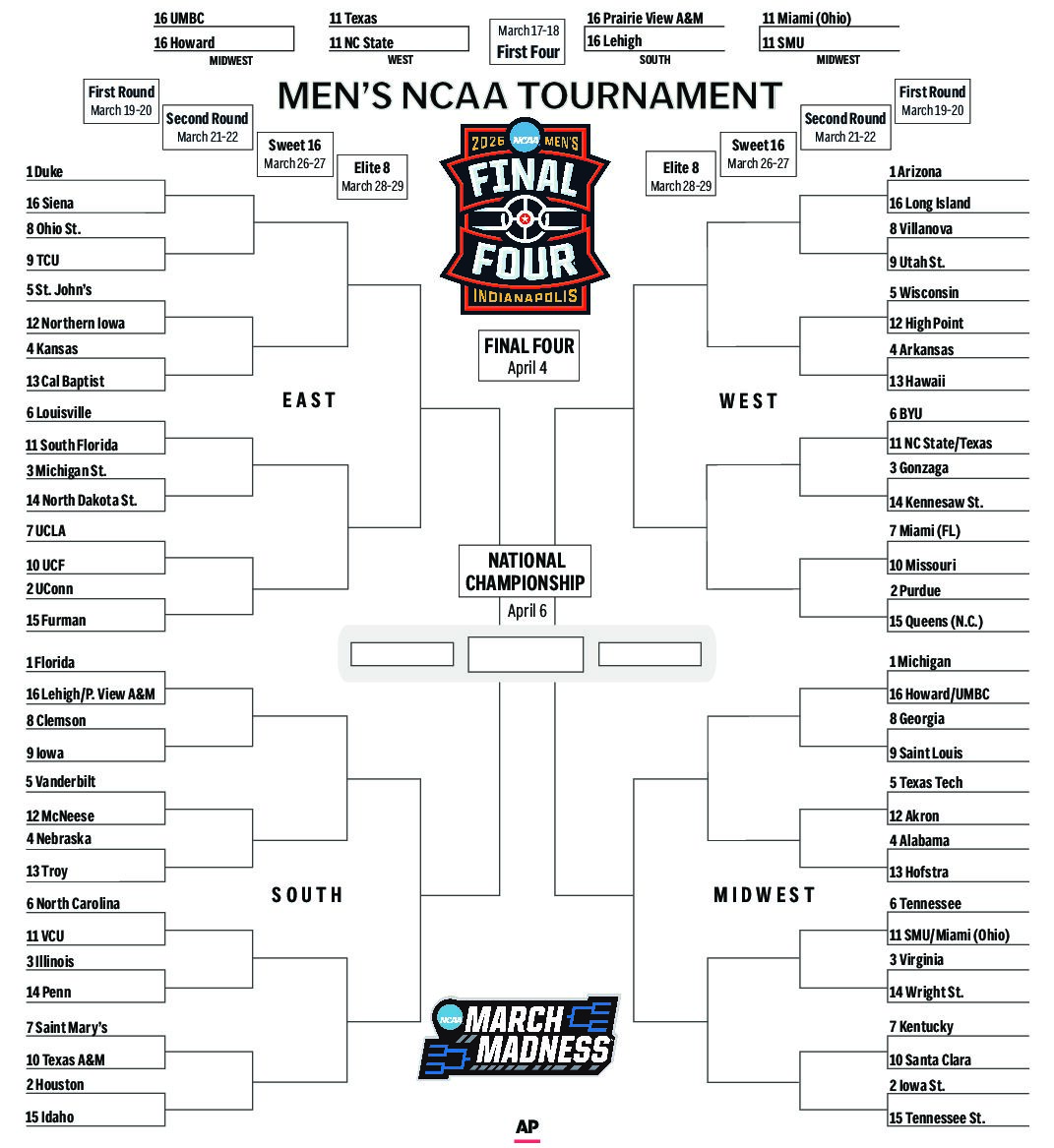
Duke received the top overall seed for March Madness on Sunday, followed by Arizona, Michigan and Florida, each of whom would love a repeat of last season when all four No. 1s made it all the way to the Final Four.
The top line was the most predictable thing to come out of Selection Sunday, with Michigan’s drop of one spot to the overall No. 3 the result of the Wolverines’ loss to Purdue moments before the brackets were revealed, according to tournament selection chair Keith Gill.
In the day’s biggest nail-biter, Miami (Ohio) made the field as a No. 11 seed, but just barely. The RedHawks, with a 31-1 record but the 339th-ranked strength of schedule, were one of the last teams in the field and they face a First Four game Wednesday against SMU in Dayton, Ohio, not terribly far from home.
The tournament starts Tuesday with other play-in games, including one pitting bubble teams and No. 11 seeds Texas and North Carolina State. The national champion will be crowned at the Final Four in Indianapolis on April 6.
Among those left out were San Diego State, Indiana, Oklahoma and Auburn.
The Tigers had 16 losses but the third-best strength of schedule. The snub drew predictable blowback from Bruce Pearl, their former coach and father of their current coach, who was working for CBS and said “they played the toughest schedule in the country and I don’t know if they were rewarded for it.”
Even with those snubs, the Southeastern Conference led the way by placing 10 teams in the field of 68, four short of its record from last year.
The Big Ten followed with nine, the ACC and Big 12 with eight apiece — an unsurprising result in an era of massive conference expansion and NIL compensation drawing top players to the biggest spenders.
The Gators (26-7) are the defending champion, trying to repeat their back-to-back titles from 2006-07. Last season, Florida was part of an all-No. 1 Final Four — the first time that had happened in 17 seasons.
Chairman says Miami (Ohio) was not the last team in
Gill confusingly said Miami (Ohio) was not the last at-large team in the bracket, even though it was ranked in the 1-68 lineup behind bubble teams North Carolina State, Texas and SMU. Those three teams also rated above Miami in some of the key metrics.
The 31 wins must have meant something.
Injuries, player availability play a role in seeding
Gill said the committee looked hard at how injuries would impact teams.
No team suffered more, both on the bracket and the court, than North Carolina, which is a No. 6 seed after losing Caleb Wilson to a broken right thumb. JT Toppin’s season-ending knee injury was also a factor in Texas Tech’s No. 5 seeding.
Committee looked at seeding principles in some instances, not in others
Asked how the NCAA’s seeding principles played a role in moving teams around in the bracket, Gill pointed to the First Four meeting between NC State and Texas the committee would have liked to avoid because it is a rematch of a game they played in the Maui Invitational in November.
He said nothing about placing No. 2 seed Houston in the South, where it could play the regional final in its hometown — normally something the NCAA shies away from. The game could be against Florida in what would be a rematch of last year’s national championship game.
Some conference finals matter more than others. Ask St. John’s
The committee weighed the Big Ten final in moving Michigan down one notch and moving Purdue from a 3 to a 2 seed, but didn’t seem to pay as much attention to the action in the Big East.
St. John’s beat UConn by 20 in that conference final but remained where most bracketologists had them, at No. 5, and with a cross-country trip this week to San Diego to play Northern Iowa. UConn stayed at No. 2 where it had been predicted all along.
Who got left out?
Ten Southeastern Conference teams made the 68-team March Madness field Sunday, the most of any league.
It’s the two that were left out — Oklahoma and Auburn — that will draw the most controversy. The Sooners, Tigers, San Diego State Aztecs and Indiana Hoosiers were listed by the selection committee as the first four teams out of this year’s tourney.
It was hardly a surprise. Most bracketologists had Oklahoma, Auburn and San Diego State listed as the first three teams out of tourney. Indiana was typically listed in the next four out.
Those making it in ahead of those four schools included Texas, another SEC school, NC State, SMU and Miami (Ohio), which lost its distinction as the nation’s only unbeaten team with a loss to UMass in the Mid-American Conference tournament earlier this week.
The decisions came despite public lobbying from former Auburn coach Bruce Pearl to help the 17-win Tigers, now coached by his son Steven. Sixteen overall losses and a sub-.500 record in conference play proved Auburn’s undoing. The younger Pearl made his feelings known following Auburn’s SEC tourney loss Thursday to Tennessee.
“It’s my job to fight for my team,” Pearl said after proclaiming his team deserved to be in the field. “It’s my job to be my team’s advocate. It’s my job to speak about all the things that this group’s done.”
Oklahoma (19-15) also may have been left out following Miami’s loss or perhaps the early Atlantic 10 tourney loss by No. 23 Saint Louis. The Billikens earned the No. 9 seed in the Midwest Region, giving what was thought to be a one-bid league two bids — just like Akron and Miami (31-1) in the MAC.
San Diego State (22-11), the Mountain West regular-season runner-up, also found itself on the wrong side of the bubble after losing to regular-season league champ Utah State in Saturday’s conference tourney title game. Without the 2023 national runner-up in the field, the Mountain West wound up a one-bid league.
And for the second straight year, Hoosiers coach Darian DeVries and his son, Tucker, barely missed the field. They were at West Virginia last March when the 19-13 Mountaineers were listed as the first team out of the field — the third stop in three years for the father-and-son tandem who have likely played their final game together as coach and player.
Record on horizon
CHICAGO — Braden Smith ripped his jersey in frustration because he missed some early shots. His day was far from a loss.
Smith found his touch, moved within one assist of the NCAA career record held by Bobby Hurley of Duke and helped No. 18 Purdue beat No. 3 Michigan 80-72 on Sunday for the Big Ten Tournament championship.
Smith finished with 14 points on 6-of-12 shooting after going a combined 4 for 23 the previous three days against Northwestern, Nebraska and UCLA. He had 11 more assists to pull within one of Hurley’s mark of 1,076, and was selected the tournament’s Most Outstanding Player.
“It’s awesome,” he said. “Obviously it would have been a little bit better to get it today, but at the end of the day, we won, and that’s important to me. Obviously it goes a long way when you have a lot of good people that surround myself. I thank all my teammates obviously throughout my four years who have helped me achieve that.
“It goes to them just as much as it goes to me.”
Smith put himself in position to tie Hurley with a little over six minutes remaining in the game. He passed to Trey Kaufman-Renn, who hit a floater to give the Boilermakers a 66-56 lead, but didn’t get another assist the rest of the way.
Smith figures to break Hurley’s record when Purdue meets Queens in the NCAA Tournament in St. Louis on Friday. The Boilermakers are the second seed in the West.
“He was able to stay and keep growing and keep getting better,” coach Matt Painter said. “Now he’s chasing history from an individual standpoint. It’s also something that we share with him because these are passes that other people have to make shots. … You can’t get the record if people can’t make baskets.”
National Sports

Denny Hamlin rallies to win NASCAR race in Las Vegas
Miami of Ohio sneaks into NCAA hoop tournament field
USA baseball victory good for semifinals visit in WBC
Brewers’ rotation to take early hit
PHOENIX — Milwaukee Brewers pitcher Quinn Priester expects to miss at least the first month of the season as he ...
New Baltimore Raven Trey Hendrickson ready for a fresh start
OWINGS MILLS, Md. — Trey Hendrickson had a close-up view of the Ravens for several seasons while playing for the ...