
Golf boom occurred locally in 1920s
Trending
Known as golf's "Golden Age of Architecture," the 1920s witnessed more course construction than any other decade, before or since.
During the decade, nearly 2,000 new golf courses were opened nationwide, and while that time period is often referred to as the "Roaring Twenties," it is well known as a period of growth and widespread prosperity that saw the United States become the world's dominant economy.
Golf was one of many industries that prospered, and our central Pennsylvania region was certainly not left out.
Before the year 1920 dawned, local golfers had a grand total of four golf courses available to play -- Bedford Springs (opened in 1895), Altoona Cricket Club (1897), Tyrone Golf Club (1915) and Immergrun (1917).
By the end of the decade, there were nearly 20 courses for local golfers to choose from.
With a booming economy and increased leisure time, there were plenty of men and women looking for an opportunity to play. However, options were limited.
The Bedford Springs course was typically reserved for resort guests, while the Cricket Club prioritized play for railroad workers.
The Immergrun course wasn't an option, either, being the private playground of local steel magnate Charles Schwab. Something had to give.
The thirst for golf soon resulted in a local golf boom, and multiple courses across the region began to sprout up. Surprisingly, all of these 1920-era courses are still in operation today.
In the immediate Altoona area, local golfers were becoming increasingly frustrated with access to the Altoona Cricket Club.
In 1921, a group of local businessmen submitted a charter to form the Blairmont Club. Ground was chosen just north of Hollidaysburg for their links and construction of a 3,110-yard, par-35 course was completed within two years.
Not to be outdone, citizens from the Cresson area purchased the 85-acre Boland farm north of town for $8,000. By 1923, their original nine-hole layout was ready for play.
Altoona's Park Hills Country Club followed in 1927. Originally planned as a municipal course that would be run by the city, owner Dr. Frank Beck eventually opened the course as a family-run operation. It would remain that way until his death in 1945 when the course transitioned to a member-owned club.
In nearby Centre County, residents in State College banded together to form the Centre Hills Country Club in 1921. Renowned architect Alex Finlay would design the club's first nine holes which opened shortly after.
Penn State University wasn't to be left out and hired Scotsman Willie Park Jr. to build a links of their own in 1921 (later expanded into what is known as the White Course today). The prolific Finlay would design another Centre County course, the Philipsburg Country Club, in 1924.
Meanwhile, in Huntingdon, golfers were able to enjoy the original nine holes of Huntingdon Country Club, which opened in 1923.
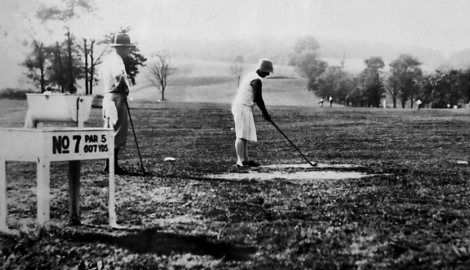
This was the layout of No. 7 in Mount Union in 1927.
Courtesy photo
Just a few years later, a grand plan was underway to construct a major resort near Mount Union that would include a golf course, horse stables, swimming area, tennis courts and housing developments. Investors in the project, including high-ranking railroad executives and a former governor of our state, eventually opened the Juniata Colony Club in 1927. While the early years of the resort were successful, a major flood devastated the property during the early 1930s. The golf course was rebuilt and sold to the American legion in 1938 and has been known as the Mount Union ALCC since that time.
The prolific decade of the 1920s also saw the prestigious Sunnehanna Country Club's construction being completed under the watchful eye of legendary architect A.W. Tillinghast in 1923.
That same year, Cambria County gained another course when a group of Ebensburg men grew weary of using the city's fairgrounds for their golfing exploits. After purchasing a portion of the Leo Kimball farm west of the city, the Ebensburg Country Club's original nine-hole course was soon completed.
A few additional courses were added to this list before the decade came to an end.
Clinton Country Club would build nine new holes in 1921 while the Clearfield-Curwensville links opened in 1924. In 1929, the last of the 1920-era courses was completed when the Arandale golf links opened in Bedford. Ownership of the club later changed, and the course is now known as the Bedford Elks.
In all, an amazing 14 area courses were opened during the decade of the 1920s. No other decade comes close (by comparison only one area course has opened in the past 20 years, Skytop Mountain Golf Course near State College in 2007), and the Roaring Twenties alone account for more than a third of the courses that golfers in central Pennsylvania enjoy today.