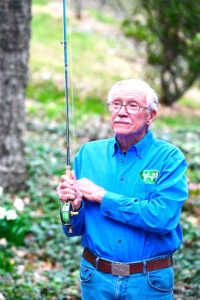
Bob Moore made career out of promoting sports
Blair County Sports Hall of Fame
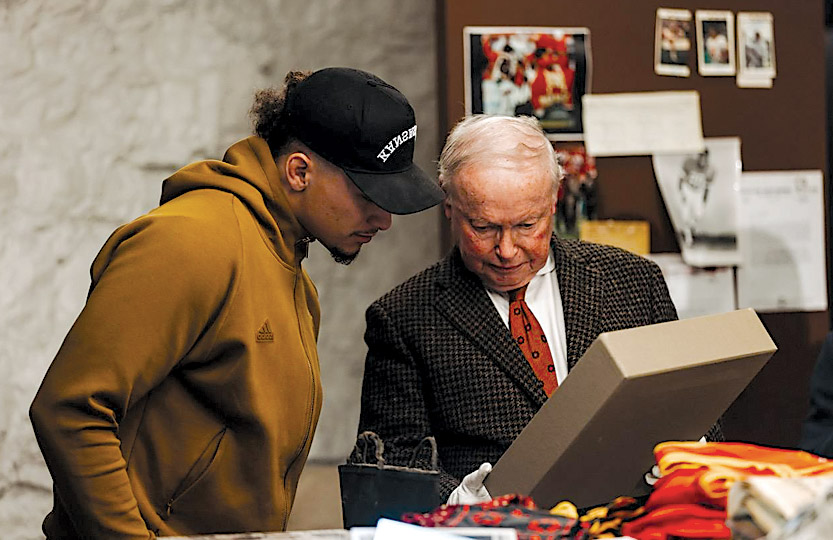
Courtesy photo Bob Moore shows an artifact from the Kansas City Chiefs Hall of Fame to star quarterback Patrick Mahomes.
Editor’s note: This is the last in a series on the Blair County Sports Hall of Fame’s class of 2026 honorees:
Bob Moore grew up loving sports, even if by his own admission, he was not a gifted athlete.
Oh, he played tennis, but it was with the realization that “my only chance at a career in sports was the press box or the sideline.”
When it came time to go to college, he chose Saint Francis — or it chose him.
His mother, Dorothy, worked for William “Skip” Hughes, a Hollidaysburg dentist who coached the Red Flash basketball team to national prominence.
“Skip got me in,” Moore said. “I never filled out an application.”
Moore had sold popcorn during games at the Jaffa Mosque — the Red Flash were then known as the Frankies — and started working in sports information at Saint Francis.
“At that time, basketball was the only true sport we had so that’s what I centered my interest around,” he said.
After working at Saint Francis and then Mount Aloysius, the 1965 Altoona High School graduate was hired as SID at Drexel University, and that’s where his career began to take shape.
The United States Football League launched in 1983, and the Philadelphia Stars were looking for a publicity director.
Moore had become friendly with some Philadelphia sportswriters, including Chuck Newman of the Inquirer.
“I had worked with Chuck when I worked at Drexel,” Moore said. “He referred me to Myles Tanenbaum, whose group was buying the Stars.”
The front office was led by general manager Carl Peterson, who gave Moore plenty of responsibilities.
“In addition to the publicity, I was actually involved with looking at players at tryouts,” he said. “Carl was signing guys from the back of the van. There were only four of us so you had to do everything.”
The Stars, who were made up of many Penn State players, won the league title in 1983, and then were relocated to Baltimore, where they defended their title in ’84.
The league folded after three seasons, but when Peterson was hired by the Kansas City Chiefs in 1989 to be their GM, he immediately called Moore.
“I knew who I wanted as my PR director,” Peterson said. “Bob is a consummate professional. Although he didn’t have a background in football, he certainly knows public relations and media relations. His contributions to me and my career were very large.”
Moore launched the Chiefs website and helped restore interest in the team, which steadily declined after appearing in the first Super Bowl (1967).
“Attendance was down,” Peterson said. “It was very dismal, and it didn’t take long to access that the fans didn’t dislike the Chiefs, they had just become apathetic. They liked the (Kansas City) Royals, who had been to a couple World Series. We had 26,000 parking spaces and 1500 of them were filled. And it looked terrible in an 80,000-seat stadium with 33,000 filled.
“I expressed to Bob that we had to change that – first on the field with a new head coach and getting new players.”
Moore worked with Peterson to popularize tailgating and a college atmosphere at Arrowhead Stadium.
“We knew it was going to hurt us in the concession stands, but we need to get people in the seats, and Bob was a huge contributor to that,” Peterson said.
The concept took off, and the Chiefs became the NFL’s attendance leader.
“We became the model of other teams emulating with the marketing strategy,” Peterson said.
Moore’s style helped the Chiefs promote their message.
“His professionalism – his ethics and directness — immediately impressed the media here and in the surrounding area,” Peterson said. “He appealed to everybody. We had been losers, on and off the field. Bob really helped our fan base grow. He’s an innovator and is always full of terrific ideas.”
At a time when newspapers were the leading media industry in the way information was decimated, Moore understood how to manage the Chiefs’ PR through access and relationships.
“I read newspapers,” he said. “There were writers and columnists I looked up to, and it was an era where those people had big reputations and a great deal of influence.”
Moore held his position as Chiefs’ PR director for 21 years, working alongside Peterson, Marty Schottenheimer, Dick Vermeil and all the Chiefs’ legends.
Like Peterson, Vermeil credited Moore’s guidance.
“The thing about Bobby is he was always there,” Vermeil said. “You could always find him. Make a request, and it would get done immediately. He never let me down. He always made me aware of what the buzz was in the media world. That helped me prepare me for press conferences. I was never caught off guard when he was in charge.”
As his stature in the organization grew, Moore became close to Lamar Hunt, who founded the American Football League (AFL) and the Chiefs and after the NFL merger became one of the sport’s most prominent figures.
In 2010, Moore was named the team historian, becoming the second historian to be employed by an NFL team (following the Green Bay Packers), which triggered a trend as there are now more than 20.
He was central to the development of the Chiefs Hall of Honor and the Founder’s Plaza at Arrowhead Stadium. He also oversaw the collection of Chiefs and American Football League artifacts and maintained the club’s archives.
“The history stuff has always been interesting to me because people need to be reminded, not informed,” Moore said. “I had reached an age where I didn’t want to be chasing players around, and the environment had changed. Lamar wanted a Hall of Honor, and it took three years for us to gather everything. We not only wanted to tell our story, but we also wanted to tell the story of the old AFL. That became a big part of the hall.”
The end result was a 27,000 square foot showcase, featuring videos of games and players, Hall of Fame busts and interactive displays.
“One of the most comprehensive museums for a professional franchise in the U.S.,” Moore said, adding the “only exception” being Green Bay, which operates in a separate building next to Lambeau Field.
It will be transferred to the Chiefs’ new stadium, which is scheduled to open in 2031.
Moore is also the author of several monographs on the history of the Chiefs and was the producer of “Games,” an NFL Films documentary on the life of Hunt.
“The Hunts are one of the first families in sports in America,” he said. “Being able to work with him and tell his story was an honor.”
Moore followed that with a film on Hunt’s groundbreaking professional World Championship Tennis enterprise, “WCT: The Road to Open Tennis,” which premiered at the International Tennis Hall of Fame in Newport, R.I., in 2014.
During that time, he rubbed elbows with the likes of Rod Laver, Cliff Drysdale, Stan Smith and John McEnroe.
More recently, he was interviewed and featured on ESPN’s “The Kingdom,” a six-part series that chronicles the Chiefs’ historic legacy that premiered earlier this month.
He continues to serve as the Chiefs’ historian emeritus and assists with special projects.
Closer to home, Moore also founded Saint Francis’ Golden Era of Men’s Basketball and was inducted into the school’s Hall of Fame in 2024.
He is the fourth recipient of the Blair County Sports Hall’s Lifetime Achievement Award to be presented Saturday. He joins inaugural winner Jim Lane (2010), strength training champion and weightlifting pioneer Jake Webb (2018) and coaching legend Julie Roseborough (2022).
Moore, who is married (wife Maggie) with a daughter and two grandchildren, said he’s grateful for the recognition and is honored to return to his roots.
“There is where my love of sports began,” he said. “My mother and father lived there all their lives. When you reach your late 70s, as I am, it’s come full circle. What I was able to learn along the way came from Blair County. Sports was a big part of my early life. Friday nights in Altoona at Mansion Park in that era? That was big time. Same with the (Jaffa) mosque. It caps off my career, and there’s no place where it would mean more me.”
When: Saturday, April 11
What: Blair County Sports Hall of Fame’s 21st induction
Inductees: Dave Baker, Cathy Beam, Lori (McConnell) Elgin, George Geishauer, Kristi (Little) Kaack
Team inductees: 1994-95 and 1995-96 Altoona Area High School girls basketball teams
Lifetime Achievement Award winner: Bob Moore
Guest speaker: Hannah Storm
Emcee: Bob Pompeani
Tickets: Sold out (more than 800 expected)
Local Sports

Berlin Brothersvalley’s Pace Prosser leads Gannon to DII basketball crown

Weather helps out Trout season opener
Bob Moore made career out of promoting sports

Mirror Track Honor Roll

Mirror girls basketball all-stars: Altoona, Williamsburg reap rewards