
Stan Musial proved to be in class by himself
Trending
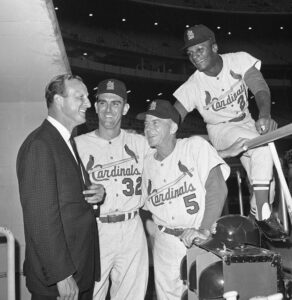
Having grown up in Donora, Pennsylvania, I never grow tired of talking baseball about our town's native son, all-time great Stan Musial.
Even though he retired after the 1963 season, more than 60 years ago, his accomplishments still glow like the blistering fires of the old U.S. Steel mills all around us.
He broke into the majors with a resounding boom, playing in only a dozen games down the season stretch of 1941 but going 20-for-47 for a gaudy .426 batting average. He never looked back.
He would go on to win seven batting titles -- only Ty Cobb, Honus Wagner, and Tony Gwynn won more than "The Man."
Prior to the 1957 season when Musial was 36 years old and shooting for his seventh crown, he told reporters that he believed he could match his lifetime batting average that season.
"That used to mean .350. Now it means .340," he quipped.
Musial, his bat always Jack-in-the-box quick, was off on his prediction. He wound up sitting atop the NL with his .351 batting average, a remarkable fifth time he surpassed the .350 plateau.
He hauled home his final batting crown like a Hollywood star loaded down with so much corporate swag.
His first six titles had come over an incredible stretch of nine seasons from his second full season, 1943, through 1952 -- utter domination. For him, a hitless game was no more annoying than a stubbed toe.
Upon his retirement, he held 17 big-league records as well as 29 NL bests and nine All-Star game records. Even now, when revered records such as the single season and the career home run marks have tumbled like dominoes, many of Musial's feats stand immovable.
The veteran of an amazing 24 All-Star games still holds tons of the most important St. Louis Cardinals team records, too.
Despite playing for a franchise that had other superb hitters such as Rogers Hornsby and Albert Pujols, Musial is the team leader in major categories such as home runs with 475, triples (177), doubles -- with a staggering 725 -- hits with 3,630, and runs driven in with 1,951.
His career Offensive WAR (Wins Above Replacement), a very popular statistical gauge nowadays, ranks him as the 6th most productive (or most irreplaceable) player ever.
Focus on his finest season, his 1948 MVP showing. Around 2010, the editor of Baseball Digest, John Kuenster, stated, "Even by today's standards, Musial's work on offense in 1948 ranks close to being the greatest in the history of the game."
Musial's 429 total bases, a whopping 113 more than his closest NL competitor, were the most since Rogers Hornsby set the NL record with 450 in 1922.
His 103 extra-base hits had been matched or bettered by only Babe Ruth, Lou Gehrig, Chuck Klein, and Hank Greenberg, and were just four fewer than Klein's NL best set in 1930, a season replete with tainted stats due to the introduction of the juiced up, "rabbit ball."
Not only that, Musial's .702 slugging percentage was the highest mark since Hack Wilson's .723, also set in 1930. No NL hitter surpassed Musial in slugging until 1994 when Jeff Bagwell posted a .750 slugging percentage.
As a matter of fact, Musial won two legs of the Triple Crown in 1948, hitting a career high .376 and driving home 131 teammates. He fell one shy of topping the league in homers with his 39 shots.
In all, he led his league in virtually every major department, at least 12, including hits, doubles, triples, on-base percentage, and slugging.
Statistics aside, this was one class act. Musial may be the most well-liked, respected, and venerated superstar in the annals of the game.
In 1998, The Sporting News ranked him the 10th greatest baseball player ever, but the men who topped him statistically trail him in the realms of class and character.
For example, Babe Ruth, number one on the list, had well chronicled foibles. Willie Mays (No. 2), Ty Cobb (No. 3), Ted Williams (No. 8) and Rogers Hornsby (No. 9), for examples, were capable, in varying degrees, of surliness and incivility. Cobb, the "snarling wildcat," was guilty of bellicose behavior bordering on the sociopathic.
Musial lacked the volatility and egotism of many superstars.
Musial's blend of prowess and personality was such that even Cobb graciously stated, "No man has ever been a perfect ballplayer. Stan Musial, however, is the closest thing to perfection in the game today."
Parts of this story come from Stewart's bio of Musial, "Stan the Man: The Life and Times of Stan Musial" available at Amazon and Barnes & Noble.