
Northern Bedford product, SFU student examines trends in men’s basketball
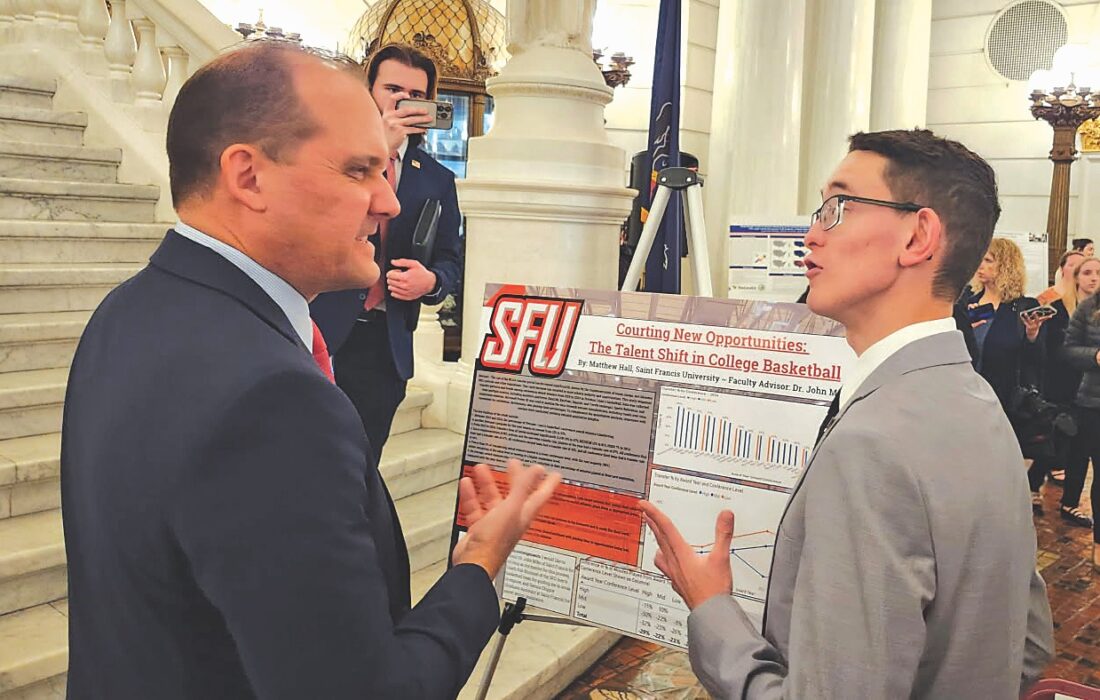
Saint Francis student Matt Hall shared information with state government officials during a recent visit to Harrisburg. Courtesy photo
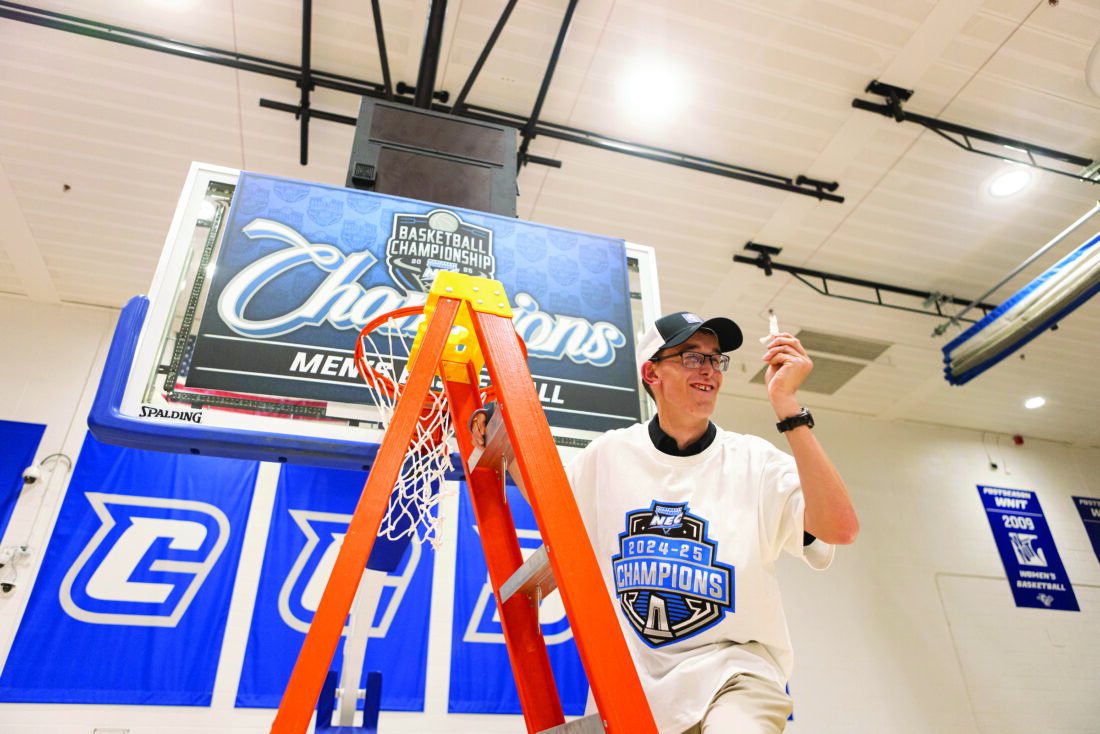
Hall, a student manager on the Saint Francis basketball team, enjoyed cutting a piece of the net after the Red Flash earned a trip to the NCAA Tournament in March. Courtesy photo
Saint Francis student Matt Hall shared information with state government officials during a recent visit to Harrisburg. Courtesy photo
Hall, a student manager on the Saint Francis basketball team, enjoyed cutting a piece of the net after the Red Flash earned a trip to the NCAA Tournament in March. Courtesy photo
Trending
LORETTO -- In the spring of 2017, Matt Hall was sitting on the bench during a Northern Bedford County Junior High baseball game when he made an interesting discovery.
"I started tracking what pitches the opposing pitcher was throwing on what count. I was bored and wanted to do something," Hall said.
"We ended up playing that team again, and the same pitcher came on in relief after we were down by four or five runs. Before my teammates' at-bats, I told them 'you're most likely going to see this pitch on this count.' In the inning that the pitcher entered, we strung together a bunch of hits, scored some runs and won the game.
"I thought 'this is really cool. You can use data to impact something.'"
Fast-forward to March of 2025, and Matt Hall was still digging into sports data as basketball fans across the country closely monitored their March Madness brackets.
Now a junior accounting and management double-major at Saint Francis University, Hall has been analyzing the transfer trends in NCAA Division I men's college basketball as part of his Honors Program thesis.
Extensive research
The New Enterprise native has followed the movement of approximately 2,500 different players from 2019-2024.
The players included in his analysis all won some type of major postseason award in their conferences over this five-year period. This includes all players who earned first, second and third-team all-conference honors, as well as those who earned player of the year, defensive player of the year and rookie of the year recognition.
The Saint Francis student intends to track the Division I players who qualify for his study from this past season and add that group to his data set.
"Matt narrowed his study to the players who earned major postseason honors, who still had college eligibility the next season and who then used that season of eligibility," John Miko, a professor of Business Analytics at Saint Francis and Hall's faculty advisor on the project, said.
"Of those players who competed at the college level the next year, he looked at what percentage of them transferred, where they ended up and the different trends that emerged."
Using Sagarin Ratings, a system that ranked and rated college and professional sports teams and conferences up until 2024, Hall recorded whether players transferred "up or down" in terms of conference strength.
The founder of this ratings system, Jeff Sagarin, retired his model in 2023, so Hall turned to another predictive model utilized by Bart Torvik for his 2023-24 data set.
The Saint Francis student used these models to rank and group the nation's 32 Division I conferences into three categories -- low, mid and high.
Hall's study covers a period of unprecedented change in collegiate sports. In 2021, the NCAA began allowing athletes across all sports a one-time transfer during their college career, without the requirement of sitting out a season of competition.
Previous history
Previously, Division I athletes who transferred to a different Division I school had to sit out for one season before competing for their new team.
Hall discovered that 19 percent of the players who earned major postseason honors at the Division I level in 2019 transferred to a different school. In 2024, that number jumped to 53 percent.
Hall has analyzed his data in different ways, including the award won. For example, from 2019-24, conference players of the year transferred 43 percent of the time.
He can also tell you what conferences were the biggest losers in terms of players lost. The Missouri Valley Conference (a mid-level conference) lost 86 percent of its major postseason award winners to the transfer portal in 2024.
The Big 12 (a high-level conference) lost the lowest number of major postseason award winners to the portal last year (14 percent) among the NCAA's 32 Division I conferences.
Over the last three years - since the one-time transfer rule took effect in 2021 - 187 athletes who won a major postseason award transferred from a mid- to a high-level conference and 60 transferred from a low to a mid. Thirty-four athletes moved from a low-level conference to a high-level one.
Just one player transferred from a high to a mid-level conference over the last three completed seasons (Kalib Boone - Oklahoma State to UNLV).
Seventy-seven mid-level conference players stayed at that level but competed at a different school during this period. Nine remained at the low-level but changed schools. Seventeen moved from one high-level conference to another one in the three seasons from 2021-24.
NIL effect
Former Saint Francis head men's basketball coach Rob Krimmel expects movement from one high-level conference to another to increase because of the opportunity for players to make money through Name-Image-Likeness (NIL) opportunities.
"You see the lateral movement more at the high level now because everybody at that level has money, some more than others," said Krimmel, whose team competed in this year's NCAA Tournament for the first time since 1991 after winning the Northeast Conference championship on March 11.
There are many players in Hall's data set who appear repeatedly from season to season. For example, former Saint Francis athlete Josh Cohen was the NEC's co-player of the year in the 2022-23 season before transferring to the University of Massachusetts (low to mid).
Cohen earned all-Atlantic 10 second-team honors last year at UMass and then transferred to the University of Southern California (mid to high) in the summer of 2024, where he played this past season.
"The low-level conferences initially had the highest number of transfers among conference award-winners," Hall said. "Now, the mid-majors are the conference level that lose the highest percentage of players.
"My initial perception was that this primarily impacted the lower conferences. While it does, the mid-level conferences are now hit just as hard, if not harder."
Hall plans to make his findings available online once his project is completed.
"My goal is to put this information out there to help people understand what is happening with the portal, what is happening with NIL, and what the implications are for what the NCAA is doing," he said.
"We are navigating through unchartered waters of NIL, paying athletes and collectives. The talent shift is changing the landscape of college basketball."
Learning tool
Krimmel believes Hall's data could be valuable to the college coaching profession.
"It makes sense that these all-conference kids are leaving, but what is the return on investment for me as a coach?" he said. "Does it make sense to go out and sign a player from a certain conference? Are they going to produce at the next level?"
Hall's study helps answer these questions. He compares athletes' percentage of playing time before and after transfer to measure their level of contribution and how much it changes.
Miko sees Hall's study as a trailblazing one for similar research projects in a topsy-turvy NCAA where "madness" has now taken on additional meaning.
"What Matt has done is very descriptive," Miko said. "The question now is 'can it be predictive?'"
Hall serves as a manager for the Saint Francis men's basketball and softball teams and provides data analytic support to these two programs in addition to his managerial responsibilities.
He was at the Red Flash's NCAA Tournament First Four game at Dayton on March 18 and presented some of his study's findings at a conference in Harrisburg earlier this month.
"He's done quality checks to make sure that the findings coming out of his research are valid," Miko said. "I think there are a lot of people who follow college sports who are going to be interested in this."
Pat Farabaugh is a professor of communications at Saint Francis and the Red Flash men's basketball team's play-by-play announcer. He served as sports information director at the school from 1999-2005.