
Tommy John, known for elbow surgery that bears his name, dies
Trending
LOS ANGELES -- Tommy John, who won 288 games during a 26-year big league career and became the first pitcher to successfully return following groundbreaking elbow surgery that later was named after him, has died. He was 83.
He died at his home in Bradenton, Florida, on Saturday night, agent Mike Maguire said Sunday. He had been in hospice care.
On Aug. 8, the New York Yankees released a social media post in which John wrote that he wanted to say goodbye to everyone, including friends and fans who followed him throughout his career, saying, "I will never forget you."
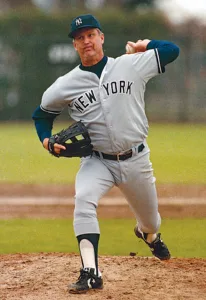
The Yankees called John "a bedrock of our rotation during his time in pinstripes and a longtime favorite of Yankees fans."
John was a four-time All-Star with a record of 288-231 and a 3.34 ERA during a career that stretched from 1963 to 1989. He pitched for Cleveland, the Chicago White Sox, the Los Angeles Dodgers, the Yankees, the California Angels and the Oakland Athletics.
"Tommy was an exceptional pitcher throughout his career in Major League Baseball, and his courageous role in becoming the first to have surgery that would go on to bear his name can't be overstated," Stan Kasten, Dodgers president and CEO, said in a statement. "His impact both on and off the field has been felt by ballplayers of all ages and will be for generations to come."
The left-hander was 31 years old when he tore the ulnar collateral ligament in his pitching elbow in 1974, a death knell for pitchers' careers to that point.
John allowed Dr. Frank Jobe, the Dodgers' team physician, to replace the ligament with a tendon from his right forearm. Jobe gave the surgery 100-to-1 odds of being successful.
John was a great pitcher, but his elbow surgery made him a baseball legend
The procedure had been done on others before, although it was usually performed on wrists and hands. John was the first pitcher to have it done on his elbow.
More than 2,600 big leaguers and thousands more amateurs have since had UCL reconstructions, better known as Tommy John surgery. It's been a godsend for many of baseball's greatest stars, including two-way sensation Shohei Ohtani, three-time Cy Young Award winner Justin Verlander and even Philadelphia Phillies slugger Bryce Harper.
"If you put it in dollars and cents, I think there's no question that Tommy John is the most valuable reconstructive procedure there is," Dodgers team physician Dr. Neal ElAttrache told The Associated Press in 2024.
Born Thomas Edward John Jr. on May 22, 1943, in Terre Haute, Indiana, he was a top baseball and basketball player at the city's Gerstmeyer High. He graduated in 1961 as valedictorian but did not give the commencement speech because of a stutter. Despite being recruited by the University of Kentucky to play basketball, John chose baseball and signed with Cleveland.
"The day I left for my first job as a pitcher, my father looked at me & said, 'Good luck, Tommy. Just remember one thing: whether you make it big in the big leagues or you don't, you'll always just be Tommy John from Terre Haute, Indiana.' I've never forgotten those words," John wrote in his Aug. 8 post.
John recorded 2,245 strikeouts but never led either league in wins or strikeouts. He had the second-most wins of any pitcher since 1900 not to be elected to the Hall of Fame. From 1995 through 2009, John was on the Hall of Fame ballot, but he never received more than 31.7% of the votes, falling well short of the 75% required for election.
"Tommy was a wonderful person who competed to the utmost and did what no player had ever done to save his career, in conjunction with the esteemed Dr. Frank Jobe," former Dodgers general manager Ned Colletti posted on X. "The HOF is missing Tommy John."
John won more games after his eponymous surgery
Known for his longevity, John was the opening day starter for both the 1966 Chicago White Sox and the 1989 New York Yankees. He won 124 games before his UCL repair and 164 after. His final appearance came days after his 46th birthday.
"While his incredible longevity and post-surgery achievements changed the fortunes and trajectory of countless athletes around the world, it also overshadowed his excellence as a pitcher," the Yankees said in a statement. "We pause to remember the totality of his legacy -- his competitiveness and skill, his penchant for conversation, his kind and gracious nature, and his stature as an athletic and medical pioneer."
John made his major league debut on Sept. 6, 1963, pitching one inning in relief for Cleveland.