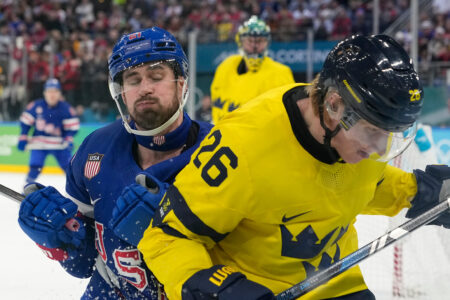
Crosby injured, doesn’t return, in Canadian victory
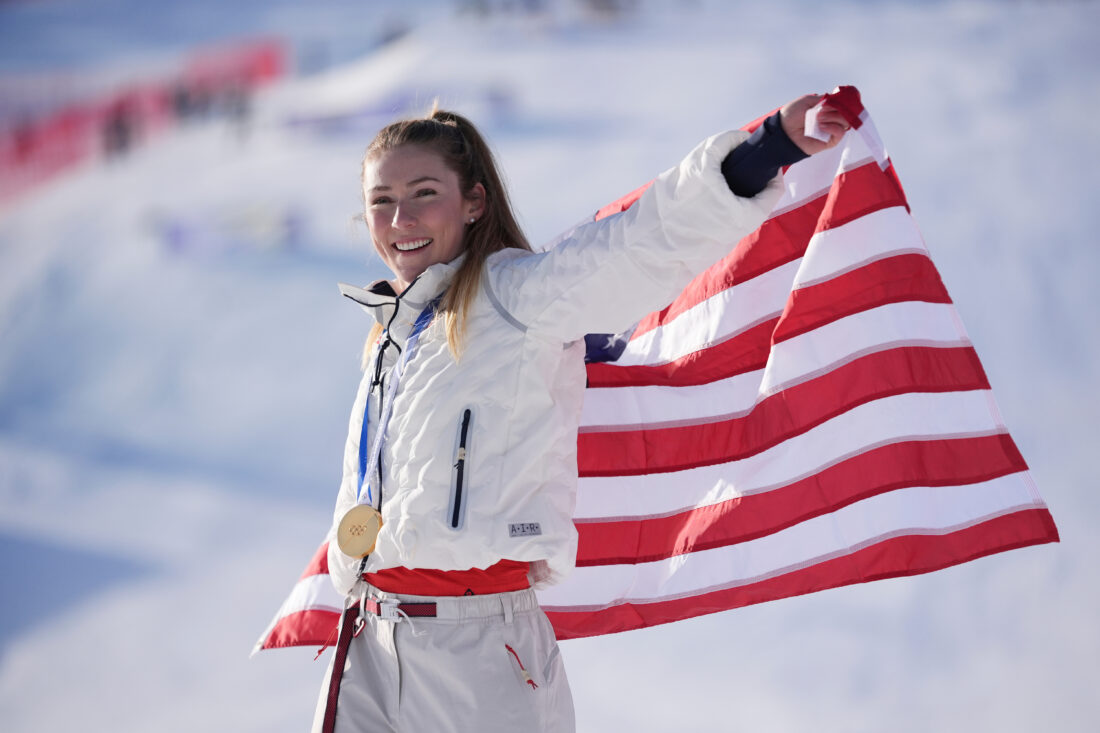
United States' Mikaela Shiffrin celebrates winning the gold medal in an alpine ski, women's slalom race, at the 2026 Winter Olympics, in Cortina d'Ampezzo, Italy, Wednesday, Feb. 18, 2026. (AP Photo/Jacquelyn Martin)
MILAN — Sidney Crosby left Canada’s Olympic quarterfinal game against Czechia in the second period because of injury, did not return and his status for the rest of the tournament is uncertain.
Crosby’s right leg appeared to buckle when he braced for contact on a big hit from Czechia defenseman Radko Gudas a few minutes into the second. Laboring as he stayed on the ice, Crosby got crunched into the boards by Gudas and Martin Necas and then left after shaking his right leg and wincing. Canada won, 4-3, in OT.
The respected 38-year-old captain addressed his teammates at the second intermission, telling them to go get it. Inspired by Crosby and doing so in his absence, Canada rallied to tie it after falling behind with 7:42 left and won in overtime.
“Unfortunately, the game goes on no matter who gets hurt,” said defenseman Drew Doughty, who was teammates with Crosby when Canada won gold at the Olympics in 2010 and ’14. “We even mentioned going out before the third, ‘Let’s try to win this one for 87.’ Glad we did.”
Coach Jon Cooper said the message was to make sure this wouldn’t be Crosby’s final game in Milan. Canada next plays in the semifinals Friday, and 19-year-old Macklin Celebrini did not want to talk about the possibility of not having Crosby moving forward.
The Penguins star was getting punished early in the second by Czechia. Ondrej Palat hit Crosby and sent him sliding into the boards, with no penalty called despite the puck not being in the vicinity, and then the big check from Gudas.
Crosby is Canada’s oldest and most accomplished player. He scored the famous golden goal in overtime against the U.S. at the 2010 Games in Vancouver to win it all on home ice and was captain when Canada went unbeaten and never trailed on the way to gold in 2014 in Sochi.
Shifrin wins gold
CORTINA D’AMPEZZO, Italy — Mikaela Shiffrin is well-versed in the bargain the Olympics forces athletes to make.
The risk that comes with laying yourself bare on the world stage. The way it challenges your mental and physical health. The ever-present fear of failure and the way it can frame — fairly or unfairly — the public’s perception of you.
“It’s not the easiest thing in the world to do,” she said.
No, it’s not.
Trying to nudge that bargain toward friendlier terms is next to impossible. The greatest ski racer in the history of the sport has spent years wrangling with it. On Wednesday, Shiffrin may have finally found peace.
Standing on the medal stand, a second gold medal in slalom around her neck a dozen years after she earned her first, Shiffrin closed her eyes, mouthed the lyrics to “The Star Spangled Banner” and breathed in a moment built on tireless practice, innate talent, purity of purpose and a self-belief that is harder to come by than you might think.
The peace she felt didn’t come from shedding the weight of getting “ripped apart by people who sit on the couch,” as teammate Paula Moltzan put it.
No, Shiffrin returned to the top of the Olympic medal stand for the first time in eight years by leaning into what drew her to bunny slopes in New England as a kid in the first place: the challenge of bending gravity and her body to her will as she navigates from here to there while darting between gates as fast as she can.
Silver lining
TESERO, Italy — The U.S. men’s cross-country ski team had won only one medal in the history of the Olympics before the Milan Cortina Winter Games.
Now it has two more. Gus Schumacher anchored a two-man team relay that took the silver medal behind Norway and held off Italy in third.
The medal makes this the winningest U.S. men’s team ever. Schumacher’s partner in the relay, Ben Ogden, became the first American man to win a cross-country skiing medal in the Olympics in 50 years when he won a silver in the sprint on Feb. 10.
Until then, Bill Koch, who won silver in 1976 in Innsbruck, was the only American man to medal in the sport.
National Sports
Coffey returns to coaching
EDMONTON, Alberta — Paul Coffey is returning to the Edmonton Oilers’ coaching staff after a previous two-year ...
Canada stands in way of USA women
CORTINA D’AMPEZZO, Italy — The United States and Canada meet in the gold medal match in women’s hockey at the ...

MLB Players Union looks to recover from scandal involving their leader
NFL putting back games in Mexico City
MEXICO CITY — The San Francisco 49ers will return to Mexico City to play a regular-season game this season, the ...

Crosby injured, doesn’t return, in Canadian victory