
Revival of lost art has church bells ringing
Teacher, students restore dwindling practice of tolling bells by hand
Trending
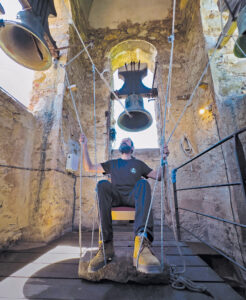
JOANETES, Spain -- Xavier Pallàs plants his feet on the belfry floor, grips the rope, and with one tug fills the lush Spanish valley below with the reverberating peal of a church bell.
Clang-clong! Clang-clong! Clang-CLONG! The swinging bronze bell resonates with each strike of the clapper, filling the small stone tower with an undulating hum. Once Pallàs finishes his peals, the metallic melody fades to stillness. Silence returns to the tower, giving the valley's soundscape back to the birdsongs and rooster crows.
For most, church bells are just a quaint bit of automated background noise. But Pallàs and his 18 students at the Vall d'en Bas School of Bell Ringers are trying to change that by resuscitating the dwindling art of tolling -- and communicating -- by hand.
The shift to mechanical tolling devices over the past century has flattened the bells' dynamic songs and muted their messaging powers, said Pallàs, the school's founder and director. If played with the know-how, the sounding of church bells in various sequences, tones and rhythms can signal the time for rejoicing or mourning and when to run to the aid of a neighbor in need.
"For centuries, the tolling of church bells was our most important communication method," said Pallàs, standing inside the belfry which doubles
as his classroom.
"Machines cannot reproduce the richness of the sounds that we used to hear, so there has been a simplification and unification of bell ringing. The language has been lost little by little until now, when we are finally recognizing its worth."
Before newspapers, radio, telephones, television and the internet, it was bellringing that transmitted important information. A physically demanding job that required long hours and complete dedication, to be a bellringer was to be a human clock and the public loudspeaker.
While manual church bell ringing has persisted in Eastern Orthodox countries, it has largely been replaced by bell ringing systems in Catholic and Protestant churches in Western Europe.
Many of Spain's church bell towers that were automized in the 1970s and '80s are in a dire state, said Pallàs, who witnessed widespread problems while researching the belfries of Garrotxa, a county in northeast Catalonia. The rural area is known for its verdant hills, dormant volcanoes and picturesque villages where most people speak Catalan before Spanish.
His research included the 12th century Sant Romà church in Joanetes, a tiny village about two hours north of Barcelona, where Pallàs has spent the past
10 months teaching the inaugural class one Saturday a month.
"Since the last generation of bellringers had died off, the only thing to do was to train new ones in how to toll the bells. And that's where the idea of the school was born," Pallàs said.
Intangible heritage
The initiative comes two years after UNESCO added manual bellringing in Spain to its compendium of humanity's intangible cultural heritage. UNESCO described how the bells had knitted together communities even before they were functioning modern states.
"The first thing we have to do is rediscover the bells. That is why this school is so important," said Roman Gene Capdevila, president of Catalonia's Bell Ringers brotherhood. "There are so many ways to ring a bell, what we need are bellringers."
The bellringing course, officially recognized by the ISCREB theology school in Barcelona, finished last week with a demonstration by the class. All drawn to the allure of the banging bells, the students were men and women with diverse professional backgrounds ranging from engineering to teaching. One was in his 20s; several were retirees.
They spent the past few months researching old chiming sequences, documenting their origins and learning to play them. That ethnographic task meant students had to search out old bellringers, or their family members, to record what they knew.
Utopian, quixotic?
Maybe not
What might seem like a quixotic mission has so far had a promising start. While admitting that his dream of having a bellringer for every bell tower is "utopian," Pallàs said he has a full class lined up for the fall and some 60 more people on a waiting list. Many of his graduating pupils, including Sauri and Osuna, hope to continue playing at their local parishes or help convert their belfries into systems that allow manual ringing.
Pallàs believes that a recovery of bell ringing in a neighborhood or town's life could help strengthen communities in this dizzying age of technological, economic and political change.
"This is a means of communication that reaches everyone inside a local community and can help it come together at concrete moments," Pallàs said. "That can include a death in the community or the celebration of a holiday. It can help mark the rituals that we need."