
Living with history: Byzantine churches head Thessaloniki’s holy sites
Trending
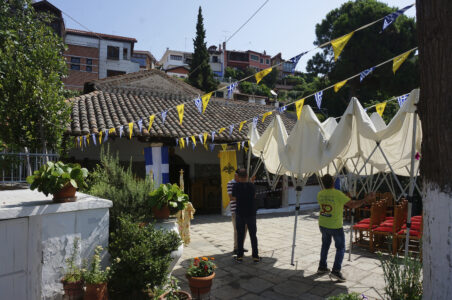
THESSALONIKI, Greece -- Under fluttering strings of Greek and Byzantine flags, three men raised a party tent on the terrace of the 5th century Osios David church one recent Saturday, hoping it would shelter festivalgoers from the heat that already shrouded the view of Mount Olympus across the gulf.
That's Thessaloniki in a snapshot -- a seaside trove of early Christian art and architecture, with echoes of the sacred all around the city, from the mythical mountain home of the ancient Greek gods to the contemporary Orthodox Christian monasticism of Mount Athos.
Pervasive if more hidden traces of Islam and Judaism also persist, even though many monuments were destroyed in a 1917 fire.
"People see the (archeological) ruins next to them, but no one knows the diverse history," said Angeliki Ziaka, a professor of religion at Thessaloniki's Aristotle University. "Now is the time to rebuild this knowledge, to find the intermarriage of cultures."
Each of the last six years, I've spent at least a few days in and around Greece's second-largest metropolis, which bubbles with the energy of a city historically at the crossroads of Europe and Asia, about halfway between Athens and Istanbul.
I find Thessaloniki eminently walkable even in the summer heat, thanks to an inexhaustible supply of the iced coffee drink called frappe and the sea breezes off the Thermaic Gulf. Overlooking its waters are the iconic White Tower and a beloved, miles-long promenade.
Simple meandering leads to monuments woven into today's urban fabric: Going to buy roses at the flower market, I discovered next to it a 500-year-old bathhouse (hammam) built by the Ottomans in the multi-domed style of Byzantine architecture and named Yahudi Hammam, after the Sephardic Jews who settled here.
The hammams and the still-functioning markets were for centuries the mingling places for the city's Jews, Muslims and Christians, who lived in separate neighborhoods, Ziaka said.
During centuries of Muslim Ottoman domination -- a legacy perhaps most immediately visible in today's profusion of buzzing coffee shops -- Thessaloniki was the refuge of a thriving Jewish community. Its history, told by the Jewish Museum, will be further spotlighted in a Holocaust museum and education center that's in the works.
Until the beginning of the 20th century, most Muslims lived in the Ano Poli, a quiet warren of walled gardens, houses with overhanging upper floors detailed in wood, and steeply inclined streets climbing to a hilltop fortress.
But more than a millennium before the Ottoman conquest, it was here that St. Paul first brought Christianity to the Thessalonians - to whom he later wrote some of Christendom's most widely read letters.
Churches dating from across the centuries when Thessaloniki was a center of the Byzantine Empire still dot the labyrinthine landscape.
Down a tiny, fruit-tree-lined alleyway that opens to a spectacular sea view, diminutive Osios David preserves in its cupola a 1,600-year-old mosaic of Christ presiding over fish-filled rivers of paradise, with two Old Testament prophets looking on in astonishment.
Frescoes from the 12th century adorn the walls, though the city's most outstanding mural paintings are at Agios Nikolaos Orfanos, another small Ano Poli church deep inside a garden. Their colors still vivid after 700 years, they portray the lives of Jesus, prophets and saints in minute and individual details, such as one hermit's flowing beard and matching striped tunic and cap.
Just downhill from the church is the Rotunda, a capsule of Thessaloniki's interconnected religious history.
The vast circular building was constructed as a Roman temple or mausoleum in the 300s, shortly after became a Christian church, later on a mosque - whose tall minaret remains standing - and is now a museum and a sanctuary for dozens of swifts that fly chirping around it.
Liturgy is still celebrated a dozen times a year, but most visitors come for the early Byzantine golden mosaics adorning the immense dome, portraying a fusion of Roman architecture and Christian worship with people praying in front of the empire's most luxurious buildings.
From the worshippers' distinctive coiffures to the curtains billowing in the pavilions behind them, it's a slice of early Christianity come alive -- the beginning of a religious story that continues uninterrupted to this day.