
Israel holding off on Gaza withdrawal
Netanyahu says forces will stay until Hamas is disarmed
Trending
DEIR AL-BALAH, Gaza City -- Prime Minister Benjamin Netanyahu said Tuesday that Israel will not withdraw from its current lines in Gaza until Hamas has completely disarmed and pushed back on a recent deal announced by U.S. President Donald Trump.
Netanyahu's remarks cast more doubt on the deal to disarm Hamas, which was seen as a potential breakthrough for ending the war. It also marked a rare public display of friction with the Trump administration.
The agreement called for Hamas to begin disarming and for Israel to halt its strikes and begin withdrawing from the roughly 60% of Gaza it currently controls. It was based on an October ceasefire agreement that ended major military operations and brought about the release of the remaining hostages held in Gaza but has stalled on other fronts.
Netanyahu, who faces a tough battle for reelection in October, reiterated his stance that disarmament should come first. He said Israeli forces would continue to "do whatever is necessary to protect themselves, our territory, and our citizens."
The Trump administration "sent us a draft. We did not agree. It is not our draft. We sent our comments. ... This is our position," Netanyahu said in a video posted on social media.
Funeral held for dozens killed in 2023 strike
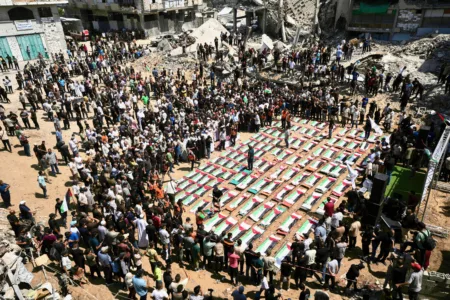
Earlier on Tuesday, Palestinians gathered for a mass funeral of more than 100 bodies finally recovered from a deadly Israeli strike in Gaza in 2023. More than 300 people were killed on Nov. 22, 2023, weeks into the war with Hamas, when warplanes flattened a residential block in Gaza City's Sabra neighborhood.
About 40 bodies were recovered soon afterward in a frantic scramble of rough tools and bare hands, but most were buried deep beneath the rubble. Reports of the high number of victims in one of the war's deadliest attacks took days to reach the public in the chaos just before its first ceasefire.
Over the weekend, first responders dug through the destroyed buildings and recovered remains of 112 victims, including 40 children, according to the Civil Defense, a rescue agency operating under the Hamas-run Interior Ministry.
It said 157 bodies still have not been found.
"The only crime of these martyrs was that they remained steadfast and resilient in their homes, believing that these homes would protect them," one relative, Taysir al-Hassayna, told The Associated Press following the funeral prayers.
For the missing, it's "as if their bodies had evaporated without a trace."
Current ceasefire allowed recovery
Only now are some bodies of people killed in the war's ferocious early months slowly being recovered, as the fragile ceasefire allows such efforts to push ahead in parts of devastated Gaza.
At least 7,400 people have been reported by relatives to still be under the rubble, Zaher al-Waheidi, head of the ministry's records department, told the AP. The true number is likely thousands higher because in some cases entire families were killed in a single bombing, leaving no one to report the missing, al-Waheidi has said.
The people mourned on Tuesday were from a residential block belonging to the Hassayna and Abu Sharia clan, and many were related. AP has identified at least 60 families across Gaza who lost 25 or more family members during the first three months of war.
On Tuesday, the remains of the victims, wrapped in Palestinian flags, were laid in rows on the ground. Many were marked with photos, and flower petals were scattered around them all. Hundreds of people surrounded the bodies for funeral prayers, some standing on the rubble.
Following the prayers, people carried the bodies on stretchers along a narrow street lined by destroyed buildings and buried them in a nearby cemetery.