
Out of commission: End of skill games devastates bottom line for device owners, local host sites
Trending
The holiday season is here, and DeLeo Games' service technician Tim Allison is contemplating a year-end layoff, as the company shrinks from 22 employees to six, in response to the state Supreme Court's ruling in June that made skill games illegal, coupled with the General Assembly's failure to make them legal again within the court's four-month grace period.
Allison, 57, has been in amusements and vending for 40 years, including the last decade at DeLeo's -- a "home run" of a job with a firm that cared for all its workers, all of whom got along, he said.
Now, there won't be as many presents under his tree at Christmas, and, as someone who's "no spring chicken," he'll have to look for work and may need to settle for running parts or a job as a courier, he said.
The recent end of skill games in Pennsylvania has been devastating for distributors like DeLeo's, but also for the games' software developers and hardware manufacturers, along with host locations like bars, restaurants, corner stores, social clubs and fire halls, some of which relied on skill game revenue, including the 30 or 40 sites that have folded due to its loss -- while other sites have merely scaled back worker pay, bonuses and charity, according to DeLeo employees and observers like Michael Barley, chief public affairs officer at skill game developer Pace-O-Matic.
The crux of the problem is that organizations had more than a decade to develop a reliance on skill game income, and many had "put that (income) into the operational budget," Barley said.
Such revenue had become "a bit of a lifeline" for them, especially after COVID shutdowns, he said.
When skill games arrived in 2014, they helped many clubs and bars in the area climb out of their habitual red ink, enabling them at that time to begin fixing up their properties and hiring more employees, said Byron Cassidy of Juniata, a DeLeo Games supervisor.
That's over now.
At the Bavarian Aid Society, skill game revenue accounted for 15% of the budget, said society President Robin Haas this week.
The society had 14 machines, Haas said.
She agrees with Barley that it would have been better if the state had eliminated the machines before organizations like hers started to depend on them.
DeLeo Games' third-generation owner Tom DeLeo agrees.
"After 12 years?" he said, referring to the start of the games in 2014, when Pace-O-Matic got approval in a Beaver County test case for the recently introduced games. "(The Supreme Court) pulled the rug out from under us."
The loss of skill games has led to a revenue decrease from $2,600 to $1,700 per day at FeFi's of Fourth Street, along with a decrease in patronage from between 450 to about 125, estimated employee Jimmy Patel.
Business is "too much down," Patel said.
The games provided some business income that was nice, but hardly critical.
Steve Horton, owner of Co"BRH"s Lounge on the 1200 block of Sixth Avenue and a pizza shop on the 5800 block of the same avenue appreciated the $1,000 to $2,000 generated by his five machines at the bar and two at the shop, but didn't really rely on that income.
"It was definitely a plus," he said.
But the flow was erratic.
"There were good months and bad months," he said.
Customers waiting for takeout orders or waiting to compete in pool or darts, and those who came in to watch football on TV on Sundays, often played the games, he said.
The machines were definitely a draw, he said.
There would be major influxes when chat room participants who tracked jackpot potentials would highlight one of his machines, he said.
That was especially true if a jackpot reached a significant figure like $10,000, he said.
Family Pizza owner Dave Servello thought the loss of the machines would hurt him, but found that his business was strong enough to withstand it.
"Luckily, I didn't have to lay anyone off," he said.
He had used skill game revenue for employee bonuses, he said.
Since the games went away, Bavarian club members have been buying more "small games of chance" rip tickets, and playing more Pennsylvania Lottery games like Keno and Derby Dash, which has offset some of the revenue loss, Haas said.
Family Pizza customers likewise have switched to lottery purchases, Servello said.
The rip tickets and lottery games, however, don't have as much entertainment value as the skill games, according to Haas.
"That's the part that hurts us," she said.
Many members played the games in groups, with each individual chipping in $20, for example, she said.
The skill games also helped occupy the attention of bowling league spectators, she said.
The games were also less of a hassle for club employees than the small games of chance, Haas said.
DeLeo's took care of the money distribution and reporting on skill games, but club employees need to fill up the rip ticket machine and go to a local supplier several miles away to buy refill tickets, she said.
Servello's customers, too, miss the skill games for their entertainment value.
"I wish they were back," Servello said. "People enjoyed them."
They complain to him about the loss, he said.
"I hear about it every day," he said.
Some people were addicted to the games, but some simply enjoyed them, said Mike Mikolajczyk, who collected money for DeLeo's.
For some older people, the games were the only thing they had to keep themselves occupied, Mikolajczyk said.
They'd go to the store and play and talk to their friends, he said.
Some are really upset at the loss, he said.
Skill games likely to return
State Rep. Scott Barger, R-80th, thinks that it's likely not only that the skill games will come back, but that it will happen this year.
The members of both chambers in both parties collectively "didn't do a great job of coming up with a workable solution," during the grace period, Barger said.
"They ignored it and pointed fingers and watched as thousands were laid off," he said.
It was "awful," he said.
It also showed that sometimes state government doesn't work "for the people," and that it's easy for elected officials to get distracted by election issues, he said.
But the state has an operational deficit of $6 billion or $7 billion going into next fiscal year, and while it has money in its rainy day fund and additional "surplus" money, there is pressure to find additional revenue to "backfill" that deficit, Barger said.
The new Democratic "trifecta" at the beginning of the year (the Democrats now have a new majority in the Senate, as well as their existing majority in the House and their possession of the governorship) will focus on wage and abortion issues, but will then turn its attention to the budget -- and specifically revenue opportunities, Barger predicted.
Skill games present such an opportunity, he said.
That doesn't mean that the games will be back under the same prior conditions, though.
They're likely to be taxed, Barger said.
He would like for them to be prohibited in unmanned locations, which are an invitation for trouble, he said.
While skill games weren't taxed directly under the gaming laws, they still generated corporate and business income taxes and income taxes from employees connected with the industry, DeLeo employees pointed out.
"The issue (of bringing them back) is very much alive in Harrisburg," Barley said. "But the challenges that kept the deal from getting done before are still there."
Those include figuring out tax levels and regulatory responsibility, he said.
There is likely to be an overall limit to the number of skill games permitted in the state, and there is a move to limit them to establishments with a liquor license, Cassidy said.
The pro and con divisions over the games are not partisan so much as regional, according to Barley.
Casino interests and the state lottery are among the most prominent opponents of skill games, as they were previously handled, according to online sources.
Because under the Supreme Court's ruling, skill games are slot machines and now require a casino license to operate, the state is essentially favoring "the super rich," said DeLeo's service manager Dustin Wible.
"It's discouraging for the little guy," Wible said.
Machines in storage; layoffs loom
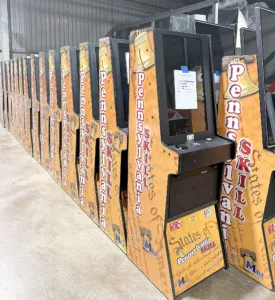
As the grace period ended in mid-October, DeLeo's removed all its hundreds of machines from establishments all over the region, Tom DeLeo said.
About a quarter of them were destroyed and the rest put into storage, he said.
The ones that were destroyed were contained in old cabinets that he didn't want to pay to store, DeLeo said.
The employees that will be laid off at the end of the year are currently on "shared unemployment," working three days, off two -- with unemployment income for those two days.
He feels "terrible" about the whole situation, DeLeo said.
He provided his employees good wages, health insurance and a 401(k) and profit sharing, he said.
That's financially impossible now, he said.
Cassidy installed DeLeo's first skill game 12 years ago.
At the end of the year, he'll go from being a supervisor to a route collector, which will mean a cut in pay, he said.
While that will hurt him financially, things will be "way, way more detrimental for a bunch of other people," he said.
That includes not only fellow DeLeo's employees and customers, but employees of the skill game cabinetry manufacturer, he said.
Mikolajczyk will be laid off at year-end too, but, like Cassidy, he'll be OK financially.
He's retired from the state prison system and has a state pension, and has only six months to wait before he can collect social security.
He'll be able to collect unemployment compensation, meanwhile, he said.
He'll also look for a job if only to stay busy, perhaps in security or driving a medical van, he said.
DeLeo's service manager Dustin Wible will be laid off like the rest, but not for a few months.
He has four children, including one with uncontrolled epilepsy.
"The only reason (Tom DeLeo) is keeping me on for a couple of months (longer than the others) is he knows I have four kids," Wible said.
The company's plan for keeping the employees on the (partial) payroll until the end of the year is generous as it is, Wible said.
He wonders about the stress on Tom DeLeo.
Unemployment compensation won't be enough to pay his own mortgage when the layoff comes, Wible said.
When the time comes, he'll be looking for a job, he said.
He can "push a broom somewhere," if necessary to feed his family, he said.
The whole situation "sucks," Wible said. "It really sucks," he added.
Mirror Staff Writer William Kibler is at 814-949-7038.