
Central Blair Rec art program gives kids creative space
Glasgow-native Bennett teaches multiple classes for local youth
Trending
The Central Blair Recreation and Park Commission is known for sports programming for kids: Flag football, basketball, baseball, volleyball, wrestling, tennis and swimming, to name a few.
For six years, the commission has also offered programming for kids who aren't necessarily interested in sports.
It's art, as taught by Jae Bennett, 47, an artist from Glasgow, Cambria County, who recalls a sports-minded friend asking him after one art class at the commission's headquarters on Fifth Avenue: "Who won?" A rock and mountain climber, Bennett is familiar with competition, the will to win and success. But nobody won, he told the friend.
There's a saying in the mountaineering community attributed to late American climber Alex Lowe: that the best climber is the one that's having the most fun, Bennett said. That's how it can be with art, he said.
"The person who is most creative with their emotions is succeeding," Bennett said during an interview in his spacious studio classroom in the basement of the commission headquarters last week. "To succeed is to put something on the wall and to make sure someone else (who looks at it) feels something."
Sports requires athletic output, while art, which can be equally exhausting, requires creative output, he said.
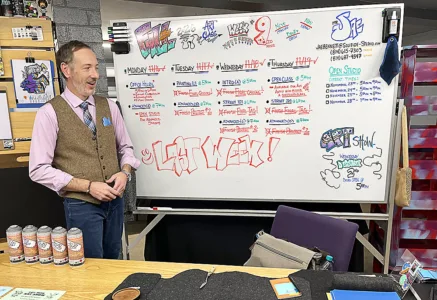
Bennett teaches between 45 and 60 kids each fall, spring and summer: Introductory art, street art 101, street art 201 and painting, along with four advanced classes.
The minimum class size is 14 students, who range in age from 8 to 16.
Some of the ones in the advanced classes have been with Bennett for three or four years.
He's paid 70% of the commission's tuition fee, which is $90 for the painting and advanced classes and $60 for the other classes.
Bennett uses all his stipend to buy supplies for the kids, he said.
And by the end of each semester, he's supplementing those purchases with supplies from his own stock at his professional studio in State College, he said.
If one of the students "is a little overproductive," he doesn't want to tell them to cease and desist, based on their having used all their allotted materials, he said.
"More and more, I realized that I found that this is so meaningful for these kids," he said. "I've created a studio for them, more than an art class."
He spends about 20 hours a week at the commission headquarters, plus another 10 to 15 hours cleaning up.
He was raised by his maternal grandparents Mary and Robert Bennett in Glasgow.
"My mom had me super young," then finished high school and went off to college, he said.
His grandfather wrote poetry, played piano and took him backpacking.
His grandmother would advise people not to tell him twice to do something.
"Mention it once, and it will get done," his grandmother would say.
He doesn't like being told what to do, he said.
It probably has something to do with his artistic temperament, he added.
He majored in philosophy at Penn State after starting with architecture, but finding that the straight lines of architectural drawings were too limiting.
The people in his orbit were paying more attention to his art, anyway.
"I never liked too many rules," Bennett said. "Not that I'm a rule breaker or an anarchist."
There was more liberty in art than in architecture, because, after all, "a building has to stand," he said.
At the commission, he's comfortable with having philosophical discussions about art with his students, even the young ones.
It seems he recognizes their right to be uncomfortable with following all the rules, too.
He spoke one time with a 9-year-old girl about the benefits of shifting the main subject of something she was working on away from the center of her canvas into the "negative space" on one side, and about how the horizon line for a sunset should not be "right down the middle."
As he spoke, he "could see the wheels spinning," he said.
She didn't altogether buy what he was saying, but didn't altogether reject it either.
They came up with a compromise, Bennett said.
He tries to help them achieve their visions with his technical suggestions.
One student wanted to paint wildflowers in watercolors and was having trouble getting the detail she wanted.
He brought out ink and a nib, and she was able to get the detail she needed.
"I remember how big her eyes got when she realized 'this is working,'" he said.
He urges them to go beyond what they're most comfortable with.
A student who likes charcoal drawing might benefit by experimenting with pen and ink, he said.
He wants to encourage their passion -- and prod them to go beyond, he said.
At the end of semesters, Bennett asks for two canvasses -- one they choose and one he chooses.
One might elect to do a pen and ink drawing, and he'll challenge them to also paint a landscape in acrylic, he said.
He wants them to "find their aesthetic," he said.
He started the art classes upon the encouragement of his friend Andy DeArmitt, the commission's superintendent of recreation.
"(Andy) called me up and said, 'We're really thinking of expanding'" outside of sports, Bennett said.
Bennett had been looking for "another outlet," anyway, to give himself a break from his professional studio, he said.
"We gave him his space and left him to roll with it," DeArmitt said at a recent commission meeting.
"It's important to provide opportunities for individuals who don't want to participate in sports," said commission Executive Director Mike Hofer.
The art instruction isn't the commission's first non-sports program.
Years ago, it offered theater opportunities at Valley View Park, Hofer said.
It still runs summer playground programs in Altoona and in Bellwood.
Hofer said he'd be glad to entertain proposals from people in the community who are capable of instructing kids in activities -- sports or otherwise, he said.
Early art start
Bennett's mother has said that he began sketching as soon as he was born.
Bennett credits the schools he attended while growing up with giving him the opportunity during slack periods and when he'd finished his regular work to practice his art.
As a professional artist, Bennett designs logos for companies and produces commissioned art.
For a time, he earned a living by producing stylized, vertically oriented climbing guides that show routes on mountains in a way that trail and climbing organizations found to be useful and effective -- as they were easier to understand than topographical maps or drawings that focused too much on fussy detail.
That work was "a cool way to integrate" art with climbing, Bennett said.
He also paints for himself.
He's had seven shows since 2001, starting with one at the Palmer Museum of Art on the campus of Penn State.
He learned about climbing from family and friends, and he tucked into the climbing culture when he went to State College.
His most ambitious climb was Wallface Mountain in the Adirondacks near Lake Placid by himself in winter.
He pulled rib cartilage and damaged nerves in the process, but he's "kind of proud of it," he said.
He started in the dark and finished in the afternoon seven hours later. The effort included a cross-country ski from a nearby lodge and ice climbing.
Mirror Staff Writer William Kibler is at 814-949-7038.