
Penn State Altoona criminal justice group holds First Responders Day at Ivyside campus
Criminal justice club organizes event at Penn State Altoona
Trending
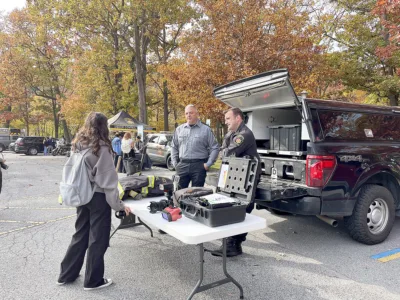
The Penn State Altoona criminal justice program held its first First Responders Day Wednesday at the Ivyside campus to honor, recognize and support local police, fire and ambulance services, while also giving those services a recruitment opportunity.
Senior criminal justice major Ally Black of Tyrone has wanted to be in law enforcement since late in her high school career. She completed an internship in the summer with the state police and has applied to become a trooper.
"I want to help people," Black said.
During her internship, Black observed that her mentors were caring and "people-first-oriented," and that on traffic stops, they'd first check to be sure the people they encountered were doing all right, she said.
"It was a lot different than on TV," she said.
Those officers were, however, prepared to play the part when "the situation demands," she said.
Black's parents at first may have thought her career choice would involve risk, but they're proud of her and support that choice, realizing "that this is the path I want," she said.
Fellow senior Lily DeMarco of Wallingford, Delaware County, came to her interest in law enforcement through the career choices of relatives: an aunt and uncle who practice law in New Jersey and her mother, a paralegal in Camden, N.J.
DeMarco was hoping that the day's activities along the driveway near the Smith Building and in the Port Sky Cafe would help campus students get more comfortable with first responders.
Black hoped the activities would "bridge the gap between the community and law enforcement."
Junior Payden Imler-Knisely of Roaring Spring wants to be a detective.
Imler-Knisely has talked to detectives and likes how they solve problems and "build a case from the ground up."
Junior Frankie Stricker of Dillsburg wants to be a victim services advocate.
She grew up and was herself a victim in a family troubled by domestic and sexual violence, she said.
Those problems weren't handled property, mainly because the victims did not file a report, due to their awareness that the law enforcement process for handling those problems is "dehumanizing," she said.
Often, in such cases, responding officers don't believe the victims,
rape kit processing retraumatizes them and defense lawyers often belittle them and accuse them of lying, Stricker said.
"It's rare to see someone go through the entire process," she said.
She cited the Cornell case that has been in the news recently.
The victim in that case, known as Jane Doe, has faced harassment and threats, according to online sources.
Junior Abigail Hayes of Vermont wants to become either a federal prosecutor or an environmental lawyer.
She always loved "legal matters" and studied case briefs in high school.
"I could see myself doing that the rest of my life," she said.
There are many things that happen in the world that make her feel "powerless," she said.
A law career would give her the power to correct some of those things, especially in cases of child abuse or environmental wrongdoing, she said.
Trooper Adam Pufka, who works in forensics, manned a table with Cpl. Scott Swasing, a fire marshal.
As of early afternoon, they'd encountered a half-dozen interested students.
"You either want to do this (kind of) job or not," Pufka said, adding that the heart must be in it.
Pufka served "on the road" for 11 years before deciding it was time for a change.
The forensics opportunity was available, although it required him to take classes.
He's mostly called in on major cases, including robberies and homicides.
He collects fingerprints and DNA samples, although a large part of the work is "scene preservation" through photography.
In contrast to TV shows in which DNA results come back quick, his reality has been that they take weeks or even months.
That is changing, however, with recently acquired Rapid DNA machines that can produce results in 90 minutes -- but only if the DNA information for the person to be matched is already in "the system," he said.
Pufka grew up in Altoona and always knew he wanted to be a cop.
"I wanted to help out with the community and do what I could to stop crimes," he said. "And make people safer."
The campus' Criminal Justice Organization, a student club, not only organized the event, but raised money from local organizations to pay for two "sensory communication" backpacks that will be given to each police department in the county, according to Nathan Kruis, associate professor of criminal justice, who grew up in the Tyrone area.
The backpacks contain items that officers can provide to autistic people they encounter.
The items include weighted blankets that those on the spectrum can wrap around themselves and that mimic a hug; noise-canceling headphones that are especially useful when there are sirens and other scary sounds; chew sticks, fidgets and spinners that can facilitate the "stimming" behavior that autistic people engage in to regulate their emotions; and laminated sheets with pictures and words for common demands and feelings that autistic people can express by pointing.
Mirror Staff Writer William Kibler is at 814-949-7038.