
Pa. school enrollment to drop 6% over decade
Projections show populations will decline across state, continuing recent trend
Trending
Editor's note: With K-12 enrollment declining across the country, State Affairs is examining how states are responding to shrinking student populations -- and who is bearing the cost. This story is part of an ongoing series, "The New School Math," that digs into the numbers, the causes and the policy responses.
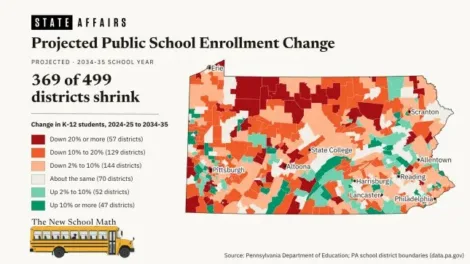
Four out of five school districts in Pennsylvania saw their enrollments drop ahead of the 2025-26 school year, state data shows. The number of students enrolled in Pennsylvania schools dropped by 20,000 students total.
The situation will only worsen in the years ahead, state projections reveal.
Over the next decade, the number of students attending Pennsylvania schools is expected to drop 6%, with nearly 90,000 fewer students attending class.
And as more people move into the suburbs, urban and rural school districts stand to bear the brunt of the decline.
It's an issue that has not fully caught the attention of elected officials and policymakers, though in many ways, they have tried to help school districts respond, said Pete Schweyer, D-Lehigh, majority chairman of the House Education Committee.
"We've taken steps around the edges, but it's a real conversation that I've been, very candidly, telling my colleagues to be prepared for this conversation next session," Schweyer said.
Long-range planning in response to changing demographics is difficult because community members are often skeptical of the objectives and resistant to changes.
"I don't want to lose those neighborhood schools," Schweyer said. "I don't want anybody thinking that we're going to kick you out of your kids' high school or do anything like that. But we have to be honest about it. We have school districts that can't field a baseball team. And so, when you don't have those opportunities in schools, when you don't have enough to put on a high school musical, if you can't find somebody to teach AP world history, these are real concerns that are happening in a lot of these districts, and there's got to be a better way to share resources and/or look at ways of more direct governance."
Pennsylvania has been grappling with finding a school funding system that provides resources to help growing districts scale up while ensuring that districts that are losing students receive the assistance they need to serve the students they still have.
Pennsylvania schools rely heavily on local property taxes for funding. Only six states -- Missouri, New Hampshire, Nebraska, South Dakota, Nevada and Connecticut -- rely more heavily than Pennsylvania.
The Keystone State's reliance on local school funding has contributed to wide disparities in per-pupil spending among districts and led to a 2023 state Supreme Court ruling in a lawsuit alleging that the state was unconstitutionally shortchanging students in less affluent school districts.
One district that participated in the lawsuit and lent its name to the decision is the William Penn School District in Delaware County. The district hired a consultant in 2019 to assess how it was using its school buildings. The review found that more than half of the district's elementary schools were operating at less than 90% capacity, with one school, Walnut Street Elementary, at 64% capacity, according to the decision, authored by Commonwealth Court President Judge Renee Cohn Jubelirer. Enrollment at Walnut Street Elementary has fallen 32% since 2018-19, state enrollment data shows.
In response to the court ruling, the state has directed an additional $1.9 billion to less affluent school districts, including $565 million in the 2026-27 budget.
The 2026-27 state budget allocated William Penn just $473,882 in additional basic education funding, but when the increase tied to the court ruling is included, the district's state funding will rise by more than $5.5 million.
Over the next decade, the Philadelphia school district is projected to lose more than 9% of its student population as enrollment is expected to slide from more than 118,000 to 107,099 by 2034-35.
The Pittsburgh, Reading and Lancaster school districts face even steeper declines when district size is factored into the equation. Pittsburgh schools are expected to shed 4,300 students, 23% of their current enrollment. The districts in Reading and Lancaster are projected to see similar drops of 17.4% and 22.5%, respectively.
Meanwhile, the Great Valley School District, in an affluent part of Chester County, is expected to see student enrollment rise almost 26% over the next decade as the student population increases by more than 1,200. The Muhlenberg School District, just outside Reading, is projected to see enrollment grow 28% as the student population is set to increase by more than 1,200.
The Seneca Valley School District, in a wealthy and fast-growing part of Butler County, is expected to add nearly 1,000 students, a 13% increase over its current enrollment.
Challenges in small school districts
While dwindling enrollment may trigger fever dreams of school closures and long bus rides, consolidation isn't an option for some districts, which may have only one school building to begin with.
All of the roughly 300 students in the Galeton Area School District attend classes in one building. The district isn't the smallest, but it's one of the tiniest in the state. And it will only shrink further if state projections hold. The Department of Education estimates Galeton enrollment will dip to 220 students over the next decade.
Being so small has at least one perk: There's no debate over which school building to prioritize for maintenance.
"We did a project, like three years ago, and did improvements to a lot of different areas, the heating systems, the main replacement of windows, that kind of thing," Galeton Superintendent Clyde Pierce said. "When you only have one building to maintain, it makes it a little bit easier to do. Planning is easy, or at least less complicated. There's no competition."
The high school, which graduated 22 students in 2026, has two English, two math, two social studies and two science teachers. Teachers of special subjects, like gym and music, are certified to teach all grade levels.
With such a small staff, the district has little flexibility to make adjustments if needed. And the challenge has been compounded by a growing number of students opting to attend school virtually rather than in the classroom. In Pennsylvania, traditional public school districts must pay tuition for students attending cyber schools, with costs based on the district's spending on in-person students, minus certain deductions.
Galeton's elementary school has just one teacher per grade level.
"If a kid moves out of that classroom, I think the thought is that if you have less and less kids, it shouldn't cost you as much to educate them," Pierce said. "But if one or two kids leave that classroom, and let's say they go to a cyber school, I have that increased cost for the cyber costs, but I only have one teacher. It's not like I can reduce the number of teachers in those grade levels that have one or two teachers."
The number of students attending cyber schools tripled after the COVID-19 shutdowns, he said. And the district in 2024-25 paid close to $1 million in cyber school tuition bills, almost 10% of its operating budget.
Big-city schools face similar challenges
Facing the same pressures from dwindling enrollment and more students attending classes online, the Philadelphia Board of Education in April approved a controversial $3 billion facilities plan that calls for closing 17 schools by the 2027-28 academic year.
After months of pushback, the School District of Philadelphia cut the number of schools on the chopping block from 20 to 17.
District officials say all the school buildings are at least 70 years old and require ventilation work and other major repairs. Closing the schools will allow the district to focus its resources on fixing the nearly 170 buildings that remain open.
"This historic investment will fund 159 school modernizations and reduce the number of District school buildings rated unsatisfactory or poor from 85 to zero," district officials said in announcing the plan.
Philadelphia allows families to choose the school they want their children to attend. That policy, in some cases, has created intense competition for spots at popular schools while leaving less sought-after schools with partially empty classrooms, said Farah Jimenez, president and CEO of the Philadelphia Education Fund, a nonprofit that provides college and career advising services in the district.
"Philadelphia's High School for Girls has some classrooms with as many as 55 students in the class," Jimenez said. "They've had huge overenrollment, so much so that students went to headquarters to protest."
By contrast, Roxborough High School saw its enrollment drop by half after a student was shot while playing in an off-campus intramural football program, prompting many families to reconsider sending their children there.
Complicating efforts to manage student enrollment and provide students the services they need is simply the fact that too many students do not remain in one place long enough, Jimenez said.
"The biggest challenge in Philadelphia is not necessarily enrollment; it is the fact that we have so many kids who are highly mobile," Jimenez said. "We are supporting the school districts in their Gear Up program. Gear Up is a federal grant-funded program that supports schools in providing postsecondary enrichment to cohorts of students. It follows them along from sixth to seventh grade, eighth grade, ninth grade and so on until their first year of college. So that cohort in middle school was about 5,000 students. That cohort is now in year six, which means they are in 11th and 12th grade. They've been reduced to 3,881 students."
The drop was linked to those roughly 1,000 students having switched schools or left the district, she said. In some cases, those families move voluntarily, but in many cases, the children have no choice, Jimenez said.
"The high mobility of our students is a consequence of their being attached to systems. Foster youth have historically a very high mobility; they move from one placement to another placement and change schools along the way -- students who are unhoused. I work with young people. I work with families living in shelters," she said. "You will see this really high mobility among our student population. That results in very low education attainment."