
Joyce wants answers on string of railroad mishaps
Answers sought from NS, Federal Railroad Administration about recent derailments
Trending
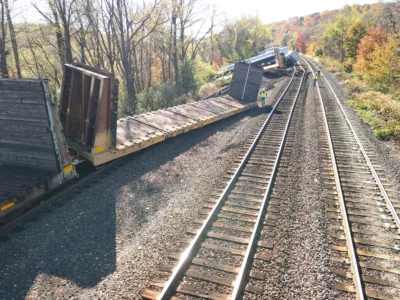
In the aftermath of the fourth derailment this year Friday on the Norfolk Southern mainline near Altoona, U.S. Rep. John Joyce, R-13th District, Monday sent letters to the Federal Railroad Administration and Norfolk Southern, asking why there has been such a string of mishaps and what the parties are doing to prevent a recurrence.
A total of at least 100 railcars came off the tracks in derailments that occurred in February, March, August and October between the Horseshoe Curve area and the western boundary of the city, according to a news release from Joyce that accompanied the letters.
"The frequency of railcar derailments in and around this specific portion of Norfolk Southern rail lines is troubling and raises valid concerns as to whether there are underlying issues along this stretch," Joyce wrote to the FRA.
"Four publicly reported derailments along this specific rail corridor in just nine months are unprecedented and completely unacceptable," he told NS.
Joyce asked both parties whether they'll investigate to determine the cause or causes of the repeated derailments.
He asked the FRA whether NS notified it in a timely fashion about each derailment; what the agency's protocol is for responding to derailments; whether it has coordinated with NS and the National Transportation Safety Board "to better understand" the incidents; and whether it has previously identified the local corridor as at special risk.
Joyce asked NS for a "remediation plan" to stop the derailments; asked why prior routine inspections didn't identify whatever risk has led to them; asked what the railroad is doing to ensure against damage from toxic spills and whether the railroad has considered rerouting hazardous materials away from the local mainline until the possible issues are identified and fixed.
"Norfolk Southern must do more to prevent these accidents and assure the local community that it can operate safely through Blair County's rail corridor," Joyce told the railroad company.
Joyce also asked NS about its procedure for notifying local officials and first responder agencies about derailments, and whether those procedures were "successfully executed during all four Blair County derailments this year."
On Friday, 10 cars came off the tracks just west of Mill Run Road, including three tank cars containing Liquified Petroleum Gas, a hazardous material.
There were no leaks, officials said.
Those three railcars, as well as a tank car containing lubricating oil, have been taken down the rail embankment and are currently stored at an industrial property at the intersection of South 10th Avenue and Curtis Street.
The air nearby is being monitored, and the contents are scheduled to be unloaded today, according to local emergency officials.
It wasn't clear how they would be unloaded, however, local officials said.
From the railroad's standpoint, "everything went the way they would have hoped," said Rusty Shoenfelt, chief of Logan Township United Fire Department about Friday's incident. "No hazardous materials released; no injuries; no catastrophic loss of property."
From the point of view of local emergency officials, however, "all of us hoped for better communications in the early stages of the incident," Shoenfelt said. "A liaison from NS to deal with local emergency management would have been ideal."
Blair County "was lucky once again there wasn't a hazardous materials release that affected the citizens," Shoenfelt added.
Adam Free, Altoona fire chief and head of the county's hazmat team, was in contact with one of NS's hazardous materials managers in another area of the state within 20 minutes of the derailment.
That official provided "a couple updates" through the weekend, Free said.
But "there was still some difficulty" with communications, even as were some aspects of the overall situation in which NS improved on its previous efforts after derailments, Free said.
Those communication efforts "always will be a work in progress," the chief said.
While Free was able to talk quickly with an NS hazmat specialist in another location, that doesn't fully compensate for there being no one "here on the ground," said Cris Fredrickson, Blair County emergency management agency coordinator.
"We don't want to have to wait three or four hours to know if it's a hazmat incident," Fredrickson said.
Like Shoenfelt, Logan Township emergency management coordinator Dave Lynch called for a "liaison" -- one that would be dispatched automatically to the scene and engage in "timely cooperation with emergency responders."
Potential causes of derailments
There are various reasons derailments can occur, and generally, "each one has a particular story," said Dan Cupper, former NS locomotive engineer and Pennsylvania-based rail publication editor.
It's possible that if the FRA or NS investigate the recent ones around Altoona, they might not find "a common thread," Cupper said.
He does not know the particular cause of Friday's incident, he said.
Derailments can occur when one part of a long train is going downhill while another is going uphill, in a "roller coaster profile." For example, if heavy cars near the rear of the train are going downhill, while the locomotive at the front of the train is laboring uphill, and the heavy cars in the back gain speed and slam into lighter cars in front, it can send those lighter cars off the tracks, he said.
However, the old Pennsylvania Railroad mainline that runs through Altoona and that is now owned by NS "was superbly engineered from a geometric stand point," and there isn't much of a "roller coaster" risk, Cupper said. That sort of risk is mostly confined to railroads in the south, where some railroads simply laid tracks along the profile of the terrain, Cupper said.
Derailments can also occur when trains are "improperly made up," due to management incentives to pack "as many cars as possible"; due to improperly maintained equipment; and due to a lack of inspections, because of a lack of inspectors, Cupper said.
There are also "unforeseen circumstances," like brake lines cut by debris kicked up or equipment falling off during travel, he said.
"When you're talking about 10,000 to 20,000 tons, there are all kinds of physics in play," he said.
It's almost certain that the recent derailments didn't occur due to track deficiencies, because "NS always maintains good track," Cupper said.
Mirror Staff Writer William Kibler is at 814-949-7038.