
Norfolk Southern: Local inspection of track not automated
Railroad has not used its waiver that allows for reduced in-person inspections in region
Trending
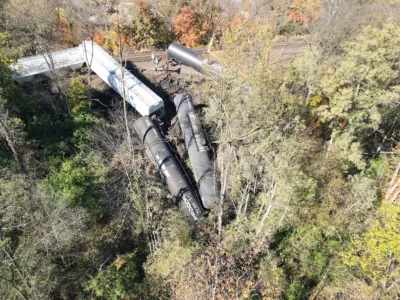
The Norfolk Southern track that runs through Altoona and that has been the scene of four derailments this year just west of the city became subject on Aug. 2 to a Federal Railroad Administration waiver that enables NS to use automated track inspections (ATI) in place of one of the twice weekly visual, human inspections that would otherwise be required, according to the Brotherhood of Maintenance of Way Employees Division of the International Brotherhood of Teamsters union (BMWED-IBT).
While two of the four local derailments occurred after NS received the FRA waiver -- one derailment occurred Aug. 11 and one Oct. 23 -- NS nevertheless has not reduced the number of visual, in-person inspections in this region, and is only using the automated inspections as a supplement to those in-person inspections, according to an NS email.
Using the automated inspection system as a mere supplement to in-person inspections is the right idea, according to the union: "ATI does not pick up on the vast majority of track defects," states the union in a publication about the automated system. "Only 26% of all track related-defects can be detected by ATI, (while) the other 74% can ONLY be detected by a human being," the publication states. "(The union) believes that the rail industry should voluntarily or be required to adopt a higher ATI inspection frequency than currently required to catch more track geometry defects, while maintaining human visual frequency of inspection requirements to catch other track defects."
NS argued for the value of the technology in an emailed response to a request for comment.
"In 2025, the industry was granted a waiver to allow us to use proven digital inspection technology to inspect our track, enabling us to identify defects or hazards that might otherwise be missed during routine visual inspections," NS stated. "In Altoona, our incredibly accurate digital track inspection systems inspect NS track approximately every 36 hours, significantly exceeding inspection requirements" -- even as the regular in-person regimen continues, according to the company.
The automated inspections provide "an added layer of safety, with track in the region subject to both regular manual and digital inspection," NS added.
The automated Track Geometry Measurement Systems (TGMS) that the Federal Railroad Administration greenlighted through an industry-wide waiver in December under the Code of Federal Regulations, permits participating railroads to reduce in-person inspections from twice a week to once a week, "provided they comply with numerous reporting, inspection and performance conditions intended to demonstrate that the reduced inspection program provides a level of safety equivalent to the existing federal regulations," the union analysis states.
But the automated systems "measure only geometry-related conditions," the union states.
Reports filed since Union Pacific and Burlington Northern Sante Fe Railway have begun taking advantage of the waiver in the spring show "numerous instances where qualified track inspectors discovered reportable defects after TGMS inspection vehicles had already traversed the same territory," the union states.
The automated system measures "track geometry," and isn't "designed to identify many categories of defects routinely discovered through visual inspection, including defects involving ties, fasteners, ballast, drainage, switches, crossings and joints," the unions states.
About three-quarters "of defects identified during visual inspections involved conditions outside the capability of current ATI systems," the union states.
The American Association of Railroads takes a more favorable view of the new technology.
It makes no more sense to stick to the prevailing 1971 FRA regulations than to continue to use the eight-track tapes prevalent then, according to the AAR.
Ever since 1971, in-person inspectors have walked or ridden along rights-of-way in special vehicles looking for worn rails, loose fasteners and track movement, according to the AAR.
The modern technology uses lasers, high-definition cameras and other sensors mounted on locomotives and railcars in regular duty to check tracks under the actual weight of moving trains, collecting data along every few inches of track, according to the AAR.
The technology can detect "subtle changes (that are) hard or impossible to measure with the human eye," according to the AAR.
The information gathered is sent to maintenance crews for review, after which crews are dispatched to make repairs where needed, according to the AAR.
The data collected can help railroads identify patterns and trends that assist with long-term preventive maintenance, helping to keep small problems from becoming big ones, according to the AAR.
The automated inspections can be conducted more quickly and efficiently than in-person inspections, according to the AAR.
"ATI systems are a vital railroad safety tool for reducing track-caused derailments," an AAR fact sheet states. "(They detect) track geometry defects more accurately, consistently, and frequently than visual inspections."
Visual inspections will still be done, but at a reduced level, according to the AAR.
A map provided by union spokesman Clark Ballew shows that the entire Pennsylvania mainline of NS is among the rights-of-way covered by the waiver.
The union supports a proposed law, the Secure Tracks Act, which would "codify the twice weekly visual track inspection requirement that has long served as a core rail safety safeguard, while reinforcing the principle that inspection technology should supplement, not replace trained human inspectors unless and until safety equivalency is clearly demonstrated," according to the union analysis.
Mirror Staff Writer William Kibler is at 814-949-7038.