
Large garage in residential area of Logan Township angers neighbors
Seven-bay structure’s owner says building complies with township codes
Trending
Kiley Snyder of Hillside Drive off Avalon Road in Logan Township used to call his neighbor John McTigue "dad," and McTigue would call Snyder "son."
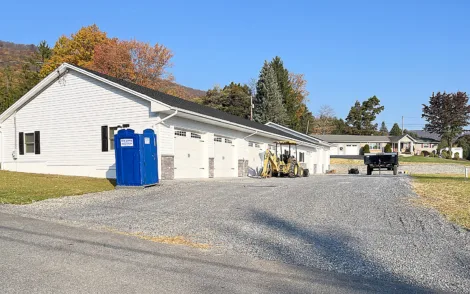
Those familial feelings have been washed away for the past year-and-a half due to the younger man's opposition to McTigue's construction -- now virtually complete -- of a seven-bay garage on a lot he owns just up the street from Snyder's home, containing a house where McTigue's grandparents once lived, and which McTigue now rents to a tenant.
Snyder has tried without success to convince township officials to halt construction, arguing that McTigue has violated various code requirements, at one point obtaining a short-lived injunction from Blair County court and becoming part of an effort that he and another neighbor who supports the cause say includes 30 signers of an anti-garage petition.
As long as McTigue keeps his word that he's not using the garage for business, he's in compliance with the code, township officials say.
Snyder's opposition to the garage represents a personal vendetta against him that began because McTigue hired Snyder's brother to do some work on a family property, and Snyder and his brother do not get along, McTigue said.
"Everything was done with township approval," McTigue said of the garage. "I've had all the permits, inspections and approvals."
Snyder has flown drones over his property, and has yelled and sworn at home and at the contractors who have worked on the property, McTigue said.
"I don't respond," McTigue said. "I don't acknowledge him."
Neighbor Scott Lear is Snyder's ally, and like Snyder, wants to see the garage demolished.
"Nobody would have complained if it were just an ordinary garage," Lear said. "But it's a gigantic commercial building."
It's not a vendetta, Snyder said.
Rather, it's a response to McTigue going "behind everybody's back to build this monstrosity in an R-1 (residential) neighborhood," Snyder said.
Snyder and others accuse McTigue of intending to use the garage for commercial purposes.
McTigue accuses Snyder of operating a landscaping business illegally out of his own house.
"I'm grandfathered," Snyder said.
His father began the business prior to the 1979 adoption of the township zoning code, said Snyder's lawyer, Phil Robertson.
Snyder's business is actually not grandfathered, according to township Planning Director Cassandra Schmick.
Robertson, on Snyder's behalf, cited two definitions in the zoning code to argue that the garage is illegal.
One is "accessory use," with the relevant passage: "An accessory use may be conducted in the main building or in an accessory building, but in the latter case shall not occupy a floor area greater than one-half the area of the first floor of the main building."
Because the garage is far bigger than half the area of the house on the property, it's an illegal development, Robertson said during an interview at his office.
The second definition is "private garage" -- "A garage not conducted as a business or used for the storage of more than one commercial vehicle which shall be owned by a person residing on the premises."
Because McTigue doesn't live in the house on the property where the garage is located, the garage is thus doubly illegal, Robertson said.
Robertson is wrong on both counts, according to township solicitor Dan Stants.
The "accessory use" provision refers to an activity that is business-oriented -- nonresidential -- one that, if conducted in an accessory building like McTigue's garage, must not occupy more space within that accessory building than half the footprint of the house on the property, Stants said.
He gave a beauty salon business as an example of an accessory use.
If someone operated a beauty salon in McTigue's garage, the space it occupied would need to be no greater than half the square footage of the first floor of the house, Stants said.
Because McTigue is not planning to conduct an "accessory use" in the garage -- he simply plans to store personal belongings there, McTigue has said -- the accessory use provision doesn't apply, Stants said.
The code imposes no overall restriction on the size of the garage, Stants said.
The private garage provision cited by Robertson is designed to allow for a family with a breadwinner who brings a work vehicle home, Stants said.
For example, a worker in an HVAC business might bring a truck home at night and park it in a garage, because he gets called out after hours, Stants said.
As for Robertson's contention based on the private garage definition that the owner must live on the same property, Stants cites a different definition: the one for "accessory building" -- "A subordinate building the use of which is customarily incidental to that of the main building, and which is located on the same lot or parcel of land."
It's a definition that does not include any requirement that the owner of the accessory building live on the same property.
McTigue's opponents also claim that the "aesthetics" of the garage are harming property values and that the development has caused flooding.
"The township says, 'Oh, he's fine,'" Robertson said. "We don't believe he's fine."
His client "wants the garage to go away," Robertson said.
By contrast, township officials and McTigue "want me to go away," Snyder said.
"He just won't let it go," McTigue said.
Mirror Staff Writer William Kibler is at 814-949-7038.