
Needs of firefighters subject of hearing at Cambria County Regional Firefighters Association’s training academy
Trending
PATTON -- As the demand placed on fire departments continues to rise, so has the costs associated with training, putting a financial strain on many firefighters in rural Pennsylvania, who are reportedly paying thousands out of pocket for their own training.
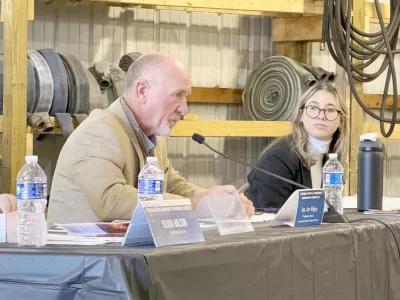
During an informational hearing Friday at the Cambria County Regional Firefighters Association's regional training academy in East Carroll Township, members of the state House Veterans Affairs and Emergency Preparedness committee heard testimony from local first responders about firefighter training, recruitment and retention efforts across the state.
The hearing was hosted by state Rep. Jim Rigby, R-Cambria/Somerset, who said the goal was to give the committee a better understanding of what the association does and how it needs to be funded.
Rigby said he wants to secure $30,000 for the association, so that any of the first responders from the 84 fire departments in the training academy's 10-county region can obtain the training they need to become a firefighter.
"They're sitting on a bill of over $18,000 from this past year's trainings," Rigby said of the firefighter association, which holds annual fire academy weekends in April to provide hands-on training classes for career and volunteer firefighters across the region. Participants who complete classes at the fire academy site and/or Cambria Heights High School then earn state certifications through Bucks County Community College.
When Rigby joined the Ferndale Volunteer Fire Company in 1977, there were more than 300,000 volunteer firefighters in Pennsylvania, he said, noting there are fewer than 36,000 almost 50 years later.
That's a problem state officials need to address, Rigby said, adding he heard reports that a firefighter wanted to go through the academy this year, but that person reportedly wasn't able to obtain training, due to a lack of funding.
"If we're turning people away that want to be firefighters and not (letting) them get the training they need, that's (a) shame on us," Rigby said, noting
volunteers shouldn't have to pay out of pocket for their training.
"A little extra money could go a long way," Rigby told the committee. "We should make sure that they get the training they need, so that they can protect our communities."
In his testimony, Randal "R.J." Wilson, a Pennsylvania certification coordinator for the association and a former fire chief of the Reade Township Volunteer Fire Department in northern Cambria County, said many small and financially-strained fire departments are being asked to carry the weight of full-time emergency services without the funding, staff or training infrastructure required to do it safely.
"Here's the reality in rural Pennsylvania: in many rural communities, the fire department isn't just the first line of defense; it's the only line of defense," Wilson said, adding many of those same communities are economically depressed, with shrinking tax bases, aging populations and limited revenue.
Reade Township, for example, covers an area of about 40 square miles in the northeastern part of the county and has only about 400 houses, according to Wilson.
When he was the fire chief, Reade Township Volunteer Fire Department operated on a total annual budget of $35,000, Wilson said, noting the department had to keep its lights on, fuel its trucks, maintain aging apparatuses and purchase gear with a third of that funding.
"Volunteers are paying out of pocket for gear and training, and it's very expensive," Wilson said.
In order to obtain the entry-level firefighter I certification, volunteers must first certify as a support firefighter, which costs about $230, Wilson said.
Then, they must complete a first aid and CPR course, which together could cost upward of another $100, he said.
"Only then are they eligible to pay for the firefighter I exam, which is another $230. That does not include the cost of the training itself, which can push the total investment up to $1,000 per firefighter," Wilson said.
For a rural department operating on a $35,000 annual budget, those costs are "staggering," especially if volunteers struggle with the coursework and have to retake exams, Wilson said, adding every firefighter from the department in the last three years received their training through private donations that were made to the firefighter association.
"Reade has no budget, zero, to train these people -- not less, not limited, but none at all," Wilson said. "If those donations disappeared tomorrow, our training would stop instantly."
Northern Cambria Community Development Corp. Executive Director Matt Barczak, who is also the Hope Fire Company of Northern Cambria's first assistant chief, said it's important for the committee to understand what fire departments have to endure outside of training costs.
According to Barczak, a firetruck Northern Cambria purchased for $750,000 in 2020 costs about $1.6 million today, and many of their fundraisers aren't making as much money as they used to.
"We live in a world where firefighters are not firefighters," Barczak said, noting fire departments don't fight as many fires as they once did. But they're now called upon to assist ambulance agencies and municipalities that are both struggling with their own manpower.
As a result, firefighter training is more critical than ever, said William Lehman, who is the association's training chairman.
According to Lehman, Pennsylvania led the nation in civilian fire deaths in 2025. Since 2023, the commonwealth has also led the nation in firefighter line of duty deaths, he said, noting New York and Texas are the only two other states that are that bad or worse.
"But if you look at per population served, our line of duty deaths in Pennsylvania far outrank both of those states," Lehman said.
Jim McCann, the city of Johnstown's fire chief, said the lack of training trickles down to the paid fire service, as paid departments like Johnstown rely heavily on volunteer fire departments for their recruitment efforts.
"We're unique in the city of Johnstown for the fact that we require a certain level of training to apply for a position within the city of Johnstown," McCann said. "When you see the decline in training and training dollars, it can affect our recruitment as well."
State Rep. Jared Solomon, D-Philadelphia, who chairs the committee, said he is committed to working with Rigby to ensure the association receives the funding it needs for training.
"We want to make sure that this here wasn't just folks blowing out air, but that we can actually get resources to this community. So, that's a pledge I want to make," Solomon said at the hearing's conclusion.
Mirror Staff Writer Matt Churella is at 814-946-7520.