
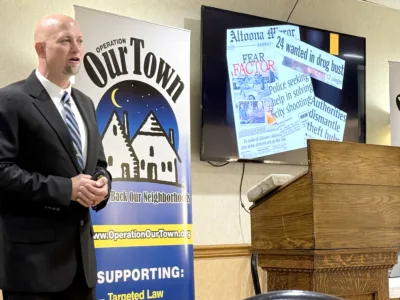
Blair County DA speaks at Operation Our Town event
Weeks discusses ongoing drug use issues at workshop
Trending
TYRONE -- One of the biggest myths about drug crimes is that they are isolated, victimless and nonviolent, Blair County District Attorney Pete Weeks said.
"I say this hoping you think it's funny and ridiculous, but I will tell you that our legislature thinks it's true because they keep saying it is in the laws that they pass," he said.
Weeks and others discussed ongoing drug use issues during an Operation Our Town drug abuse workshop held Friday at the Tyrone Elks Lodge No. 212.
It's become popular to act as if drug crimes have no impact on communities, Weeks said, but that's simply not true.
To help stem the tide of crime caused by drugs in Blair County, a group of business owners came together years ago to form Operation Our Town. The premise was to fight the drug use that led to violence, blight, homicides and shootings.
Weeks estimates that over 90% of nondrug crimes -- like murder, assault and rape -- are impacted by the use or sale of drugs, and he noted that fentanyl and methamphetamine are the two biggest illegal drugs that are trafficked and abused.
Weeks gave the workshop's opening presentation alongside Tom Brandt, regional director of the state Office of Attorney General, and Andrew Crist, a supervisory narcotics agent for the attorney general's office.
Blair County is fortunate to have a drug task force run by the attorney general's office, Weeks said, noting the program is in partnership with local police departments and the district attorney's office.
Proactive response
The unique thing about drug offenses is they can be investigated proactively -- either buying drugs from dealers and arresting them or by intercepting dealers from coming back into the community with large amounts of drugs, Weeks said.
That's huge for two reasons, according to Weeks, who said the drugs seized by officers are put into an evidence room and therefore don't get used or cause overdose deaths. Secondly, the vast majority of homicides in Blair and Cambria counties are drug-related, Weeks said.
"If you arrest the drug dealers dealing drugs and put them in jail and send them to a state prison, they can't shoot anybody on the street," Weeks said, noting dealers will cause other crimes of violence if they're out selling drugs in the community.
Since drug dealing is illegal, fentanyl dealers can't call State Farm to inquire about their best insurance packages, Weeks said, adding there are lots of ways for drug dealers to lose money.
The police can take the drugs or the people who use their drugs cannot afford to pay them, which happens a lot, Weeks said.
"There's something in drug trafficking called fronting where I give you drugs, you go out and sell them, and you're supposed to pay me back. Well, when you're dealing with crackheads and fentanyl addicts, they don't always remember to pay you back," Weeks said, adding the enforcement mechanism drug dealers use to protect against losses is violence.
While many businesses compete against each other, drug dealers can't run Super Bowl halftime commercials to sell drugs and protect their market, so they often shoot other drug dealers, Weeks said.
Proactive enforcement
Proactive enforcement of drug crimes can be really effective at lowering other types of crime, Weeks said, noting if there are two guys hanging out at 2:30 a.m. in front of a closed business, a good police officer will approach them and ask questions.
A lot of times, encounters like that will turn into drug seizures, Weeks said.
"The big thing is that in these types of cases, the judges usually don't let us tell you about 90% of what these guys know," Weeks said.
When a case like that is presented in court, Weeks said police will often say they stopped "Bob," who was nervous and gave deceptive answers, so they got a K-9, did a search warrant and found drugs.
"What we're not allowed to tell you is Bob was on parole for selling drugs, Bob had eight prior drug convictions and we had information from three different people that Bob is coming back and forth from Pittsburgh with drugs," Weeks said.
In other instances, officers use confidential informants -- typically lower-level drug dealers who are in trouble with the law -- to make controlled purchases from their suppliers, leading to additional arrests, Weeks said.
Tyrone Borough Mayor John Harlow asked how long do officers typically use confidential informants. Brandt said it's all dependent on how many targets they can do with each informant.
"We've had informants that have been active for over a year, some up to two years. But generally speaking, three to six months," Brandt said.
"From my perspective, the shorter the better," Weeks said in response to Harlow.
Event: held in response to deaths
Friday's event also featured presentations from Altoona police officer and K-9 handler Stephen Fox, Duncansville Borough Police Chief Rodney Estep and drug and alcohol counselor Michael LaRocco.
It was Operation Our Town's sixth drug abuse workshop in the Tyrone area, said Sue Griep, a member of the organization's steering committee.
"One of the reasons why we decided to do this workshop this year is if any of you remember that we had three overdose deaths last year in the borough," Griep said during her opening remarks. "We thought it was important to get the correct information and hear it from the people who are on the front lines."
In response to an attendee's question about those deaths, relating to the police department's accountability, Weeks said police officers need sufficient probable cause to arrest people and cannot make arrests based on suspicions alone.
Brandt noted he couldn't think of another police chief in Blair County whose department has been more active with the drug task force over the last two years than the Tyrone Borough Police Department and its chief, Jessica Walk.
"She is very integral in getting her people involved with the community from that aspect," Brandt said of Walk.
Weeks reiterated Brandt's comments, noting when they went around to all of the local chiefs and talked about their plan for interdiction a couple years ago, the Altoona Police Department said they were on board, and every other police chief originally said they weren't on board with their ideas, except for Walk.
"She has done, with all the resources that she has, everything that she can," Weeks said of Walk. "But that case was especially complicated because when we work with other agencies, especially federal agencies, we have to follow their rules."
Mirror Staff Writer Matt Churella is at 814-946-7520.