
Altoona Area School District graduate helped US put Americans in space
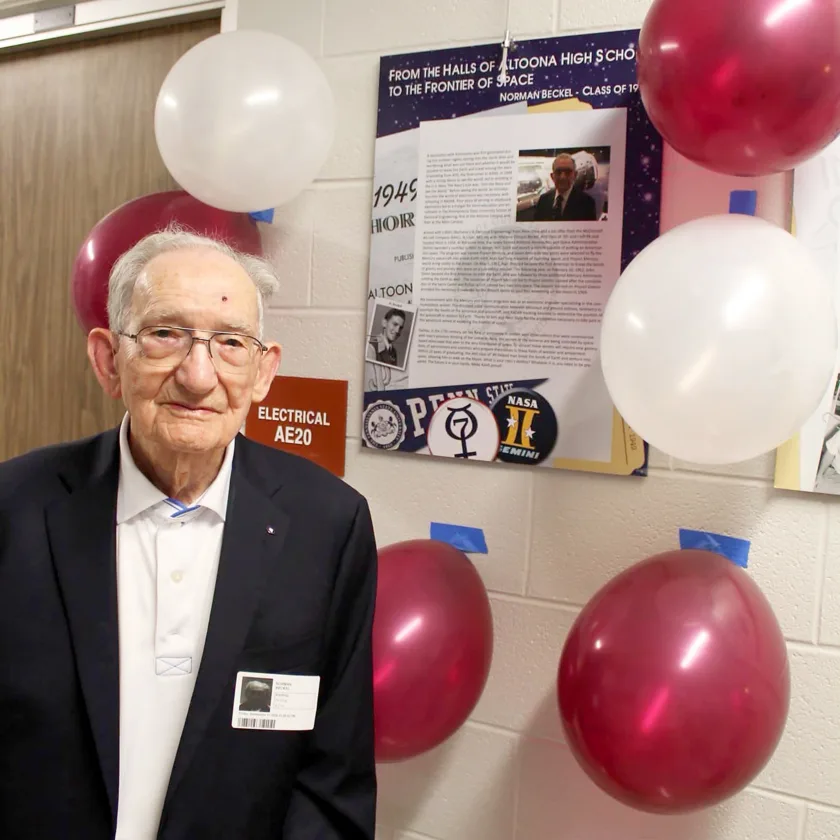
Norman Beckel Jr. is part of the Altoona Area School District’s Alumni in Astronomy wall inside the Neil Armstrong Planetarium. He worked for McDonnell Aircraft Corp., which was contracted by NASA on Project Mercury to design, build, test and launch a vehicle capable of putting an American into space. Courtesy photo
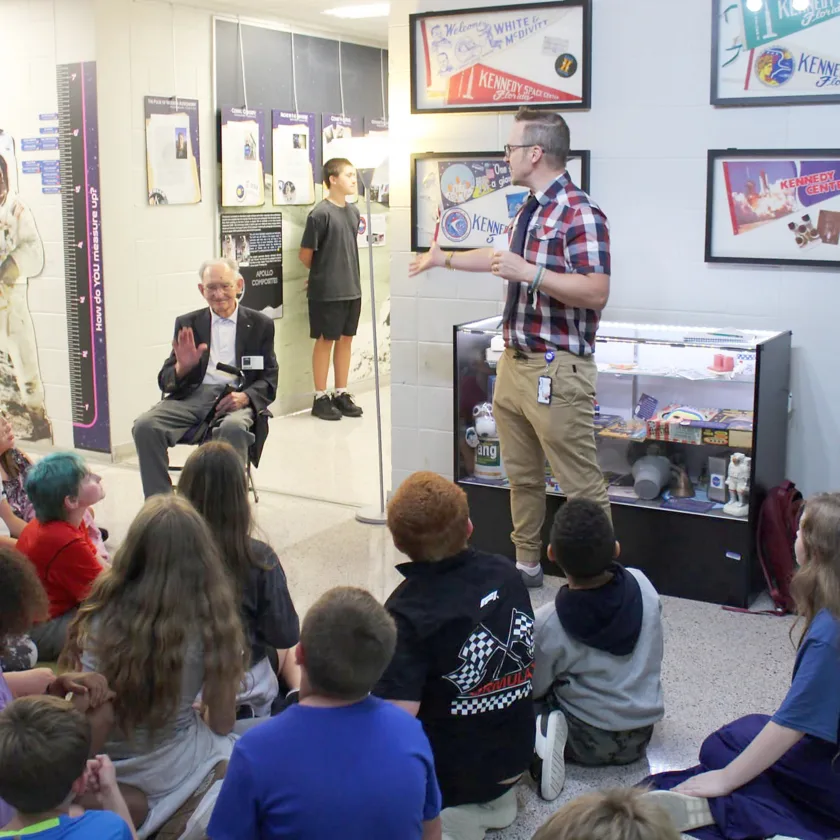
Neil Armstrong Planetarium Director Jim Krug (standing) introduces Norman Beckel Jr. to a group of Juniata Elementary fifth graders during a recent visit. Beckel, a 1949 graduate of Altoona Area, answered questions for the students about his role in Project Mercury before watching a sky show with them at the planetarium. Courtesy photo
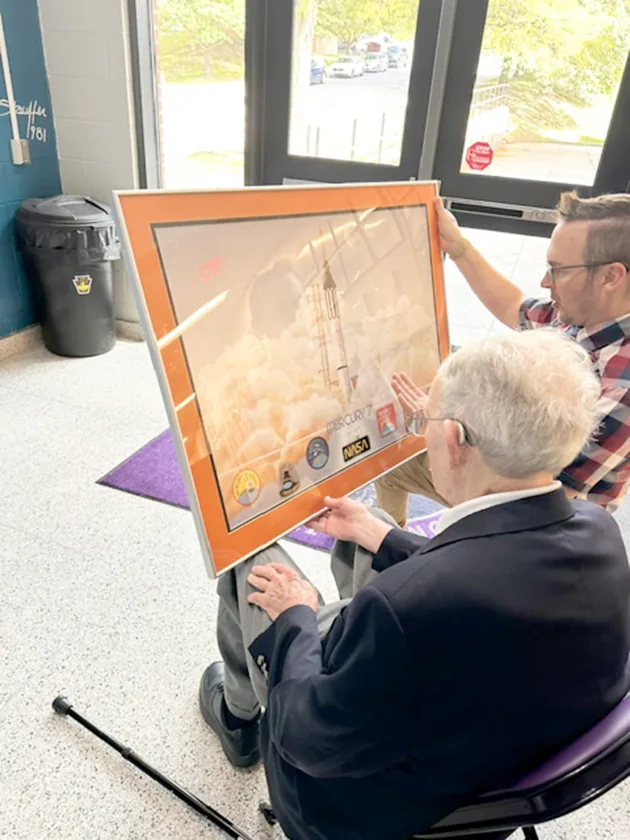
Neil Armstrong Planetarium Director Jim Krug showed Norman Beckel Jr. some special lithographs signed by NASA Mercury, Gemini and Apollo astronauts during Beckel’s recent visit to the planetarium. Courtesy photo
Norman Beckel Jr. is part of the Altoona Area School District’s Alumni in Astronomy wall inside the Neil Armstrong Planetarium. He worked for McDonnell Aircraft Corp., which was contracted by NASA on Project Mercury to design, build, test and launch a vehicle capable of putting an American into space. Courtesy photo
Neil Armstrong Planetarium Director Jim Krug (standing) introduces Norman Beckel Jr. to a group of Juniata Elementary fifth graders during a recent visit. Beckel, a 1949 graduate of Altoona Area, answered questions for the students about his role in Project Mercury before watching a sky show with them at the planetarium. Courtesy photo
Neil Armstrong Planetarium Director Jim Krug showed Norman Beckel Jr. some special lithographs signed by NASA Mercury, Gemini and Apollo astronauts during Beckel’s recent visit to the planetarium. Courtesy photo
Trending
Sixty-nine years ago last Sunday, Oct. 4, the Soviet Union launched Sputnik 1, the first artificial satellite to orbit the Earth, marking the start of the Space Age and the first significant milestone in the space race between Russia and the United States.
In 1958, the following year, McDonnell Aircraft Corp. was selected to design, build, test and launch a spacecraft for Project Mercury, with the goal of putting an American into space.
Since Russia had already put a satellite in space, putting an American in space became a high priority, according to Norman Beckel Jr., who was a communications engineer for McDonnell at the time.
Beckel traces his roots back to Altoona, having grown up in the city's Juniata neighborhood. He was a 1949 graduate of the Altoona Area School District.
After high school, Beckel joined the Navy and later earned an engineering degree from Penn State University in 1958. After college, he moved his family to St. Louis, Missouri, to work for McDonnell and has basically lived there ever since, with the exception of a few years he lived in Florida.
Beckel said McDonnell's crew worked on the Mercury spacecraft for about a year until 1960, when most of the crew was transferred to the Cape Kennedy area of Florida to launch the first mercury rocket.
First, they launched an unmanned rocket, but they later launched a chimpanzee named "Ham" into space, Beckel said, noting it was all done with a Redstone rocket off of pad five, which was controlled by a team from Huntsville, Alabama, he said.
Then, in May 1961, just weeks after Russians put the first human -- Yuri Gagarin -- in space, the United States launched astronaut Alan Shepard into space on a 15-minute suborbital ballistic flight that reached a peak altitude of about 116 miles.
"They recovered Alan and the spacecraft downrange several hundred miles," Beckel, 95, recalled.
According to NASA's website, the spacecraft landed safely in the Atlantic Ocean and was recovered by a Marine Corps recovery helicopter from a Naval aircraft carrier.
Then, in August, Beckel said they successfully launched the second astronaut in Project Mercury, Virgil "Gus" Grissom.
Unfortunately, Grissom's spacecraft was lost because valves were not shut to keep seawater out, Beckel said, noting the spacecraft filled with water and sank, but Grissom was recovered.
Then, in February 1962, their attention turned to launching the first astronaut on the Atlas booster rocket, John Glenn, Beckel said, noting the Atlas was a transcontinental missile adapted for carrying the Mercury spacecraft into orbit.
Glenn was launched successfully and completed three orbits around the Earth, making him the first American to go into orbit, Beckel said.
After that came a series of five more Mercury launches, with each one being a little more challenging than the last, Beckel said.
The final astronaut to fly in Project Mercury was Gordon Cooper, Beckel said, noting Cooper spent "just about a whole day in space." That took place in May 1963 -- about six months prior to President John F. Kennedy's assassination.
Over his 34-hour flight, Cooper did 22 orbits, which was "really stretching it for a Mercury capsule," Beckel said, noting a Mercury capsule was "very unsophisticated," much like the Ford Model T was in the automobile industry, he added.
Gemini
McDonnell also got to partake in the Gemini project, NASA's second human spaceflight program that paved the way for the Apollo 11 moon landing in 1969, which then fulfilled Kennedy's challenge to NASA to land a man on the moon before the decade ended, Beckel said.
"Gemini was completely different," Beckel said, adding everything was analog on Mercury, while everything was digital on Gemini, which was named after the constellation because the spacecraft used in Gemini, a Latin word for "twins," carried two astronauts instead of one.
The goal of Project Gemini, Beckel said, was to learn as much about human exploration in space as possible before taking that "one giant leap for mankind."
It included a lot of extravehicular activity -- any work an astronaut performs outside of a spacecraft in the vacuum of space, Beckel said.
"One of the astronauts opened the doors in space, and one of the astronauts would get out and do some cursory work," Beckel said, adding they couldn't stay out very long on Gemini like they did later in space shuttles.
"On Gemini, what we were really trying to prove is that we could rendezvous two vehicles in space, meet them up, which would have to be done to recover people who went to the moon," Beckel said.
When Neil Armstrong and Buzz Aldrin walked on the moon, they had to rendezvous with the Apollo spacecraft, which was something that was proven could be done on NASA's Gemini spacecraft, Beckel said.
None of the astronauts were killed on Mercury or Gemini, Beckel said.
However, the first Apollo vehicle had a fire during testing that killed three of the astronauts, two of which were also part of Mercury and Gemini, he said.
McDonnell's role
The Mercury spacecraft was already well designed by the time McDonnell got the contract from NACA, the National Advisory Committee for Aeronautics, which was the predecessor to NASA, Beckel said.
"Our job mostly was to build what we had proposed," Beckel said. "That was not a straight line because every day we learned something different."
As the communications engineer, Beckel's systems basically included all radio frequency systems, including UHF, or ultra high frequency voice communications.
"We had command receivers on there where the ground could command different functions to occur in the spacecraft, and we had C bands and S band radar beacons," Beckel said, adding they had kilometer transmitters, too.
"One of our big design projects once we got the contract was to design test equipment that test the spacecraft," Beckel said. "So, I was intimately involved in designing the spacecraft and then when we launched, there would be a launch crew that we selected that would be in the blockhouse."
Beckel said he was McDonnell's capsule communicator for Alan Shepard's launch, the first American to travel into space. Then he transitioned over to the Atlas program, which aimed to put a man into orbit.
When they were working on the Mercury program, they didn't have time constraints and could launch the spacecraft at any time of the day, Beckel said.
"When we got to Gemini, we didn't have the freedom," Beckel said, noting the spacecraft could only launch at a certain time of the day because they had to launch two vehicles -- the Agena and the Atlas -- and do so in a way that they could rendezvous in space.
"To get those rendezvous, it was like an energy equation, so if you didn't launch at precisely the right time, you would burn an awful lot of fuel," he said.
The whole spacecraft program was like building blocks -- each mission built on the previous one and became more sophisticated over time, he said.
Beckel retired in 1994, after about 37 years of service to McDonnell, which merged with the Douglas Aircraft Company in 1967 to form the McDonnell Douglas Corporation. McDonnell Douglas then merged with the Boeing Company in 1997.
Visit to Altoona
Beckel, who turns 96 in December, recently returned to the area for a wedding last month and visited the district's Neil Armstrong Planetarium, where he answered questions for a group of Juniata Elementary fifth graders and watched a sky show with them.
"They were bright and alert, and they asked very good questions," Beckel said, adding a lot of times when he talks with elementary children, they often ask him how astronauts used the toilet or what he ate for lunch.
The Juniata Elementary students were more interested in the Mercury program and the role he played in it, Beckel said. "They were quite active, and (James Krug, the planetarium's director) is quite a teacher -- he had those kids eating out of his hand. It was a good afternoon."
Beckel is immortalized with a plaque as part of an alumni in astronomy wall in the planetarium, according to a district Facebook post made about his visit with the students. Krug said that initiative began in 2017 when he met Nancy McClelland, Beckel's niece, and learned about his contributions to the country's space programs.
When Beckel visited the planetarium in September, it was he and Krug's first in-person meeting, Krug said, noting after the students left, he spent some time with Beckel while he waited for his family to bring their car around.
Krug showed Beckel special lithographs signed by NASA Mercury, Gemini and Apollo astronauts -- something Beckel said he really appreciated seeing.
"Norman exudes the academic and career excellence embodied in many Altoona Area High School graduates," Krug said of Beckel. "He built an excellent foundation here in the late 1940s and used that platform to launch to heights most consider impossible."
Krug said he enjoyed learning personal stories from Beckel that history doesn't record, including that the United States could have beaten the Soviets and Sputnik 1 into space.
"It was so enjoyable to watch Mr. Beckel reminisce about a time in which American pride and achievement was so high, and he was a big part of it," Krug said.
While the 1960s was "a phenomenal decade," Beckel pointed out that at the same time as scientific advancements were being made, there were several assassinations -- including Kennedy; his brother, Robert F. Kennedy; and civil rights activist Martin Luther King Jr. -- and a lot of rioting.
"It's hard to believe that at the same time we were working on all this and advancing mankind, we were also bitterly engaged in divisiveness," Beckel said. "Man is a complex animal."
In today's America, where there's a lot of news about political unrest and violent shootings seem to occur too often, progress carries on in the meantime, Beckel said, noting his iPhone reportedly has more computer power in it than what the people who went to the moon had in their spacecraft.
"When I was a youth, the schools taught me the state of the art at that time, and now that state of the art is pretty crude, and the cars we drive are nothing like the Model T," Beckel said, adding advancement is just part of "man's inquisitive nature to always wonder what's on the other side of the hill."
"Man is pretty good at inventing things, and if we have a solution with no problem, man will create a problem to use the solution," Beckel said, adding he's fascinated with the advancements in technology today.
Bob Beckel, Norman's cousin, said the Beckel family is "very proud of what Norman was able to do with his life."
"He was always in everybody's minds and hearts because of what he did," Bob Beckel said, adding, "I'm not a rocket scientist, but my cousin is."
Mirror Staff Writer Matt Churella is at 814-946-7520.
The Beckel file
Name: Norman Beckel Jr.
Age: 95
Education: Altoona Area School District, Class of 1949; Penn State University, engineering degree, Class of 1958
Work: He was part of the team that worked for McDonnell Aircraft Corporation, which was contracted by NASA on Project Mercury to design, test, build and launch a vehicle capable of putting an American into space. He retired in 1994.
Residence: St. Louis, Missouri
Hobbies: He enjoyed golfing and cycling in his day. Attending church remains an active part of Beckel's life.