
Model citizens: Model train association helps to keep city’s railroad culture alive
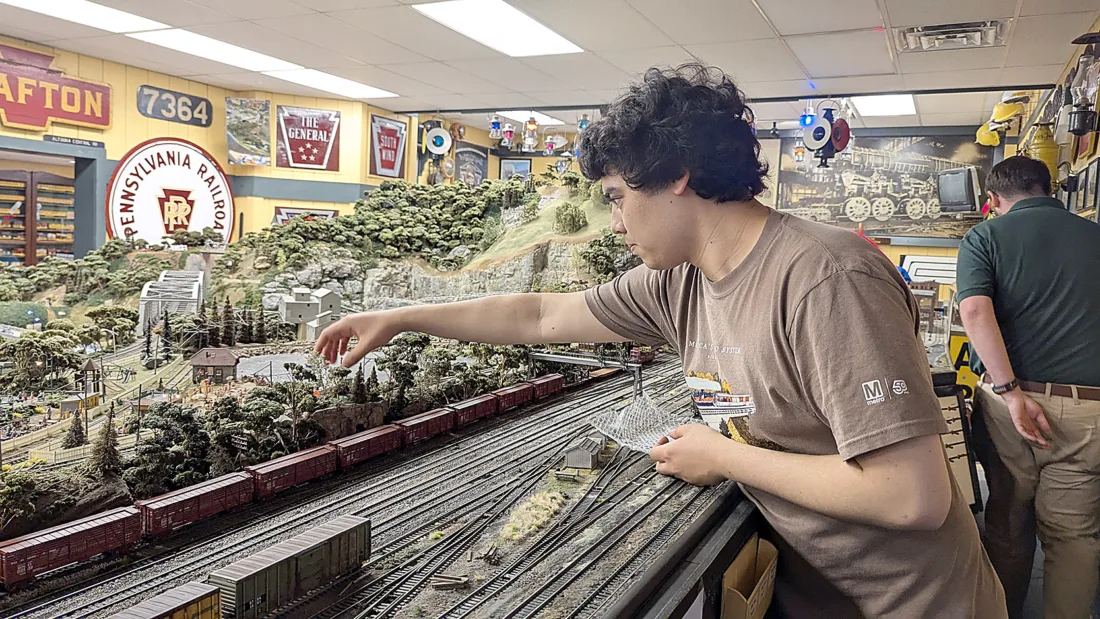
An Altoona Association of Model Railroaders member adjusts scenery on the HO-scale layout. Mirror photo by Rachel Foor-Musselman
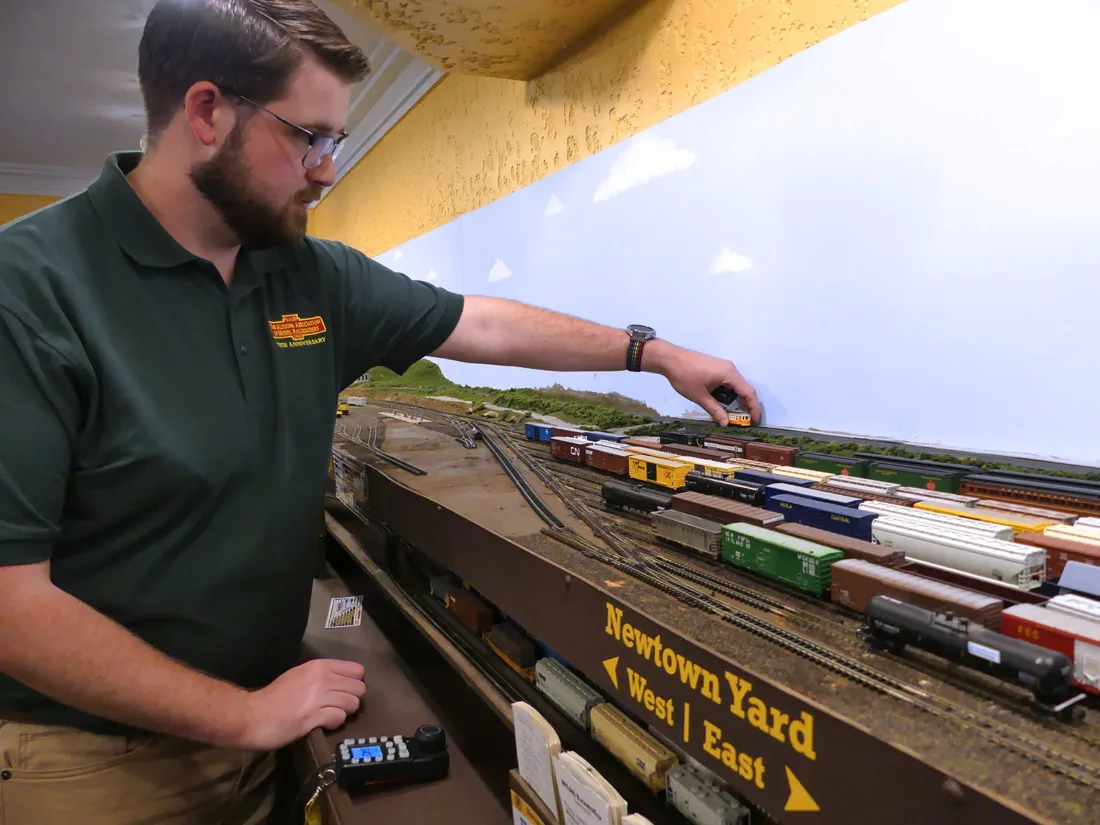
Altoona Association of Model Railroaders Secretary Zach Rudisill carefully places a trolley car on the N-scale layout in the downstairs portion of the group’s South 10th Avenue building. Mirror photo by Rachel Foor-Musselman
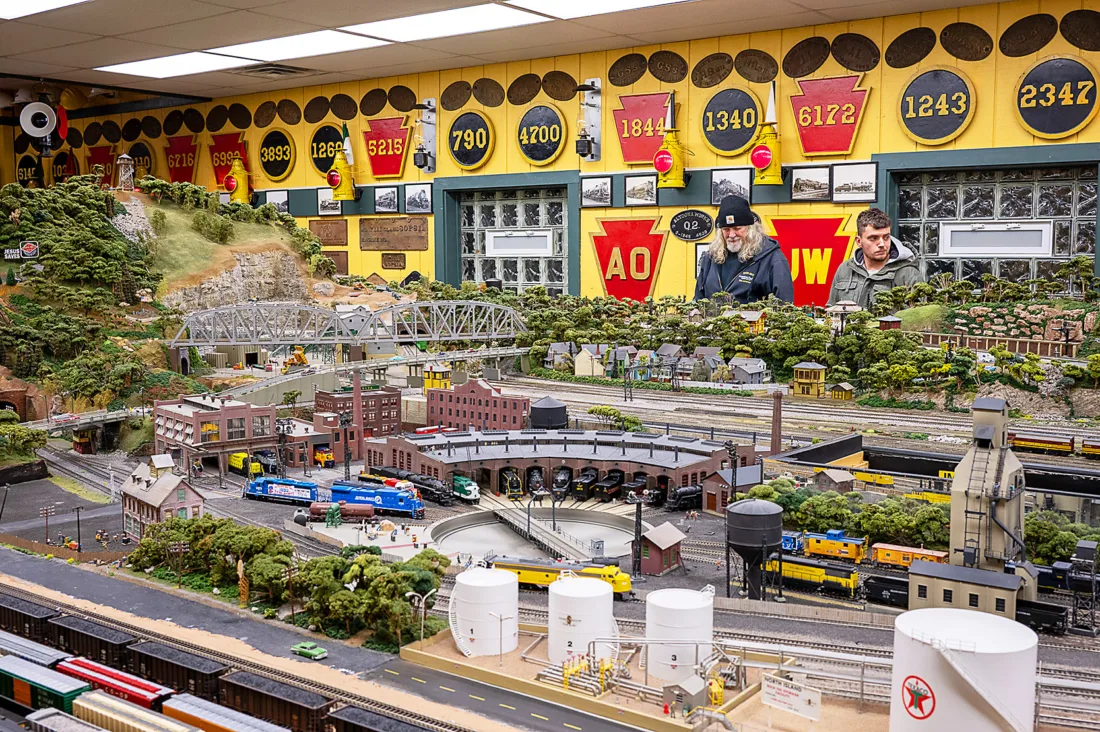
Altoona Association of Model Railroaders members overlook part of their HO-scale layout. Mirror photo by Rachel Foor-Musselman
An Altoona Association of Model Railroaders member adjusts scenery on the HO-scale layout. Mirror photo by Rachel Foor-Musselman
Altoona Association of Model Railroaders Secretary Zach Rudisill carefully places a trolley car on the N-scale layout in the downstairs portion of the group’s South 10th Avenue building. Mirror photo by Rachel Foor-Musselman
Altoona Association of Model Railroaders members overlook part of their HO-scale layout. Mirror photo by Rachel Foor-Musselman
Trending
If you asked 100 model train enthusiasts what makes the hobby special, you would never get the same answer twice -- and that is especially true at the Altoona Association of Model Railroaders, whose members have spent more than 75 years helping to keep the city's train culture alive.
"There are so many layers to the hobby that provide different pathways to enjoy it," said Joey Carter.
A Baltimore native, Carter joined the association in 2021 while a freshman in Penn State Altoona's rail transportation engineering program and remains an active member.
"You can be a hardcore photographer/train chaser, or you can take the laid back approach and just sit by the tracks to watch the trains go by," Carter said. "You can be a prototypical modeler and make everything as accurate as possible, or you can do whatever you want and make everything completely fictional. You have the freedom to choose how you enjoy the hobby, and it's fun to explore all the subcategories of being a train enthusiast that go far beyond the surface-level interest."
Carter graduated from Penn State in 2024 and now works as a freight and passenger conductor for the Everett Railroad Co. in Hollidaysburg. He jokes that, even after spending all day working on real trains, he still needs to get his fix "running the tiny trains, too."
"I have my own collection of model trains that I run on the club layouts," Carter said. "I think everyone is at least a little bit fascinated by trains in some way. It's like letting out your inner child."
Association Secretary Zach Rudisill agreed that "the fun part about model railroading is you can do a little bit of everything."
Rudisill said the association has members who enjoy woodworking and electrical work, and noted that 3D printing has become a big part of the hobby, too.
"There's something for everyone," Rudisill said. "There are people who just like to run trains when we have open houses. Then you have people like Carl, who's the layout superintendent. He doesn't really care to run them, but everything underneath, the electrical and everything, that's his wheelhouse."
Carl Haslett was born and raised in Altoona and retired in the area after working as an electrical engineer in New Jersey for about 45 years. He was heavily involved in a model train club in New Jersey and brought his expertise back to the association with him.
Haslett is pretty flexible when it comes to the layout itself, but likes to make sure it remains "presentable" and in "good quality."
"That's another side of it, is someone really into the painting and into the miniatures and not so much into the trains but producing the city scene, the hobby helps people like that have a home for items they might create," Haslett said. ""It's not like you end up with 50 electrical people, there's always a mix of people to make the layout look nice and run nice."
Creativity housed inside
All of these types of train enthusiasts come together at the association, in a gray, non-descript two-story building that sits along South 10th Avenue in the city. Its exterior belies the creativity housed within its walls as once visitors open the door to its first floor, they are greeted by a 15-foot by 30-foot N scale layout, while upstairs is a 22-foot by 50-foot HO scale layout.
An N scale layout is 1:160 scale, according to the National Model Railroad Association. Model railroads can range in size from the smallest at Z scale, which is 1:220, to the largest at O scale, which is about 1:45. The HO scale is also known as the "half O" and comes in at about 1:87.
The N scale layout set up in the Altoona Association's first floor was built by Jim Brown in his Clearfield County basement, said Rudisill.
"One of our senior members worked on the layout when he was a kid," Rudisill said. "They just stayed friends and all and when Jim passed, his widow contacted Tim and said 'hey, you can have this layout if you can move it.'"
The members got a truck and moved the layout, Rudisill said, but everything was "a little bit narrower because it was in a basement" so they "expanded some of the highways."
"But other than that, for the most part, it's pretty much the same track layout," Rudisill said.
His favorite part of the layout is a house with a removable roof and has an N scale model of the layout that was housed in Brown's basement on the inside, Rudisill said, adding that the model was Brown's idea.
Rudisill pointed out different sections of the layout, which featured names like Bendville, Titefitt, Evanmore and Katesburg.
"This town is Evanmore because it's the later part of the layout," Rudisill said. "As he was building it, his wife walked downstairs and said 'you're building even more?'"
Titefitt was split into two, with North Titefitt and South Titefitt created to "fit" around the boiler in Brown's basement, Rudisill said.
"The fun part about model trains is the layout's never done," Rudisill said. "It's a neverending cycle."
About once a semester, or twice a year, Rudisill said the association members will put on headsets and use radios to coordinate trains on the layout.
"Like, you can't go on the main line, you have to call the dispatcher to get permission, schedules and everything," Rudisill said. "It's a really fun time."
Show is now international
Founded in 1949, the association has expanded to include an "N-Scale Weekend Train Show," now held at the Blair County Convention Center, Rudisill said.
The show was started by Mike Phillips of Bedford County "a little over 20 years ago," Rudisill said. It was initially held in a fire hall but it kept expanding and getting "bigger and bigger."
When the COVID-19 pandemic hit, the show was being held every year at the Jaffa Shrine. In 2022, Rudisill said Phillips reached out to the association and asked for help running the show.
"We took it to the convention center," Rudisill said. "We had about 600 attendees that year. This past year we had 1,300 attendees, so we've about doubled it."
The show itself has become international, as they have welcomed visitors from places like Ontario, Germany, Panama, the UK, Cuba and Australia. What sets it apart from other model train shows is that the N-Scale Weekend is exclusively for N scale model trains and layouts, Rudisill said.
"A lot of the bigger shows, like in Pittsburgh, they have all scales, OH, G, everything," Rudisill said. "There is not a lot of N scale."
It is at these shows that a lot of creativity is shown, with Haslett saying he's seen layouts featuring everything from dinosaurs to SpongeBob SquarePants. A particularly notable layout had the Philadelphia Eagles' stadium in its background and the train delivering goods.
"I don't care if Thomas the Tank engine runs around the layout," Haslett said. "I'm not dedicated to it being so realistic. Let people express themselves."
This, Haslett said, ties back to model railroading still being a growing hobby, especially with the aid of 3D printing.
"It is phenomenal, the level of detail you can get," Haslett said. "I was really impressed by some of the things I saw."
Carter echoed these sentiments, saying it's "wonderful to see it continue to grow over the past few years."
"You don't have to be a hardcore train enthusiast to enjoy the show and appreciate the various model railroad displays that really showcase the hobby at its best," Carter said. "It's the highlight of our year."
A community for all
While model railroading is fundamentally about trains and layouts, some could argue what lies at its core is cultivating a community and crossing generational divides. As spaces for young people continue to disappear, places like the association offer somewhere for students, especially those in the rail transportation engineering program, to gather.
"It's neat to have the diverse range of membership between the college students all the way up to the retired folks who share the same interest that we can all bond over," Carter said. "I could go on and on about what makes this such a great hobby, but for me there's two specific things that stand out -- the people and the diversity."
Carter said model railroading gave him "so many amazing friendships over the years" that allowed him "to build plenty of close connections with other people who share my lifelong interest in trains."
"It's very easy to make friends in this hobby," Carter said, "and I've met so many wonderful people over the years that I still keep in touch with, no matter the distance between us."
As many of the members are college students, Haslett said he always tells them he is always there to help them out.
"Anything they have questions about or want to learn about, like soldering, installing electronics, I'm more than happy to share that with them," Haslett said.
It is a two-way street, as Haslett admits he "was never much of a software programmer."
"I was more of a hardware person," Haslett said.
A newer aspect of model trains is the ability to program them with sounds, Haslett said, so "they are teaching me" how to use the association's computer to program his own trains to make noise.
It's not just within the association that model trains bridge generations, but within the member's families themselves as Carter, Haslett and Rudisill each independently said it was a grandparent gifting them a model train at a young age that got them into the hobby.
Haslett, his grandfather's first grandson, said he was nine months old when he received a Lionel train set.
"That started it all."
Rudisill said his grandfather, who passed away when he was 2 years old, left him and his father train sets. He said his grandfather had a layout with a big loop that he would "always go down to play with."
Carter was about 1-2 years old when his grandmother gifted him his first "little electric toy train for under the Christmas tree," which he described as "the initial spark."
"From there, that initial fascination only grew with me over the years," Carter said.
To Carter, that fascination and interest in not only model railroading, but railroading itself is important to keep alive for a myriad of reasons, such as "the history and nostalgia."
"Railroading is a way of life, and for many families it spreads across generations," Carter said. "It provides a great sense of purpose knowing the work I do is meaningful, and I'm glad to know that there's so many other people out there who share an interest and appreciation for it."