
Local disaster recovery specialist recalls working 9/11
Maher was one of first on scene in NYC after first responders cleared devastation
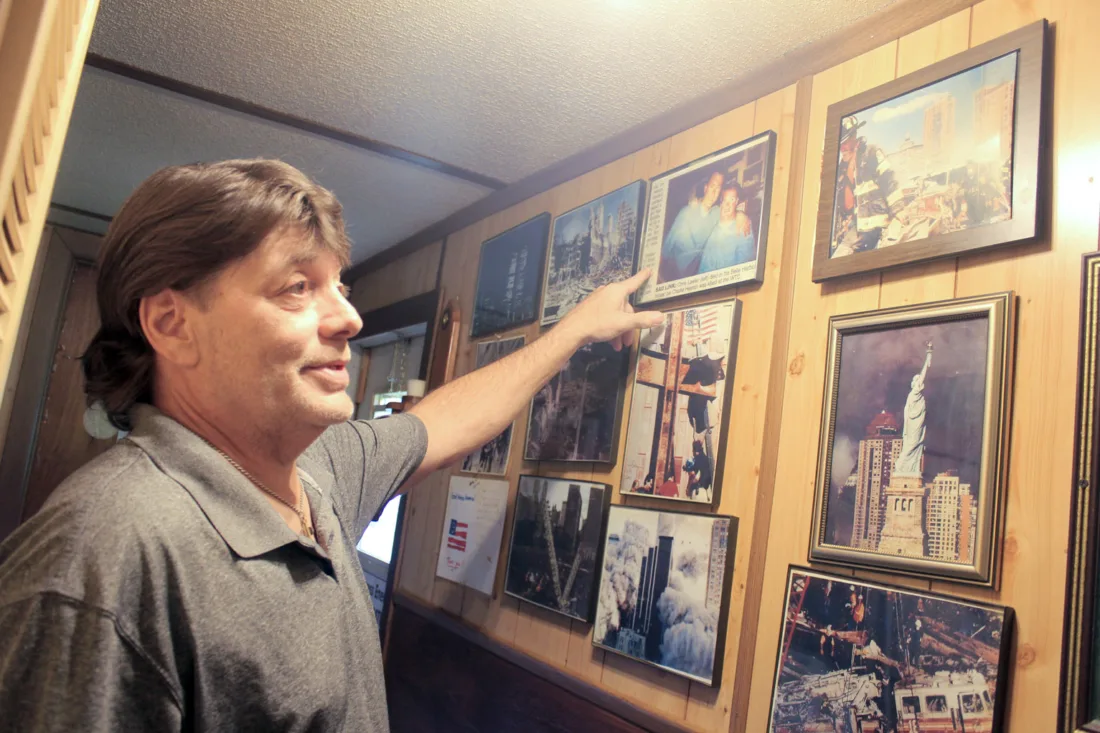
Mirror photo by Colette Costlow / Maher looks at his framed photographs, cards and memorabilia in his Saxton home from his time as a disaster recovery specialist during the aftermath of the 9/11 attacks.
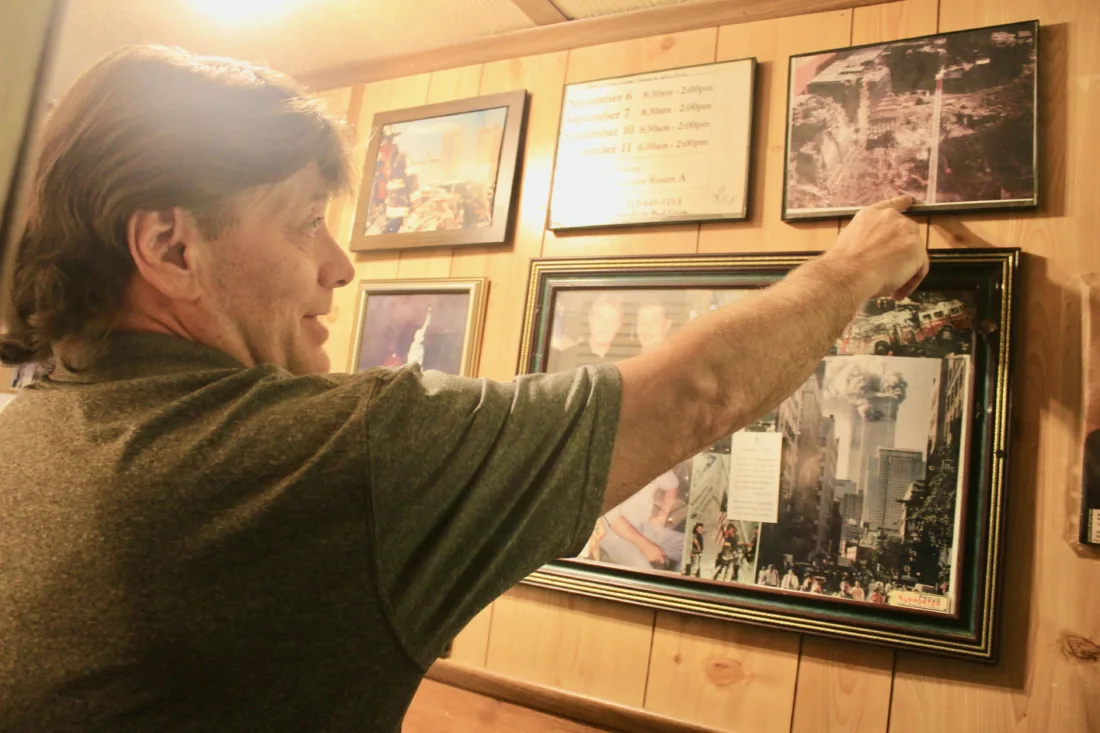
Mirror photo by Colette Costlow / Many of Maher’s original photographs feature the unseen aftermath of the Twin Towers, including the original photo he points to that shows what it looked like when people jumped from the building.
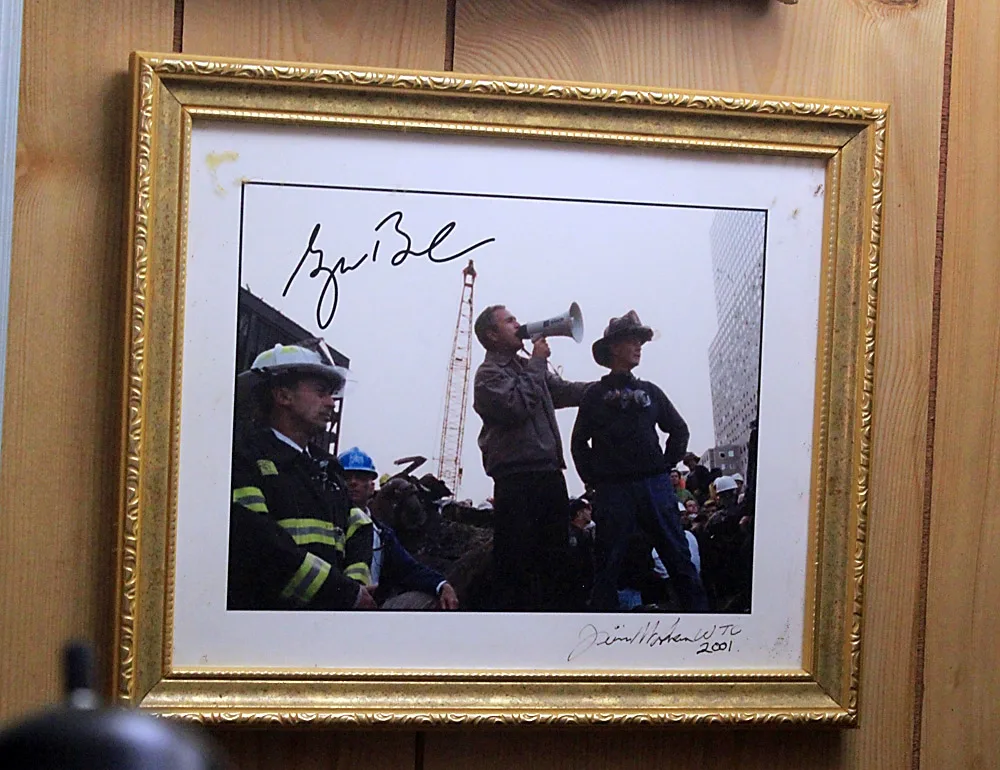
Mirror photo by Colette Costlow / Maher took a photo of President George W. Bush uplifting the 9/11 recovery workers. Maher’s men wore white hats in the picture.
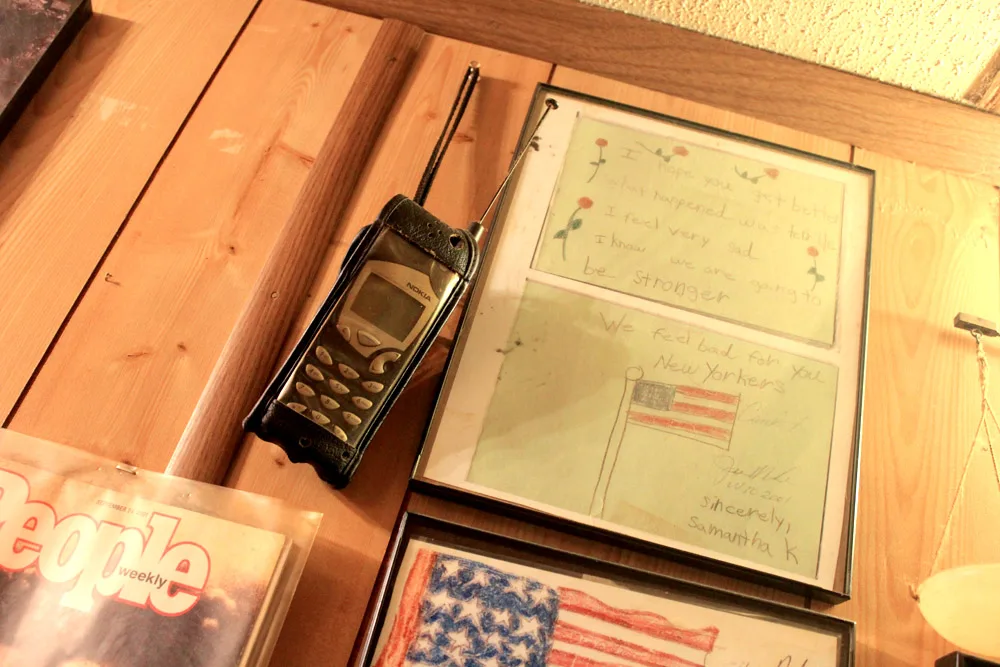
Mirror photo by Colette Costlow / Maher's phone used during his time on scene at the Twin Towers after the 9/11 attacks.
Mirror photo by Colette Costlow / Maher looks at his framed photographs, cards and memorabilia in his Saxton home from his time as a disaster recovery specialist during the aftermath of the 9/11 attacks.
Mirror photo by Colette Costlow / Many of Maher’s original photographs feature the unseen aftermath of the Twin Towers, including the original photo he points to that shows what it looked like when people jumped from the building.
Mirror photo by Colette Costlow / Maher took a photo of President George W. Bush uplifting the 9/11 recovery workers. Maher’s men wore white hats in the picture.
Mirror photo by Colette Costlow / Maher's phone used during his time on scene at the Twin Towers after the 9/11 attacks.
Trending
Altoona native Jim Maher remembered kissing his daughter goodbye before starting his job as Pennsylvania's first disaster recovery specialist in September 2001.
"I told her I would see her in six months, but I was gone for two years," he said.
Maher was moving into his office in Manhattan when two planes hit the Twin Towers. Twenty-four hours later on Ground Zero, he was given maps to recover as much material as he could from the two buildings.
"It (the attack) was the last thing I thought was going to come across my desk," he said.
During his time at the Twin Towers, he collected photos, cards and memorabilia, which now hang on walls around his home in Saxton. As the artifacts turned 25 years old this fall, Maher said the terrorist attacks of 9/11 are an important moment in history to remember.
"Let's hope it never happens again," he said.
Maher was the youngest of eight children born to Shirley Maher, who headed a food drive for the elderly and low-income families during the Thanksgiving season, according to past Mirror reports. Maher vividly remembered cleaning donated toys alongside his siblings for his mother's annual Christmas toy drive.
"Even though we couldn't afford nice gifts, we would clean gifts for other families," he said.
Since she contracted polio during her teenage years and was confined to a wheelchair, Maher recalled carrying his mother into restaurants. As a disabled person, she advocated for handicapped parking spots and helped make them a reality. Maher has a photograph of his mother holding Amy Carter, daughter of former President Jimmy Carter.
Maher's older sister, Mary Maher Barrows, said their mother taught them about compassion through giving back to the community.
"And probably Jim took it to heart more than the rest of the family," she said.
"She was very good at leaving her mark, and we inherited that from her," Maher said.
While attending Altoona High School, Maher also spent five years studying aviation electronics at the Naval Academy before eventually enlisting in the Navy. Family obligations called him home to his daughter.
Ground Zero
Working in disaster recovery, he eventually worked his way up to becoming Pennsylvania's disaster recovery specialist in November 2000, handling both man-made and natural disasters.
The terrorist attacks of 9/11 were his first assignment.
He initially believed the first attack was fake or something produced artificially until he looked around his office and noticed his co-workers' reactions.
"I spoke with more people in the office, and secretaries were weeping, and I thought, 'something is going on.' More than five minutes later, they were in my office, and I knew it wasn't going to be good," he said.
Already in New York, Maher had 24 hours to be on Ground Zero. His disaster recovery crew readied their equipment after first responders controlled the situation, he said.
"We honestly didn't think it would collapse," he said. "That was a complete game changer."
His first assignment was to gather personal belongings from the office workers who were killed in the Twin Towers. When he opened office doors, there wouldn't be a room but a space showing 40 stories below "because the rest of the building was missing," he said.
Maher was also part of the tunnel-dweller group that worked three stories beneath the Twin Towers. Some of the computers were still on because they received power from the backup generators. He was instructed to remove hard drives from 270 computers in the IRS office located on the third sub-floor.
Working 16-hour days, seven days a week, he had no vacation days or free time. Staying in a room at the Roosevelt Hotel in New York City, he often saved time by drawing a bath, soaking his work clothes in the water while eating a sandwich, then going to bed before waking for work again.
"I knew I was physically beat," he said. "It was like that movie 'Groundhog Day'; every day was the same."
While working on the wreckage, Maher also kept close in contact with two of his sisters, Barrows and Joyce Villani, updating them on his whereabouts and condition.
"We always stayed close and did a lot of praying," Barrows said.
Maher remembered riding the subway in his work clothes covered in ash. Looking up, he saw New Yorkers piling in with costumes. He didn't realize it was Halloween until a few passersby complimented his "costume," assuming Maher was dressed as a first responder.
Maher wasn't the only member of his family to provide disaster relief services following 9/11; his brother Todd also worked on the Twin Towers but in another group, while his brother Mike was in the Air Force and worked in the mortuary, preparing the bodies of those who lost their lives to the attacks.
"I know for years he tried to stay positive," Villani said. "They wouldn't watch the news or read the papers for years because it was too overwhelming."
After working on the Twin Towers for 90 days, Maher worked on another plane crash in November 2001, surrounding Queens, and disaster-recovery jobs on the East Coast piled up.
However, the post-9/11 dust and ash began to irritate Maher, along with other first responders working on Ground Zero. Diagnosed with asthma, he was put on steroids for 13 years before his lung condition worsened over time.
"I could climb 50 stories, but when I couldn't pass it, I knew something was wrong," he said.
Despite his health conditions, he worked as the state's disaster recovery specialist until he turned
42 years old. For 15 years, he's lived in rural Saxton with his wife, Annette, fishing and crafting silver and gold rings.
Lasting effects
Like other 9/11 first responders, Maher was provided with his own health insurance that completely covered hospital stays, medicine and his inhaler. He attends an annual physical to check for developing health issues.
In 2018, Maher fell and broke his back in three places while shopping at his local pharmacy. While recovering in a Pittsburgh hospital, he learned that his medically prescribed steroids were weakening his bones. He was told he had the bone health of an 84-year-old man.
Because of his newfound osteoporosis diagnosis, Maher couldn't undergo surgery and was later sent home in a back brace.
Maher has continued to deal with ongoing health issues, such as an asthma attack that sent him to a nearby hospital at 1 a.m. He provided his insurance card and was later thrown out for "impersonating a 9/11 first responder."
"They thought my insurance was made up," he said.
Maher never thought he'd have to struggle with his proof of presence as a disaster recovery specialist in the future, but he later found out that his company wiped records dating back 10 years.
Many 9/11 responders have died since the attacks, and Maher said he is the only Pennsylvania 9/11 representative alive from his group. As more co-workers passed away, it became more difficult for Maher to find people to vouch for his work at the Twin Towers.
However, he collected postcards, photos and even handmade cards written by middle school children across America during his time working on the aftermath of 9/11.
"I saved them (the handmade cards) because I thought they were adorable, but now these kids have kids of their own, and God forbid they go through anything like this," he said.
"That was a very hard undertaking," Villani said. "He really tried to help everyone, and he did his best."
While these photos and cards serve as a constant reminder to Maher of 9/11, Barrows said they also portray her brother's selflessness in action, helping others before helping himself.
"He's a bit of a family hero," she said.
Mirror Staff Writer Colette Costlow is at 814-946-7414.