
Court weighs adding legal protections in OD deaths
Trending
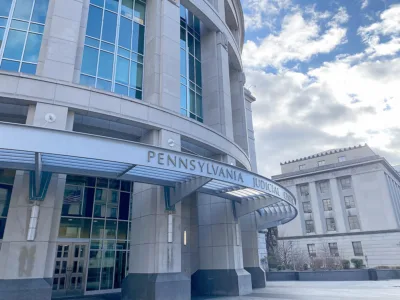
HARRISBURG -- The Pennsylvania Supreme Court is weighing whether to add new legal protections for defendants accused of providing drugs that caused a deadly overdose.
A decision from the state's highest court could address a frequent criticism of these overdose death prosecutions: that they target fellow drug users instead of high-level dealers.
But some justices appeared skeptical that they -- and not the legislature -- have the power to change how the law works.
"This case was definitely overcharged and definitely oversentenced," Justice David Wecht said in arguments earlier this year. "But I don't see how we can do anything about it."
The cases highlight the emotionally charged issue in Pennsylvania, where supplying drugs in fatal overdoses has led to hundreds of state prison sentences, previous Spotlight PA investigations found.
Cases with a drug delivery resulting in death charge, which carries a maximum prison sentence of 40 years, were filed more than 680 times from 2021 through 2025.
Pennsylvania is known as a national leader for bringing this type of criminal charge, but prosecution rates vary widely between counties here and grieving families are divided over whether these prosecutions do more harm than good. Supporters say these cases bring needed accountability, while critics say the fear of spending decades in prison discourages people from calling for help if someone overdoses.
The two cases before the Supreme Court focus on the question of what happens when people "jointly and constructively acquire and use drugs," Justices are considering whether that should be a defense for drug delivery resulting in death charges and similar offenses -- and if so, whether that's sufficient for an acquittal or entitles the defense to a jury instruction that addresses the issue of joint possession.
The court's rulings could affect how these cases are prosecuted and defended across the state. The decisions were still pending as of early September.
In legal filings, defense attorney Anthony Tambourino has talked about recognizing the "common sense reality" of how people use drugs and said the drug delivery resulting in death law was "not meant to criminalize every drug handoff among co-users." He told Spotlight PA that prosecutors currently have a lot of discretion for using the charge.
"I would hope that a favorable decision from the Supreme Court, if that's what we get, would change that and they'd have to make a little more of an assessment as to who's really the drug user here, sharing drugs jointly, versus who's the drug dealer," he said.
Two York County cases
Both cases, which have been consolidated together for Pennsylvania Supreme Court arguments, involve prosecutions that occurred in York County, which has been a leader for these types of prosecutions over multiple years, consistently outpacing some counties with higher populations. Pennsylvania's attorney general, Republican Dave Sunday, was the county district attorney when both cases were originally prosecuted.
In one case, Jerrod Scott received a 9- to 18-year prison sentence for drug delivery resulting in death and other convictions in connection to the 2019 overdose death of Zack Savage. Tambourino, an attorney for Scott, argued that Scott, Savage, and another person pooled their resources to buy drugs. Savage had money and a vehicle, while Scott had dealer connections, according to the defense attorney.
At one point that night, Scott overdosed, and Savage administered an overdose reversal drug to him, according to court documents. Scott's "life was saved" by Savage, a judge later said.
Savage then used drugs himself, passed out, and struck his head on pavement while Scott carried him back to the car. Scott continued using drugs with the third person in the group. The next day, emergency services were contacted but it was determined Savage was dead.
At his sentencing, Scott apologized multiple times: "I'm sorry that I couldn't or didn't do more than I did to help him."
In the other case -- the one Wecht said was overcharged and oversentenced -- Charles Cassell III received a prison sentence of 23.5 to 47 years for drug delivery resulting in death, murder of the third degree, and other convictions in connection to the 2020 death of Angelique Smith. She was 23, and died of a fentanyl overdose a day after leaving a drug rehabilitation facility.
At one point after the two used drugs, Cassell performed CPR on her and she was able to breathe on her own, according to an appellate court's summary of the case. He then drove them "to a nearby parking lot instead of getting help because he was concerned about her outstanding warrants." Cassell eventually called 911, but she was dead when emergency assistance arrived.
The appellate court summary noted opportunities to seek help, saying "in the three hours between Smith's initial adverse reaction to the drugs and Cassell's eventual 911 call, Cassell drove his car in the vicinity of a hospital and a fire station stocked with Narcan."
Cassell and Smith had a "co-dependent, personal relationship, not a transactional one," and they "had a history of jointly buying and using drugs together," according to Tambourino, who also represents Cassell. During Cassell's sentencing, he objected to how the prosecution portrayed him.
"I did CPR twice on this young girl, and I'm not a predator," said Cassell, now 59.
Tambourino works for the York County Office of Conflict Counsel, which represents clients who can't be represented by the local public defender's office due to a conflict of interest. He emphasized in comments to Spotlight PA "that my views on the matter are my own and not reflective of" the county government.
The York County District Attorney's Office has disputed that Scott and Cassell jointly possessed the drugs with the victims in their respective cases. A chief deputy prosecutor with the office, James Zamkotowicz, described Scott as a "middleman" who did not "share a pool of drugs or use any substances together" with Savage.
In Smith's death, Zamkotowicz said she "had no money, no mode of transportation, and no cell phone," and that it was Cassell who "suggested using heroin that day without any prompting from the victim." The prosecutor said Cassell "delivered a portion of his drugs to the victim as a gift which ultimately led to her death."
But more broadly, the district attorney's office argued that under Pennsylvania law -- with a limited exception for sharing small amounts of marijuana -- any transfer of a controlled substance is a "delivery."
"The legislature chose not to leave a loophole for those acting as agents or co-purchasers of other drugs," Zamkotowicz wrote.
Defending the prosecutor approach
During the Supreme Court arguments, Zamkotowicz responded to Wecht's comments about the Cassell case being overcharged and oversentenced by saying there were "extenuating circumstances that happened during the course of her overdose and death."
The transcript from Cassell's sentencing hearing shows a prosecutor with the York County District Attorney's Office arguing for a lengthy prison sentence: at least 30- to 60-years, "in hopes that he never has the opportunity to prey on another victim," the prosecutor said. The prosecutor said the incident was part of a pattern for Cassell and that when Smith overdosed, "he did nothing. She died in that vehicle while he drove around."
At the same hearing, a defense attorney for Cassell told the judge "we are dealing with two people that had an ongoing relationship, and, unfortunately, that ongoing relationship was the use of fentanyl" and that Cassell misread "the final signs that Angie was giving."
York County District Attorney Tim Barker told Spotlight PA the evidence in the cases currently being considered by the Pennsylvania Supreme Court goes "well beyond any characterization of a minimal 'sharing' of drugs." And he said the office looks forward to receiving the court's decision, "which will not only be binding on these matters, but also provide future precedential guidance in this critical area of criminal law."
In his statement, Barker described how the office seeks "rehabilitation and diversion where appropriate," but "will always seek accountability for criminal conduct that harms victims, especially when the actions cause the death of another."
The Cassell and Scott cases were originally prosecuted when Pennsylvania's current attorney general, Sunday, led the district attorney's office. Brett Hambright, a spokesperson for Sunday, responded to Wecht's comments about the case being overcharged and oversentenced, by saying, "We emphasize that a jury of the defendant's peers deliberated over the facts and agreed on a verdict."
Hambright said the sentence "was ordered by a Court of Common Pleas Judge."
Concerns over 911 calls
The issues in these cases overlap with a frequent concern about drug-induced homicide prosecutions: their potential to discourage people from calling 911 for help in case of an overdose. Multiple studies have raised concerns about that scenario.
Kate McLean, a professor of criminal justice at Penn State Beaver, studied the issue by surveying and interviewing people participating in an outpatient drug counseling program in southwestern Pennsylvania. Her findings -- based on 50 survey participants and 18 interviewees -- were published in a 2018 volume of Journal of Crime and Justice.
She cautioned against drawing the conclusion that "a highly punitive criminal regime" that compels "witnesses to call 911 out of fear" is effective. She wrote that "many more respondents cited the threat of homicide prosecution in justifying their decision to deal with overdose themselves, or simply flee the scene."
In an interview with Spotlight PA, McLean said she's come to believe these drug-induced homicide laws "just make everyone less safe." She said they complicate the calculations people make when, after an overdose, they decide whether to call for help.
"Even if they eventually do that, how many more minutes ... do they take to consider, 'Well, what's going to happen to me?'" she said.
The issue of risk came up during oral arguments before the Pennsylvania Supreme Court, when Tambourino responded to a comment that people should do drugs alone.
"That might not be the safest thing to do," Tambourino replied.
Across the country, 31 states have a specific drug-induced homicide law on the books as of 2024, according to one analysis. Of those, only six states provided an "affirmative defense to prosecution" for people who made "good faith efforts to seek emergency assistance," researchers found. Pennsylvania was not one of them.
State law offers legal protection from some drug violations to people who seek help for an overdose, depending on the circumstances. But the statute notes that protection is limited to specific charges, and does not prevent prosecutions for drug-induced homicide cases.
Often, little more than luck separates the person who dies from the defendant when co-users are prosecuted, said C. Melissa Owen, an attorney and president of the National Association of Criminal Defense Lawyers.
"It is always tragic for anybody to lose their life," Owen said. "But Pennsylvania's current law only adds to that tragedy when co-
users face decades in prison."
Owen sees high stakes in the cases currently before Pennsylvania's Supreme Court. Ruling against the defendants would cement "the idea that homicide occurs simply because two individuals are using together, when either could be named a deliverer to the other," she told Spotlight PA.
"These types of charges will continue, and more lives will be lost," she added.
Kelly Callihan, executive director of the Pennsylvania District Attorneys Association, called the matters before the Supreme Court an "important issue" but didn't comment on the specifics. She previously said these investigations can bring answers to families and send a broader message to the community.
What counts as delivery?
A key issue in these Supreme Court cases -- and others like them -- is what it means to deliver drugs.
In a Westmoreland County case, Assistant Public Defender Patrice DiPietro used the analogy of friends deciding to share a meal.
"Just as when a group of friends share a pizza and all pitch in a few dollars to pay the pizza delivery man," she wrote, "the friend who takes the initiative to dole out the slices on plates and passes them to his/her friends is not delivering the pizza to them, as the delivery was already completed by the pizza delivery man."
In 2023, the Pennsylvania Superior Court upheld a decision to dismiss a drug delivery resulting in death charge against DiPietro's client. The client ultimately pled guilty in the case to two drug felony counts -- ones that don't have as lengthy of a maximum prison sentence as drug delivery resulting in death.
After the favorable Superior Court ruling,
DiPietro petitioned the court to change the status of an opinion so it would set a precedent in other cases. She argued that police and prosecutors "routinely miscomprehend and misapply" Pennsylvania's drug delivery resulting in death statute. The court declined to do so.
A number of other Pennsylvania Superior Court decisions have gone against defendants in these types of cases. The court ruled against both Cassell and Scott before the Pennsylvania Supreme Court decided to hear their appeals.
In the current cases, Tambourino has cited that Westmoreland County decision, among others, as he urged Supreme Court justices to rule in favor of his clients.
"You can't deliver something to someone if they already possess it," Tambourino said during arguments.
He used a similar pizza metaphor.
But Justice Christine Donohue didn't appear convinced that it proved his case. If she goes to the door, gets the box of pizza, brings it to a table, and offers it, then she's delivered it under the statute, she said.
"I've transferred a piece of that pizza to my colleague," she said. "Now is it stingy? Should there be an exception for joint use? Maybe, but it's not here as I see it."