
August solar eclipse to sweep over Spain
Parts of US to see partial eclipse
Trending
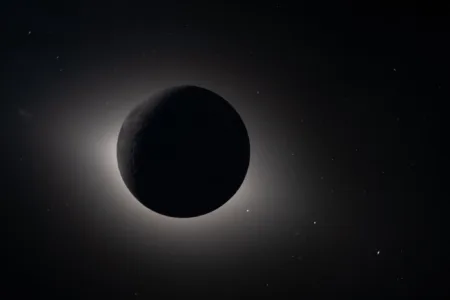
For the first time in more than a century, a total solar eclipse is coming to mainland Spain with an even longer encore next summer.
Toss in a crescendoing meteor shower and a six-planet parade on the same day, and the heavens will be overflowing with awe.
Daytime darkness will descend Aug. 12 across the Iberian Peninsula close to sunset -- plus slivers of Greenland and Iceland -- as the sun, moon and Earth align perfectly in the sky.
Starting near the North Pole before tracking south, totality will last up to two minutes and 18 seconds, an appetizer for an even longer solar show next year -- a 6 ½-minute extravaganza that will sweep from Spain to North Africa and the Middle East.
It will take 1 ½ hours for the umbra, or moon's sun-blocking shadow, to race along the 5,130-mile course, most of it over an empty Atlantic. Maximum totality will occur off Iceland's west coast. By the time it reaches a small patch of Portugal and then Spain with its massive crowds, totality will have dwindled to a minute or so. The spectacle will end in the Mediterranean.
Eclipse chasers gear up for solar spectacle
Hundreds of millions more on the sidelines are in for a treat as well.
A partial eclipse will delight as far away as Alaska and Siberia, enveloping Canada, the northern U.S., and much of Europe and West Africa.
The closer to totality's course, the more the sun will vanish behind the moon - 94% coverage in Dublin and 83% in Oslo, Norway. Montreal will see an 18% bite out of the sun, tapering to 9% in New York and 2% in Norfolk, Virginia.
Special eclipse glasses are crucial. even if a morsel of sun is showing.
Adding to the cosmic wonder, the day begins with six of our neighboring planets forming an arc in the sky before dawn and end with the Perseid meteor shower peaking after nightfall under the new moon. Streaking meteors could photobomb totality, with some of the brighter planets and stars visible in the background.
Eclipse mapmaker Michael Zeiler is chasing an even more elusive interloper: the northern lights.
For his 13th total solar eclipse, Zeiler will be on a cruise ship in a Greenland fjord, sailing as a guest lecturer. He'll point a video camera toward the north to capture any aurora forming during totality. A massive outburst from the sun would be the icing on his eclipse cake.
"What gets me excited is viewing rare phenomena," Zeiler said in an email.
He's not the only one revved up.
Solar eclipse watch parties
The European Space Agency will host a live webcast from Spain's Astrophysical Observatory of Javalambre and a public celebration in Leon. NASA will provide its own coverage, as will the Italian-based Virtual Telescope Project and others.
"For me, it's not just a scientific moment. It's not just an incredible alignment of heavenly bodies. It's also a very human moment," said ESA's director of science Carole Mundell. "It's a real human connection between us with our feet planted on the Earth and the cosmos."
Two of ESA's space telescopes will observe the eclipsed sun and its corona, or outer atmosphere. Proba-3, the space agency's artificial eclipse-making satellite duo, will be in the wrong part of its orbit during totality as seen from Earth, but will try to sneak in some before-and-after shots.
U.S. college research teams are also pitching in, launching more than 60 high-altitude balloons from Spain and Iceland to study Earth's atmosphere and other changes during the eclipse when the temperature momentarily drops. They launched 10 times as many balloons during the 2024 total solar eclipse that captivated North America.