
Hollidaysburg musician inspires on the global stage
European program gives Ringkamp chance to play organ in historic settings
Trending
The field of engineering's loss became music's gain when a Hollidaysburg native switched his major in college and set the course for a career in playing the organ.
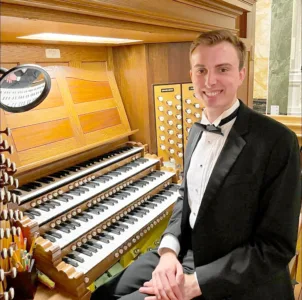
Nathan Ringkamp, 25, is now studying the organ in France as part of a program paid for by a scholarship he won from a Boston-based music foundation. He has played organs in famous churches in America and in Europe, such as Notre Dame in Paris and Westminster Cathedral in London.
Ringkamp said his goal is to perform and compose beautiful sacred music to uplift people in the congregation.
He said it's inspiring to play the organs in widely recognized churches here and overseas. Unlike churches in the United States, many of the organs in churches in Europe date back to the 1600s and 1700s.
"It's amazing to play music by composers from three hundred years ago and perform it on their instruments,'' he said.
He attended local schools growing up in the area and played the alto sax and the cello while attending Hollidaysburg Area Senior High School. He entered the Catholic University of America in Washington, D.C., as a freshman majoring in engineering. He wanted to go to a college where he could continue to pursue his musical talents on the side, such as singing with a choir.
But he didn't see himself making music as his full-time job.
"I always loved music but I wasn't sure how I could make it a full-time career,'' he said.
He started playing the organ at a young age after seeing a video tape of famous organist Diane Bish performing at the Cathedral of the Blessed Sacrament in Altoona.
"I would watch that tape on repeat,'' he said.
In addition to the other instruments he played, he had started lessons on the piano and also on the organ with local organist Jim Dengler using the organ at Ringkamp's parish, St. John the Evangelist Catholic Church in Lakemont.
At Catholic University of America, Ringkamp took more organ lessons with Benjamin LaPrairie, another noted organist who is the associate director of music at the Basilica of the National Shrine of the Immaculate Conception in Washington, D.C.
"It was my goal to play that organ for my senior year recital and that was my first organ lesson, (on the organ at the basilica).'' Ringkamp said.
His first semester, Ringkamp got to sit in the organ loft with LaPrairie during a Mass of the Americas, a two-and-a-half-hour service in Latin for about 4,000 people featuring top clerical figures such as Archbishop Salvatore Cordileone. Catholic cable network EWTN broadcasted the Mass.
"It was the first time I'd ever experienced music that beautiful or music on such a high level of professional skill. ... I got goosebumps,'' Ringkamp said.
Making a major change
He started to consider changing his career path and when he asked LaPrairie about it, he got the reassurance he needed that he could be successful as an organist. So he switched his major from engineering to the organ.
"I knew it would be difficult but the opportunity to serve the Church and provide beautiful music overshadowed any hurdles,'' he said.
Since then, Ringkamp has played the organ in churches in Washington, D.C., including the one at the basilica and in Baltimore, Md.
He served as organist at St. Dominic Roman Catholic Church in Washington, D.C., and at the National Shrine of St. Alphonsus Ligori Church and Zion Lutheran Church in Baltimore. He held those posts while completing his master's degree at the Peabody Institute of the Johns Hopkins University in Baltimore, which opened in 1857 and is the oldest music conservatory in the United States.
But most recently, Ringkamp has played organs across Europe, including the organ in the Royal Chapel at the Palace of Versailles. The palace once was home to kings and queens of France, from 1682 until the French Revolution in 1789.
He currently lives in the city of Versailles while completing an Artist Diploma in Organ Performance. He is studying with another famous organist, Jean-Baptiste Robin, who is the organist at the Royal Chapel of Versailles. He received a $25,000 scholarship from the Frank Huntingdon Beebe Fund in Boston to complete his studies. The fund supplies scholarships up to $25,000 for young musicians to study music overseas.
Ringkamp, however, wants to not only play the organ in church but to compose music for cantors and choirs to sing in church. It was while working at St. Dominic Church that Ringkamp wrote his first liturgical music for the church. He said his faith had deepened during his time at the Catholic University, where he took theology courses. He wrote a gospel acclamation verse for a Mass at the basilica celebrating the installation of the 16th president of the university. He also wrote a responsorial psalm that was performed recently by the festival choir at the cathedral in Altoona for the 125th anniversary of the creation of the Altoona-Johnstown Diocese.
Writing music for the church is a special aspect of being a musician in the church that Ringkamp takes seriously.
"It's inspiring and humbling because you know it's so much more than you,'' he said.
Challenges in career choice
Before he made the decision to change his major, Ringkamp called his uncle, Robert Long, who is music director at the cathedral in Altoona, to get his opinion.
"I told him the pros and cons about it,'' Long said.
He told him he might have to serve as both organist and choir director, which can affect his personal life.
"For family life, it's challenging because you have to work every weekend and holiday,'' Long said. "It's a really constant schedule when it comes to that.''
When Long first started as a music director in the 1980s and 1990s, participation in church and church activities reached a high point, with many people deciding to convert to Catholicism. The role of the music director, who acts as an organist and also choir director, developed during this time.
"Those jobs were starting to appear at that time,'' Long said.
But he noticed starting in the early 2000s that children's participation in church started to decline.
"I saw all of the kids' participation go way down, (in) the children's choir and summer Bible school,'' he said. "So the fact that they're having difficulty getting young organists doesn't surprise me.''
Long at that time served as director of music at St. Mary's Catholic Church in Altoona and also taught music at the adjoining school.
"I thought the church was really dynamic and growing but then that dropoff happened,'' he said.
In his current job at the Cathedral in Altoona, Long said the congregation overall participates in the Mass, including singing during the service.
"I don't know the statistics but certainly here there's a lot more enthusiasm and that's important for young people,'' he said.
In some churches, there are separate organists and choir directors who usually work on a part-time basis. But other churches have a full-time music director who fills both roles, which can be both rewarding and also at times challenging. When Long was director of music and choirmaster at St. Patrick's Cathedral in New York City, the church had two full-time organists, although at times Long played the organ.
When Ringkamp gave his senior recital at St. Matthew's Cathedral in Washington, D.C., members of St. Dominic's congregation came to hear him play. His parents, Chris and Melissa Ringkamp, were thrilled to hear him play the organ at the cathedral. He also played the organ at the Basilica of the National Shrine during his baccalaureate Mass when he graduated from Catholic University.
"It was overwhelming to sit in that beautiful church and to listen to the music being played on that incredible organ and to know that was our child making that music,'' Melissa said. "All parents hope and pray their child finds a career that they enjoy and one that allows them to use their talents. We believe Nathan has done just that.''
His father said he believes Nathan's switch from an engineering major to organ performance was divinely inspired.
"I believe our first thought was, 'We could have told you that,'" Chris said. "I can't think of another instrument that elevates the relevance of the liturgy for the purpose of glorifying God than the organ.''
Chris said he thinks Nathan won't have too much trouble finding a job when he finishes his time abroad.
"I believe there will always be parishes that appreciate organists who have the educational background and personal passion for excellence in music,'' Chris said.
Melissa said she also has faith that her son will find a suitable job in the future.
"I believe he will be able to find a job where he can bless a parish with his organ playing skills and share his love for liturgical music,'' she said.
A diminishing field
Ringkamp was the last student to graduate as an organ major from Catholic University because it has since dropped that undergraduate major. The university does still offer a master's degree as part of the school of arts and sciences.
That's an indication of what has become a shrinking profession in the United States, according to the American Guild of Organists, which has seen its members drop by half in recent years, from 20,000 to 10,000. Part of the reason for the drop is that people who play the organ are getting older, with about 60% aged 58 or older, according to data from the organization.
But Ringkamp said he's not daunted by the statistics.
"There's an excitement in leading people in song and in prayer that I love,'' he said.
Long said he's very proud of what his nephew has accomplished and complemented his expertise as an organist. He termed him a "virtuosic'' player, which means Nathan has mastered the organ and he plays and composes music with ease.
"He's got the skills to play at all (types) of concerts,'' he said. "It takes a high level of skill to play at that level ... it's amazing to hear him play.''
Long said the organ is a unique instrument, producing both "joyful and sorrowful'' sounds. It can imitate the sounds of various instruments in an orchestra, such as the strings (violins, violas, cello and double bass) and the flutes and piccalos.
"When you're playing with a big group of people singing, it gives a lot of variety of sound to lead the congregation,'' he said.
Long is hopeful about the future of upcoming organists. When young people visit the cathedral in Altoona, he asks those who are pianists to try out the organ to see the similarities in the keyboards.
"If we have young people see that, we might attract them to the organ and see that they already have a head start,'' he said.