
Deal reached to save Orchard Park
Settlement set to be voted on today that will end city plan to build homes on site
Trending
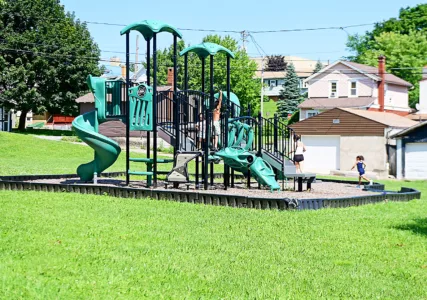
The Friends of Little Orchard Park are close to success in their effort to block the Altoona Redevelopment Authority from developing seven homes on longtime recreational ground in Logantown.
The authority today is expected to vote on a proposed settlement with the neighborhood group under which the authority and the city agree to keep Orchard Park on the 200 block of Beech Avenue open "for public purposes in perpetuity."
If the authority approves the consent order, and Blair County Judge Dave Consiglio signs off, it will bring to a close a dispute that began last fall when residents near the park became aware of the authority's plans, which are part of an effort to develop housing through new construction and rehabilitation to deal with a housing shortage and to bolster the city's tax base.
While the neighborhood group's main legal leverage appeared to have been the state's Donated or Dedicated Property Act (DDPA), which requires municipalities to obtain permission from their counties' Orphan Court to decommission dedicated parkland, even when dedication is only implied, the proposed settlement explicitly sets aside the Act -- with both sides withdrawing their DDPA claims, although both would retain their ability to bring those claims up in the future.
Instead, the proposed agreement explicitly calls for permanent maintenance of the park through public funds, a better outcome than the neighborhood group could have ever expected, according to Tim Smith of Altoona, chairman of the Bill of Rights Defense Committee -- Keystone State, which supported the Friends in their effort to preserve the park.
"(A)ny attempt by the City to do anything outside of this agreement can result in future generations (being able) to just activate this decree," Smith wrote in an email Friday, referring to assurances provided by attorney Tim Fitchett of Fair Shake Environmental Legal Services, which helped the Friends in the case.
Still, setting aside the DDPA issue by both parties, though "without prejudice" against its possible future, makes the proposed consent decree "a real compromise" in a way that would not have been true of an earlier proposal for a settlement that would have been "indistinguishable from the plaintiffs' (the Friends') best-case scenario" and "the defendants' (the city's) worst-case," stated authority solicitor Patrick Fanelli in a letter to Fitchett that was supplied to the Mirror by Smith.
That compromise still "accomplishes what your clients are seeking," Fanelli wrote.
The authority and the city settled after the scheduled date for an April trial passed, as the "authority had moved on to other things" -- specifically, myriad housing projects, according to authority solicitor Patrick Fanelli.
The authority had moved on to other things because the deadline for spending grant money in support of the Orchard Park project was approaching, which led to the city to redirect that funding, according to city solicitor Mike Wagner.
"Both parties thought maybe it was not necessary to push this to a judicial decision right now," Fanelli said. "We're not doing the development, so why do we need to have an answer whether it's a park (from the court)."
There was a push "to figure out a way to resolve it, so everybody kind of saves face and life presses on," Wagner said.
"We're going to recognize it as a park," yet with the stipulation that the DDPA is still applicable and can be cited at some later date, if the city sees fit and can marshall arguments to justify decertification in orphans court, Wagner said.
According to WeConservePA, the DDPA "provides that donated or dedicated property must stay in trust -- its original use must continue -- unless the use is no longer practicable or possible and has ceased to serve the public interest."
The neighborhood group is refraining from taking a trimphalist, "slam dunk" attitude toward the consent decree, according to Smith.
"We will strive to keep working with the city and look forward to creating a new structure for the Orchard Park Neighborhood Association to continue to work to improve the walkability, livability and workability inherent in our vibrant part of Altoona," Smith wrote in an email. "We hope the city of Altoona will work with us and see what we are capable of."
The lack of a triumphal attitude is consistent with the neighborhood group having paid its $6,000 in legal bills with the help of fundraisers, while not asking for damages, according to Smith.
In their lawsuit, the Friends sought to show that while Orchard may not have been one of the city's better-known parks, there was sufficient documentation to show that it had been one in fact.
That included a sign onsite that referred to park rules; the ground being part of an online list of parks managed by the Central Blair Recreation and Park Commission; its being referred to as a park in a city comprehensive plan and by the commission several years ago having installed a playground set coupled with other facilities having been there over the years.
The city has signed off on the consent decree, Wagner said.
"In time, I would hope the majority of the people in the Orchard Park neighborhood will understand eventually that had the development gone on, that area would have benefited, including by increased property values," Wagner said.
Smith disagreed, saying that the housing project would have represented a start toward gentrification, to the detriment of the existing neighborhood residents.
Mirror Staff Writer William Kibler is at 814-949-7038.