
Knickerbocker homes to be demolished after agreement with city
Trending
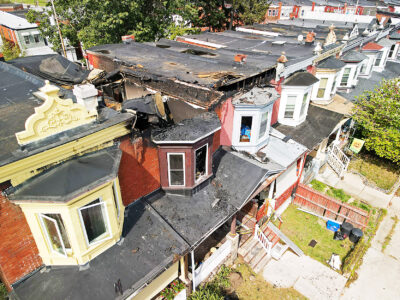
The owner of a Knickerbocker rowhouse rental property that burned last fall came to an agreement last week with the city on demolishing the building under special engineering oversight -- thus eliminating the need for a hearing on citations for having previously failed to conduct the demolition.
Terry Reed provided a demolition contract with a start date of July 1, along with a contract for a structural engineer to monitor and supervise the work to ensure the demolition doesn't further damage houses connected on either side -- both of which were damaged initially in the fire, according to Rebecca Brown, director of the Department of Codes and Inspections.
Reed was living in the house to the left of the center house, where the fire originated on the 3900 block of Fifth Avenue early on Oct. 2, 2025.
No one was seriously hurt, although a firefighter was briefly trapped by a refrigerator when the first floor of the center house collapsed, and he fell into the basement, upon which he radioed a "mayday," prompting a pair of firefighters who'd just left the basement to come back and rescue him, according to reports at the time.
The agreement between Reed and the city on the controlled demolition conforms with the requirements recommended by an engineer hired by the city in the aftermath of the fire, according to Brown and City Manager Christopher McGuire.
The engineer called for bracing prior to demolition and for monitoring while demolition is in progress, because the houses share common "party" walls, which could collapse if demolition isn't done right.
Reed has hired the engineer the city used to evaluate the situation, although that wasn't a requirement, according to Brown.
The city has not ordered that the damaged houses on either side of the center house be demolished, although Russell Stone, who owns the house to the right, has indicated he plans to work out an arrangement with the demolition contractor to take his house down also, Brown said.
Stone initially got a notice during the month following the fire to raze or repair his house, Brown said.
The city didn't follow up on that notice, after Stone explained that he was planning to wait on Reed to firm up his own arrangements for the center house demolition, then use the same contractor for his own house, Brown said.
Stone, however, complained to the Mirror of being harassed by the city codes office with "threatening letters."
There is no indication that Reed plans to have the house he was living in -- the one on the left side of the center house -- demolished, Brown said.
Reed didn't respond to a pair of messages left with his business.
Stone said he got an insurance payment on his house amounting to about $74,000.
The value of the house and its contents was about $140,000, Stone estimated.
Stone's insurance company put $15,000 in escrow with the city as a guarantee that Stone's house would be taken care of.
Once that happens, the escrow funds will be released to Stone, according to city officials.
The value of the lot once the house is gone will be minimal, perhaps $5,000, Stone estimated.
He thought it would have been fair if the city had taken care of the cost of demolition, Stone said.
The city would have worked with Stone if he had wanted to repair the house, Brown said.
If the demolition contractor tears down both the center house and Stone's house, the engineer will need to ensure that the house on the far side of Stone's is not put at risk, Brown said.
Stone was critical of the Altoona Fire Department's efforts on the night of the blaze.
The first hydrant that firefighters connected with had insufficient water, and it took 32 minutes for them to hook up to a second hydrant, so that they could fight the fire effectively, according to Stone.
It was largely that delay that caused the loss of his house, Stone alleged.
"They showed no signs of trying to stop anything," Stone said.
Fire Chief Adam Free contested Stone's allegations, while adding that he sympathized with Stone's frustration at losing his house and its contents.
It's true that the hydrant that firefighters first connected with was fed by a five-inch line, which produced about 400 gallons a minute, and that, supplemented with tank water, it still proved insufficient, and that firefighters then hooked up a second hydrant shortly after one of the next engines arrived, Free said.
But the fire was well underway when they first got there, and "there was never a delay getting water on the fire," Free said.
Firefighters actually hooked up to a third hydrant eventually, after a second alarm was called, Free said.
It's not uncommon for firefighters to hook up to two or three hydrants to fight a fire, Free said.
Moreover, it was a complex fire, because the homes involved were rowhouses, which have shared interior walls, potentially creating conditions for fire to spread easily through voids and shared attic and roof spaces, he said.
Balloon frame construction can also contribute to fire spread, he said.
The firefighters "gave 150 percent to extinguishing that fire," he said. "They would never intentionally let someone's house burn down," he said.
The emergency when the firefighter who fell through to the basement of the center house needed to be rescued didn't cause the crews at the scene to discontinue fighting the fire, Free said.
Mirror Staff Writer William Kibler is at 814-949-7038.