
Rendezvous with history: Bedford County showcases ties to nation’s founding
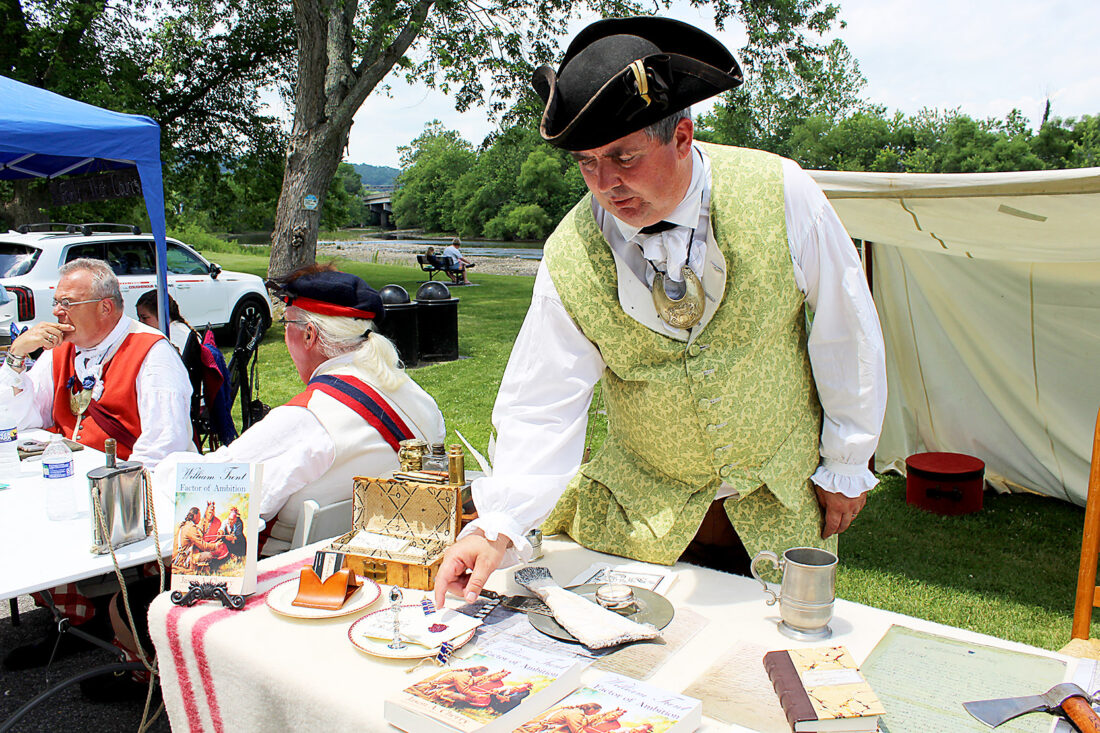
Jason Cherry, an assistant kindergarten teacher from Butler, portrays William Trent during the Fort Bedford River Rendezvous on Saturday in Bedford. Mirror photo by Holly Claycomb
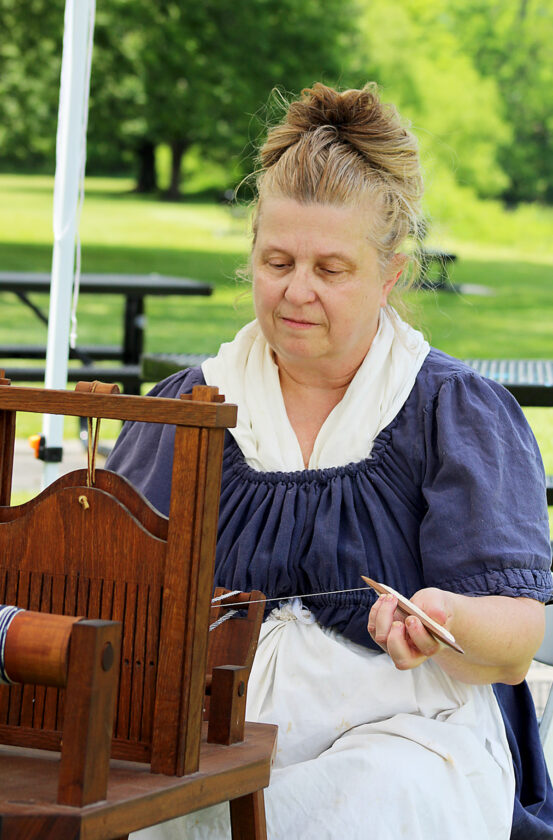
Nikki Bosley, dressed in Colonial garb, works a small loom weaving “tape” during the Fort Bedford River Rendezvous on Saturday. Bosley also portrays Betsy Ross at events and can often be found at the Johnstown Flood Museum. Mirror photo by Holly Claycomb
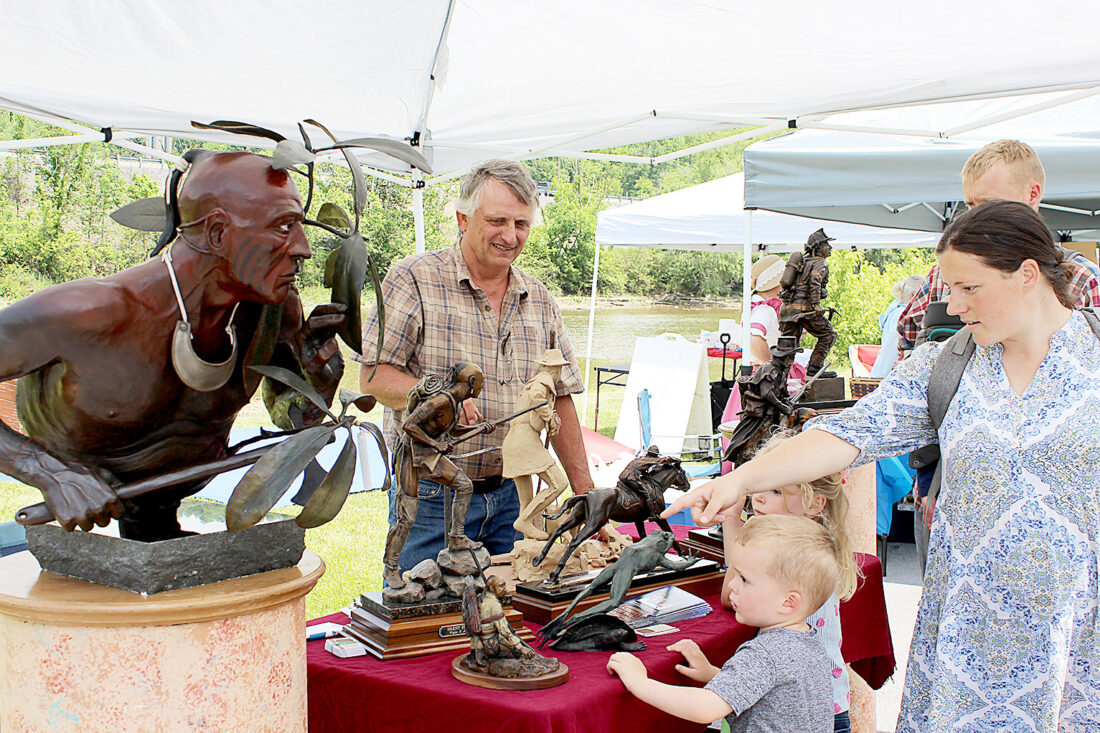
Bronze sculptor Wayne Hyde talks about his work during the Fort Bedford River Rendezvous on Saturday. Hyde has bronze sculptures in a variety of towns and cities across the United States and in Buckingham Palace. Mirror photo by Holly Claycomb
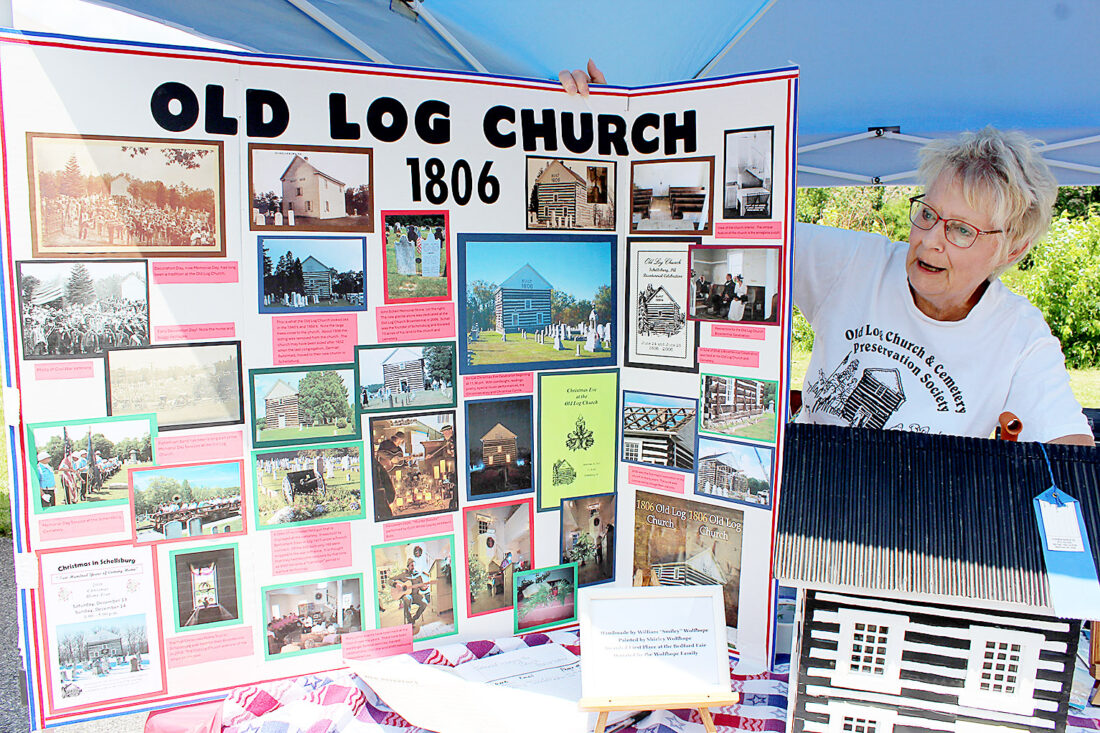
Joyce Herncane talks about the Old Log Church in Schellsburg during the Fort Bedford River Rendezvous on Saturday. Held along the banks of the Raystown Branch of the Juniata River, the rendezvous offered visitors and local residents the opportunity to learn more about Bedford County’s place in American history. Mirror photo by Holly Claycomb
Jason Cherry, an assistant kindergarten teacher from Butler, portrays William Trent during the Fort Bedford River Rendezvous on Saturday in Bedford. Mirror photo by Holly Claycomb
Nikki Bosley, dressed in Colonial garb, works a small loom weaving “tape” during the Fort Bedford River Rendezvous on Saturday. Bosley also portrays Betsy Ross at events and can often be found at the Johnstown Flood Museum. Mirror photo by Holly Claycomb
Bronze sculptor Wayne Hyde talks about his work during the Fort Bedford River Rendezvous on Saturday. Hyde has bronze sculptures in a variety of towns and cities across the United States and in Buckingham Palace. Mirror photo by Holly Claycomb
Joyce Herncane talks about the Old Log Church in Schellsburg during the Fort Bedford River Rendezvous on Saturday. Held along the banks of the Raystown Branch of the Juniata River, the rendezvous offered visitors and local residents the opportunity to learn more about Bedford County’s place in American history. Mirror photo by Holly Claycomb
Trending
BEDFORD -- The history of America lives and breathes in Bedford County, that's why when the state presented counties with a list of things to do to help celebrate the nation's Semiquincentennial, local America250 organizers could easily tick off the items.
"Bedford County does this really well already," Kellie Goodman Shaffer said of the region celebrating its place in the country's founding and subsequent success.
Goodman Shaffer, also president/CEO of the Bedford County Chamber of Commerce, said the county is celebrating America250 with expanded events throughout the year, including a countywide parade at 2 p.m. Aug. 2, in downtown Bedford.
History on display
Fort Bedford was first known as Raystown and built during the summer of 1758 by the forces of Col. Henry Bouquet, states a historical marker leading into Fort Bedford Park in downtown Bedford. The fort was the rendezvous point from which the expedition of Gen. Forbes advanced to occupy Fort Duquesne, the marker states.
Today, the Fort Bedford Museum stands on the original site of that 1700s fort and was the location Saturday of the River Rendezvous, hosted by the museum and led by Landon Defibaugh and the fort team.
The museum, filled to overflowing with remnants of the past, saw four times the number of people visiting the displays than on a typical Saturday, staff said.
In addition to the museum, the rendezvous, held along the banks of the Raystown Branch of the Juniata River, offered a glimpse of the past as re-enacters dressed in period garb helped tell the tale of life in early America.
Nikki Bosley, who can often be found at the Johnstown Flood Museum, donned a classic Colonial dress and worked a small loom, crafting tape from yarn. This thin, material tape -- made long before the 1920s sticky Scotch version -- was used to tie shoes, hold up stockings and trim blankets, among other uses.
Bosley, previously a park ranger at Harpers Ferry in West Virginia, also does interpretations of Betsy Ross. "Anything to get people interested in history," she said.
Among the information she shares with visitors are the meanings behind popular sayings, like "pop goes the weasel" referring to a skein of yarn.
According to the theory of the saying's origins, a "weasel" was a device used to measure yarn. It took 40 turns around the weasel to measure a skein of yarn, at which time the device would make a "pop" sound.
Another saying that intrigues kids and adults alike is "sleep tight and don't let the bed bugs bite," she said, noting that bed bugs were common in homes, as were rope beds.
Sleep tight refers to the tightening of the ropes to make the bed more firm. The blankets and sleeping pallet on the rope base weren't often washed, meaning they were often full of bugs -- learning this gives new meaning to the saying, she said.
Jason Cherry is an assistant kindergarten teacher by day, but portrays Capt. William Trent -- who was part of General John Forbes' campaign during the French and Indian War -- during re-enactments. To portray Trent as accurately as possible, Cherry studied him extensively and has even written several books about Trent.
Trent was involved in many Indian treaties, writing some of the treaties and/or serving as secretary, Cherry said. Trent was taught at the Friends School in Philadelphia, now known as the William Penn Charter School, he said, adding that because Trent excelled in school, he had the penmanship skills needed to serve with Forbes.
To make his re-enactment of Trent complete, Cherry not only dresses the part but has the accoutrements to match -- including some original dishes, like a 1750 pewter plate, 1770s fish slicer, and 1700s salt spoon and salt bowl.
"It helps bring history to life," he said. "It all gives people an idea of what they would have had."
Steeped in history
Bedford County is steeped in so much history that visitors could spend days in the area learning about the county's role in the French and Indian War and Forbes' campaign, or perhaps learning about the Whiskey Rebellion, the building of the covered bridges or the Lincoln Highway.
President George Washington did indeed sleep in Bedford, in the historic Espy House, a two-story stone structure that remains standing today along Pitt Street (Lincoln Highway).
Of note, the Bedford Springs has been referred to as the Summer White House, due to its famous mineral waters being preferred by President James Buchanan, who regularly retreated to the resort to escape Washington.
To the west of Bedford, along the Lincoln Highway, sits a popular stop for travelers. The Old Log Church in Schellsburg, built in 1806 and marking 220 years this year, is the resting place for many a Bedford County settler, including John Schell, for whom the town of Schellsburg is named, said Joyce Herncane.
The church, built on land donated by Schell, was the first church built by the early settlers of the area and is the oldest church in Bedford County.
Herncane was at the River Rendezvous to show off a replica of the church and a number of pictures showcasing the church and cemetery.
She and others are also raising money for the restoration of the church to ensure it continues to provide a history lesson for future generations, she said.
The church is open to the public daily during the summer months and annually hosts an 11:30 p.m. Christmas eve service.
This year, the preservation society is hosting a special tribute to Revolutionary War Patriots at 2 p.m. Sept. 12.
Between now and then, they are looking for the descendants of the eight Revolutionary War Patriots buried in the cemetery. In addition to John Schell II, they are seeking information from those related to Christian Dannaker, Capt. Duncan McVicker, Frederick Hill, John Mowry (Maurer), Tobias Hammer, James Burns and Johan Peter Hillegass.
So far, they have descendants from Washington State, Florida and Ohio planning to attend the event, said.
The church, and Bedford County in general, have a lot to offer history buffs, Herncane said.
"It's a goldmine of history here," she added.