Group treks 8 days from Pittsburgh to Moshannon Valley Processing Center near Philipsburg to protest ICE actions
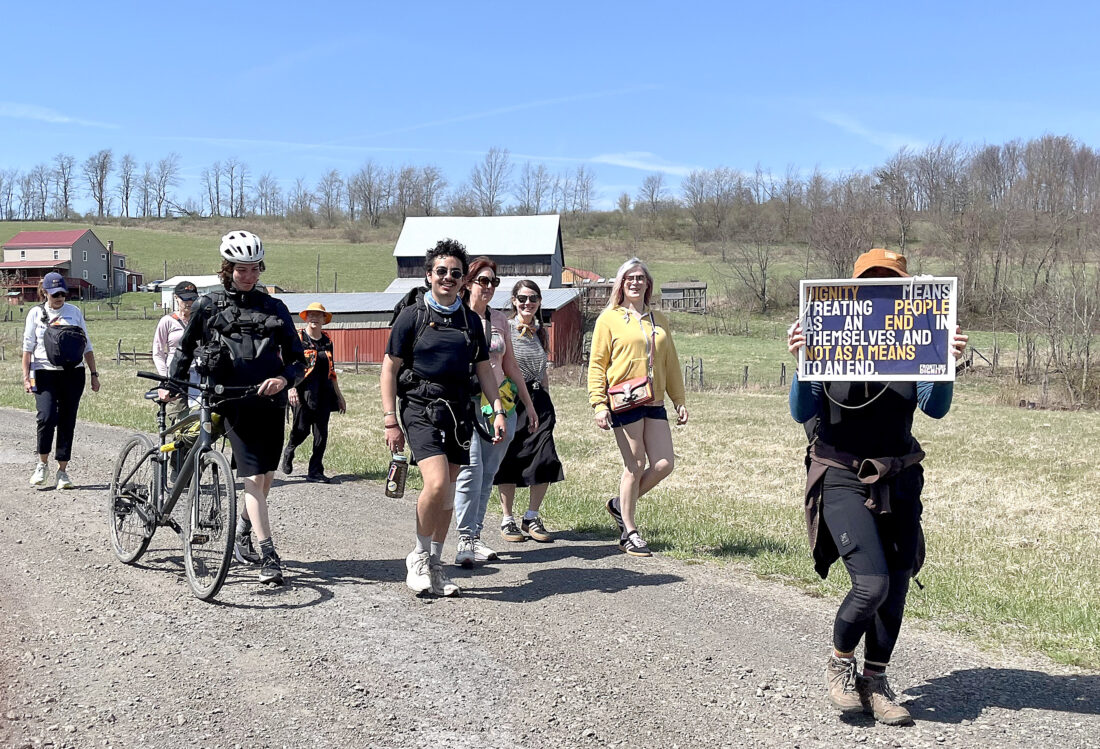
Jaime Martinez of Pittsburgh leads a group of people walking to the Moshannon Valley Processing Center in Philipsburg on Thursday. Martinez began his walk in Pittsburgh and will finish Sunday in Philipsburg. Mirror photo by William Kibler
Jaime Martinez of Pittsburgh is a Catholic who has twice participated in the Camino de Santiago pilgrimages in Europe, known in English as the Way of St. James.
The rhythm of walking for weeks, “block(ing) out the noise” of ordinary life, the need for participants to “show up for others,” the vulnerability that you feel, how walking together turns strangers into friends and how “every day becomes a parable” — all together have helped Martinez figure out his place in the world.
For eight days ending on Sunday, Martinez’s place in the world has been along the highways between the Immigration and Customs Enforcement office on the South Side of Pittsburgh and the Moshannon Valley Processing Center near Philipsburg, as leader of a walk — a pilgrimage — designed to protest the Trump administration’s treatment of undocumented immigrants.
Speaking in the gravel parking lot of a church near Hastings Thursday, Martinez, founder of walk sponsor Frontline Dignity, explained that he is the Florida-born son of immigrants from Nicaragua, and that he wants to draw attention to the actions of ICE, including “people being taken off the street without due process and housed in warehouses in subpar conditions.”
He wants the walk to counteract the “apathy to dignity” represented by the attitude of the “too many who are OK with the government treating others as ‘less than,'” he said — as he and 11 other walkers rested in the early afternoon, having come that morning from Northern Cambria, with plans later that day to spend the night in Saint Lawrence.
“We (have been) seeing each other as enemies,” Martinez said. “We’re not each others’ enemies.”
Martinez has been tracking immigration raids for a year, documenting what has been happening, he said.
“I’ve held and consoled weeping mothers and wives,” he said.
He’s also been teaching people how to observe properly, he said.
The rules include not interfering with or engaging with ICE officers and not escalating or putting anyone at risk, he said.
The idea is to document what happens, he said.
While much of the national attention on ICE raids has focused on the Minneapolis area, ICE has been active around Pittsburgh, too, he said.
At Emiliano’s Mexican Restaurant, agents made all the employees kneel with their hands behind their backs and placed a gun to the head of one female employee, and they damaged ceiling tiles and a door, he said.
ICE agents have detained people with valid status due to flags in their databases, he said, and they’ve detained people based on racial profiling.
Martinez wants the U.S. to return to the kind of country for which a 90-year-old Frenchman he encountered in Europe was grateful.
American soldiers in World War II had liberated his town, and on finding that Martinez was from the U.S., asked him to send his thanks, even though it was many generations later, Martinez said.
Martinez is aiming for the kind of renewal symbolized by something else that happened to him in France, in a small church that he found locked, but entered after getting a key from a nearby store.
The church was full of cobwebs.
But it had an organ, and he knows how to play, and he sat down and began playing Schubert’s Ave Maria.
A man burst in, interrupting him, and Martinez jumped down from the bench, figuring he’d be kicked out.
But the man was radiant.
He told Martinez that it was the first thing he’d heard coming out of the church in 10 years.
It was Martinez’s 20th birthday.
He feels called to help breathe life into American values that have become moribund, like that church.
As of Thursday, there had been a total of 60 participants in the Frontline Dignity trek — two who’d been with the group the whole time and five semi-regulars, Martinez said.
The group had gone at least 18 miles and as long as 26 miles each day, according to Mary Turak of Pittsburgh, who had joined in Monroeville.
Three of her four grandparents were immigrants, Turak said, when asked to explain why she decided to participate.
Both of her mother’s parents were born in Croatia, and her father’s mother was born in Ireland.
They were all treated with dignity when they came to America, Turak said.
“I just think you should treat someone like you would like to be treated,” she said. “The Golden Rule.”
Turak traced her belief in the Golden Rule to the behavior of her fourth grandparent, her father’s father, who owned rental homes in the Garfield neighborhood of Pittsburgh in the 1940s.
One day, while her grandfather was at home, someone knocked on the door and told him that a group of people were planning to go to a house he owned on Kincaid Street to throw rocks because a Black family had moved in.
“They’ll have to throw them at me first,” her grandfather said, before going to the house on Kincaid and stopping what was otherwise likely to happen, Turak said.
The Frontline Dignity walkers have been staying in church basements, private homes and hotels whose room rates were underwritten by community groups, Martinez said.
In Hastings, the walkers were getting drinks and snacks from a recreational van owned by Sara Petyk of Pittsburgh, who made a point of saying that many others were doing more than she was to help.
Group members have been having “wonderful conversations” with people they’ve encountered along the way, Martinez said.
Some of the encounters have broken up stereotypes — on both sides, he said.
“We’re building bridges of understanding,” he said.
Mirror Staff Writer William Kibler is at 814-949-7038.
Local News
Group treks 8 days from Pittsburgh to Moshannon Valley Processing Center near Philipsburg to protest ICE actions

Wish fulfilled: State College resident visits 30 NBA arenas in 32 days to raise money for Make-A-Wish

WISE Women of Blair County honoring seven local contributors

Settlement reached in foster case involving six children from Altoona family

Hollidaysburg man accused of assaulting teen