Huntingdon’s Standing Stone remains lasting US landmark
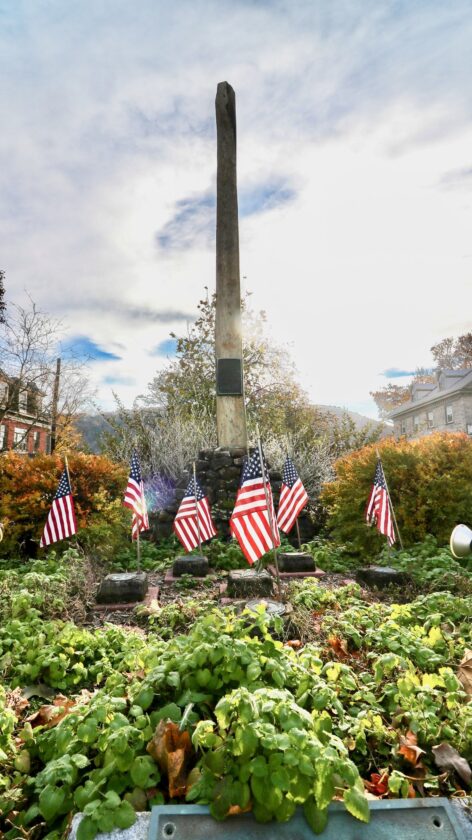
Photo courtesy of Huntingdon Landmarks Inc.’s Facebook / Huntingdon’s Standing Stone replica monument is situated between Penn Street and Third Street.
Before Huntingdon was a county, there was an original monument known as the Standing Stone, which went missing in the 1760s and was never returned.
“It’s one of the mysteries of Huntingdon,” said Margaret Skrivseth, executive director of Huntingdon County Historical Society. “Newcomers or visitors are taken by the Standing Stone.”
But Standing Stone is far from forgotten: its third and permanent replica currently sits in between Penn Street and Third Street, and schools, organizations, trails and businesses are named after it.
“No one (currently) living has ever seen the original Standing Stone,” former board President Fred Lang said. “The actual stone did exist, but the mystery revolves around the purpose of the stone.”
The original monument
Native Americans from the Onoyota’aka — meaning Standing Stone — tribe inhabited the land when European colonists arrived in the town.
Former Secretary of Internal Affairs of Pennsylvania J. Simpson Africa traced the words’ origins, “Juniata” and “Oneida,” to a Native American word meaning standing stone at Huntingdon Borough’s Centennial celebration, according to the Huntingdon History Research Network.
Legend has it that members of the Onoyota’aka tribe were chased into a forest clearing by their enemy, an article from The Daily Times states. Tribe members disappeared, and it is believed that they turned into stone.
The Huntingdon History Research Network states that the first recorded Standing Stone reference appears in Indian Trader and Interpreter Conrad Weiser’s journal when traveling through the area in 1748.
American businessman John Harris also included Standing Stone in “An Account of the Road to Logs Town on the Allegheny River.” He noted its dimensions as 14 feet tall and six inches square.
It originally stood erect at the confluence of Standing Stone Creek and the Juniata River, Skrivseth said.
Lang said no one knows why the tribe created the monument, but it may have been a marker for those traveling by boat.
Boats were a popular form of transportation at the time, he said.
At the time, the Huntingdon was off limits to European colonists during the 1750s, Skrivseth said. It eventually opened to settlement in 1754 after the French Indian War.
The original Standing Stone was gone in 1760 when the first Europeans settled in Huntingdon.
“No one knows what happened,” she said.
An unexpected disappearance
More than 250 years have passed since the original Standing Stone disappearance, but speculation still surrounds the mystery.
Skrivseth said some historians believe it was destroyed, as it’s doubtful that someone walked around town with it in tow.
After speaking with an engineer, Lang said the original monument must have been taller than 14 feet to stay erect in the ground. It would have been difficult for anyone to carry around, he said.
“We don’t know if they (the Onoyota’aka tribe) had much of an attachment to it,” he said.
Lang believes the original Standing Stone is in the river, but the geography has changed with the river’s canal and the railroad.
“I don’t know if we’ll ever know anything about that or what happened to the original Standing Stone,” he said.
In 1768, the European settlers created their own version of the stone, which bore their names, the Huntingdon History Research Network states.
Lang said the second monument was shorter than the original, and it was made of blue slate. It most likely stood where the original Standing Stone did.
At some point, Lang said a wagon wrecked into the stone, and it broke into several pieces. A resident kept one of the pieces in their fireplace. The piece eventually landed in the hands of the current Juniata College president. It remained at the college until it was given to Huntingdon County’s Historical Society.
A portion of the second stone is on display in the lobby of the Huntingdon County Courthouse.
Town icon
The third and current Standing Stone monument wasn’t created until the county’s centennial in 1896.
Two area historians, J.C. Blair and J. Simpson Africa, found two stones similar in length and appearance to match what they believed the original Standing Stone looked like. The new monument was unveiled at the county’s centennial celebration.
As the town developed, the new Standing Stone remained Huntingdon’s historical pillar.
While the town has a small population, Skrivseth said it is geographically large with a lot of history.
People are perpetuated with Huntingdon County’s history, Skrivseth said.
Standing Stone seems to pop up everywhere, as locals continue to use its name in businesses and organizations.
The monument is pictured on the borough’s seal, which Lang designed many years prior.
“It’s the icon of Huntingdon,” he said.
Mirror Staff Writer Colette Costlow is at 814-946-7414.
Local News
Huntingdon’s Standing Stone remains lasting US landmark
State lawmakers revamping murder bill ahead of deadline
A scheduled vote on legislation to revamp sentencing guidelines for second-degree murder has been postponed as ...
Bishop Carroll to present ‘Newsies’ as school musical
Group treks 8 days from Pittsburgh to Moshannon Valley Processing Center near Philipsburg to protest ICE actions

Wish fulfilled: State College resident visits 30 NBA arenas in 32 days to raise money for Make-A-Wish