Shapiro proposes housing solution
Governor unveils $1 billion action plan to address state’s housing crisis
Gov. Josh Shapiro on Thursday unveiled the state’s first housing action plan, aimed at helping more people get their own roof over their heads.
“This plan meets Pennsylvania’s housing needs head-on — building more homes, cutting red tape, protecting renters and homeowners and ensuring our Commonwealth remains the place for people to put down roots,” Shapiro said at a press conference in Philadelphia Thursday morning.
Shapiro’s plan calls for borrowing $1 billion through a bond offering to establish a Critical Infrastructure Development Fund largely aimed at confronting the housing crisis, a concept he rolled out as part of his 2026-27 budget proposal released earlier this month.
That fund would be used to offset residential housing site development costs; help fund conversions of office space into residential space; and encourage mixed-use development, typically with retail and commercial space on the ground level with housing on the upper floors.
Shapiro said there is obvious demand for the funding.
He pointed to the response generated by the Department of Community and Economic Development’s Mixed-Use Housing Development Pilot Program, launched in 2024.
The program only had $10 million to allocate and received applications for $469 million in proposed projects.
The bond concept has immediately generated pushback from Republicans who hold the majority in the state Senate.
Senate President Pro Tem Kim Ward, R-Westmoreland, said that the borrowing proposed by Shapiro would require lawmakers and taxpayers to foot the bill for the spending in the program long after Shapiro leaves office. The governor is up for reelection to a second term, but he has also cultivated a national profile, leading to speculation that he intends to explore a White House bid in 2026.
“We will be left holding the bag,” Ward said at a press conference after Shapiro’s budget address. “The people of Pennsylvania will be left holding the bag.”
State’s housing edges and challenges
The plan notes that Pennsylvania has some advantages and challenges to face when tackling housing affordability.
On the positive side, housing is generally more affordable in Pennsylvania than in many other northeastern states.
Pennsylvania ranks third out of 14 northeastern states in terms of housing price-to-income ratio.
Home prices in Pennsylvania are 21% lower than the national median and Pittsburgh is the only major U.S. metropolitan area where buying a starter home is less expensive than renting.
On the other hand, Pennsylvania’s existing housing stock is among the oldest in the country, and the state, along with Connecticut, is one of just two in which the cost of a new house is more than double the cost of an existing home.
New homes cost 37.5% more than existing homes, on average, nationally.
An analysis by LendingTree released last summer showed that new homes in Connecticut cost 126% more than existing homes and in Pennsylvania they cost 121.4% more. That adds $555,660 to the cost of a new home in Connecticut and $361,637 to the cost of a new home in Pennsylvania.
Homebuyers in Pennsylvania pay a median price of $297,831 for an existing home and $659,468 for a new one.
Regional differences
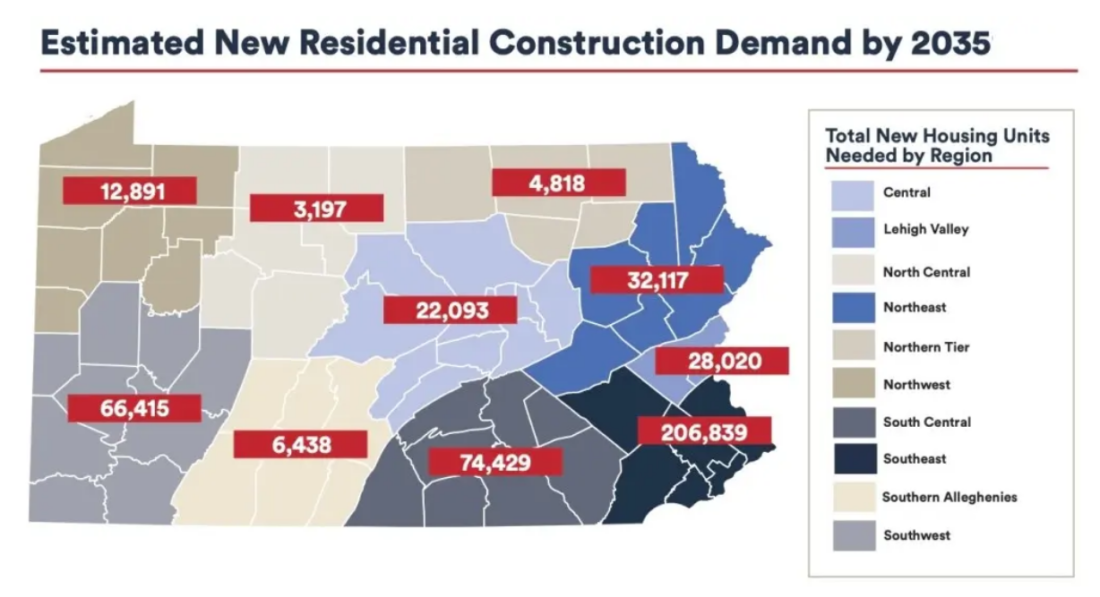
Much of the pressure to add more residential housing is in the southeastern part of the state, in and around Philadelphia and the fast-growing areas in the Lehigh Valley and South Central Pennsylvania around Harrisburg, Lancaster and York.
The housing plan projects that Pennsylvania needs more than 450,000 new residential homes by 2035 in order to meet demand.
Forty-five percent of that demand would be in the southeastern region and 16% of demand would be in the South Central region. The two counties in the Lehigh Valley — Lehigh and Northampton — would account for 6.2% of the state’s increased demand for residential homes.
“One of the big reasons (driving up the cost of new homes) is simple demand,” LendingTree chief consumer finance analyst Matt Schulz said at the time the analysis was released.
“People are frequently willing to pay more for new homes, so prices go higher.”
Restrictive local and state regulations contribute to the high cost of building in Pennsylvania as well, resulting in low inventory and high prices for new homes, according to LendingTree.
Plan looks to ease regulations
The housing plan calls for a variety of strategies to encourage local governments to do more to efficiently review and approve new residential housing developments.
– Library of model land use ordinances — Under the plan, state officials would develop model ordinances for local officials to copy and use to set land use definitions, establish parking and density requirements, determine hazard mitigation strategies and implement land use best practices. These model ordinances would be tailored with versions for small, medium and large municipalities.
– Housing-ready community designation — The housing plan also calls for the state to establish a special designation for adopting best practices in land use regulations. Municipalities with the designation would get preferential treatment when applying for state funding.
– Expanding housing options — The plan also calls for local regulations to be designed to allow the use of accessory-dwelling units, so-called contained homes or granny flats. Under the proposal, the state would encourage local officials to avoid restrictive minimum lot size and setback requirements.
Legislative proposals
Many of the strategies proposed in the housing action plan would require action by the General Assembly. Lawmakers in the state House have already introduced a variety of bills aimed at tackling some of the issues identified in the plan. Lawmakers in the state Senate are reportedly working on similar bills.
Rep. John Inglis, D-Allegheny, introduced House Bill 2185 to allow duplexes, triplexes and quadplexes in areas designated for single-family housing.
Inglis introduced House Bill 2186 to remove barriers to accessory dwelling units often enabling a senior to live adjacent to grown children.
Rep. Tarik Khan, D-Philadelphia, introduced House Bill 2109 changing local occupancy rules so unrelated people can live in the same house.
Those bills have been referred to the Housing and Community Development Committee. The committee has yet to take up the legislation.
Expected housing demand by region
Southeast Pennsylvania (6 counties)
– Existing housing units — 1.94 million
– New residential demand by 2035 — 206,839
– Projected increase — 10.6%
Lehigh Valley (2 counties)
– Existing housing units — 277,600
– New residential demand by 2035 — 28,020
– Projected increase — 10%
Southcentral Pennsylvania (8 counties)
– Existing housing units — 828,388
– New residential demand by 2035 — 74,429
– Projected increase — 8.9%
Susquehanna Valley (10 counties)
– Existing housing units — 282,295
– New residential demand by 2035 — 22,093
– Projected increase — 7.8%
Northeastern PA (7 counties)
– Existing housing units — 503,365
– New residential demand by 2035 — 32,117
– Projected increase — 6.3%
Southwestern PA (9 counties)
– Existing housing units — 1,180,571
– New residential demand by 2035 — 66,415
– Projected increase — 5.6%
Endless Mountains (5 counties)
– Existing housing units — 90,818
– New residential demand by 2035 — 4,818
– Projected increase — 5.3%
Northwestern PA (8 counties)
– Existing housing units — 326,619
– New residential demand by 2035 — 12,891
– Projected increase — 3.9%
Southern Alleghenies (6 counties)
– Existing housing units — 209,779
– New residential demand by 2035 — 6,438
– Projected increase — 3%
PA Wilds (6 counties)
– Existing housing units — 113,001
– New residential demand by 2035 — 3,197
– Projected increase — 2.8%
Local News
Fort Roberdeau director to speak at Tyrone Area Chamber of Commerce meeting
TYRONE — This month’s Tyrone Area Chamber of Commerce breakfast club features Fort Roberdeau director Glenn ...

Ahead of the curve: Many schools prepared as state requires teaching of cursive writing
Shapiro proposes housing solution

Central Blair Recreation and Park Commission to honor Filler for service
Altoona man gets 8 to 20 years for sexually abusing child