Ahead of the curve: Many schools prepared as state requires teaching of cursive writing
Many schools prepared as state requires teaching of cursive writing
-
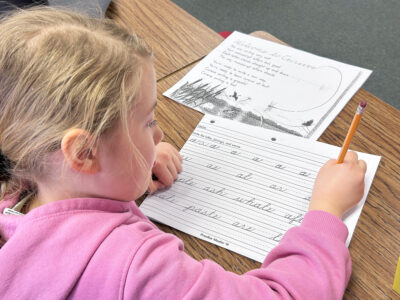
- Patience Gozaydin, 7, a second grade student at Frankstown Elementary practices cursive writing Thursday in Ann Franco’s class. Mirror photo by Cynthia Wise
-

- Oakland Butcher, 9, a third grade student at Frankstown Elementary, completes a letter a cursive writing worksheet at the school in Hollidaysburg. Oakland was praised by her teacher as having some of the best cursive writing in third grade. Mirror photo by Cynthia Wise
-
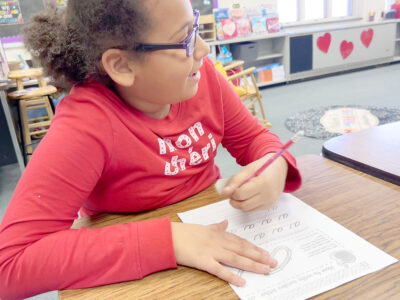
- Oakland Butcher, 9, a third grade student at Frankstown Elementary, completes a letter a cursive writing worksheet at the school in Hollidaysburg. Mirror photo by Cynthia Wise
-
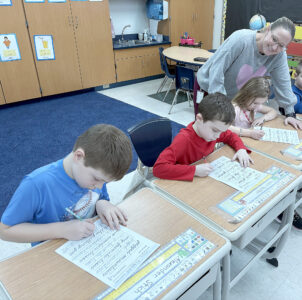
- Myers Elementary second grade students Alexander Stich (from left), Hayden Hostler and Charlie Wolfe practice their cursive handwriting skills with their teacher Tara Naylor on Thursday. Courtesy photo
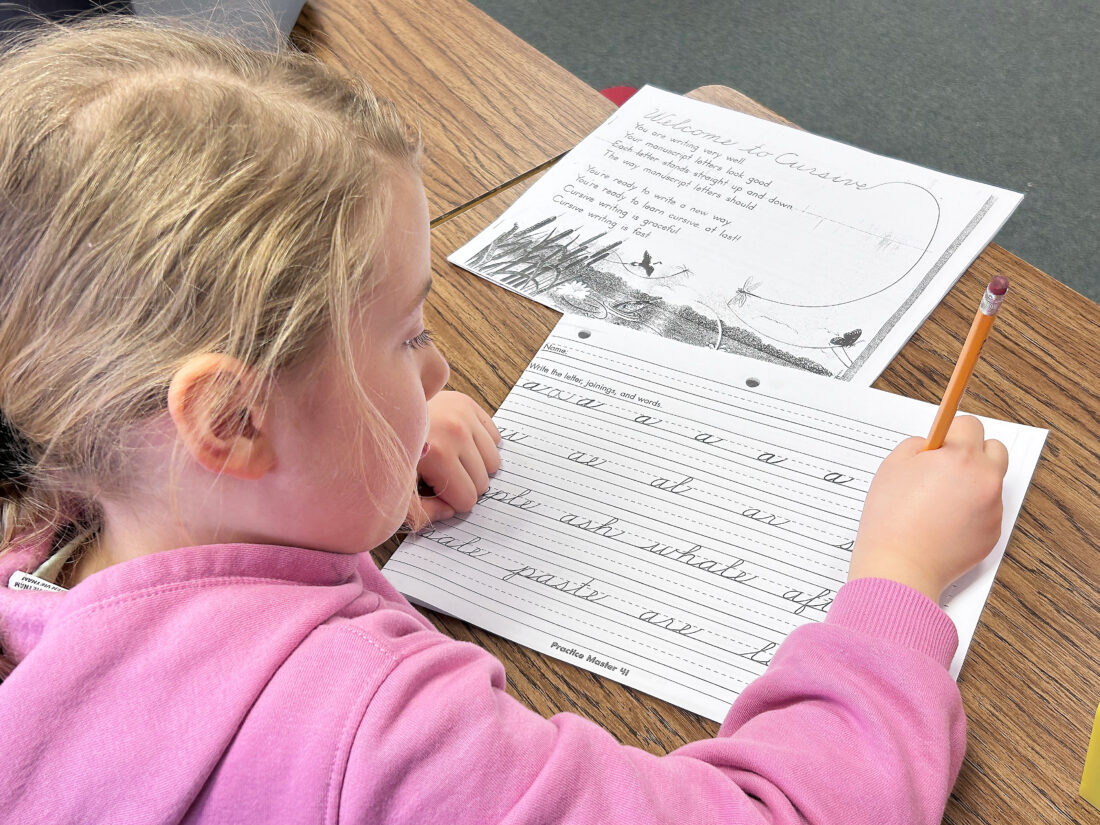
Patience Gozaydin, 7, a second grade student at Frankstown Elementary practices cursive writing Thursday in Ann Franco’s class. Mirror photo by Cynthia Wise
The flow of motion from putting pencil to paper and writing in cursive strengthens cognitive development and fosters fine motor skills, according to Travis Lee, Huntingdon Area School District’s director of curriculum and instruction.
Cursive writing also contributes to the development of language, strengthens working memory, retention and comprehension and increases students’ motivation and pride in their work, said Haley Fleegle, Altoona Area’s assistant superintendent of curriculum, instruction and elementary programs.
That’s why so many school districts in the region, like Huntingdon Area and Altoona Area, have never dropped the practice of teaching cursive handwriting and are mostly unaffected by Act 2 of 2026, a recently signed law that requires all public and private schools in the commonwealth to incorporate cursive handwriting into their curriculum.
At Altoona Area, second grade students are introduced to cursive writing during the second semester of the year, Fleegle said, adding the district will continue to review state requirements as they’re released to ensure its processes and procedures are meeting the new legislation.
At Huntingdon Area, students are taught cursive in the third grade, Lee said.
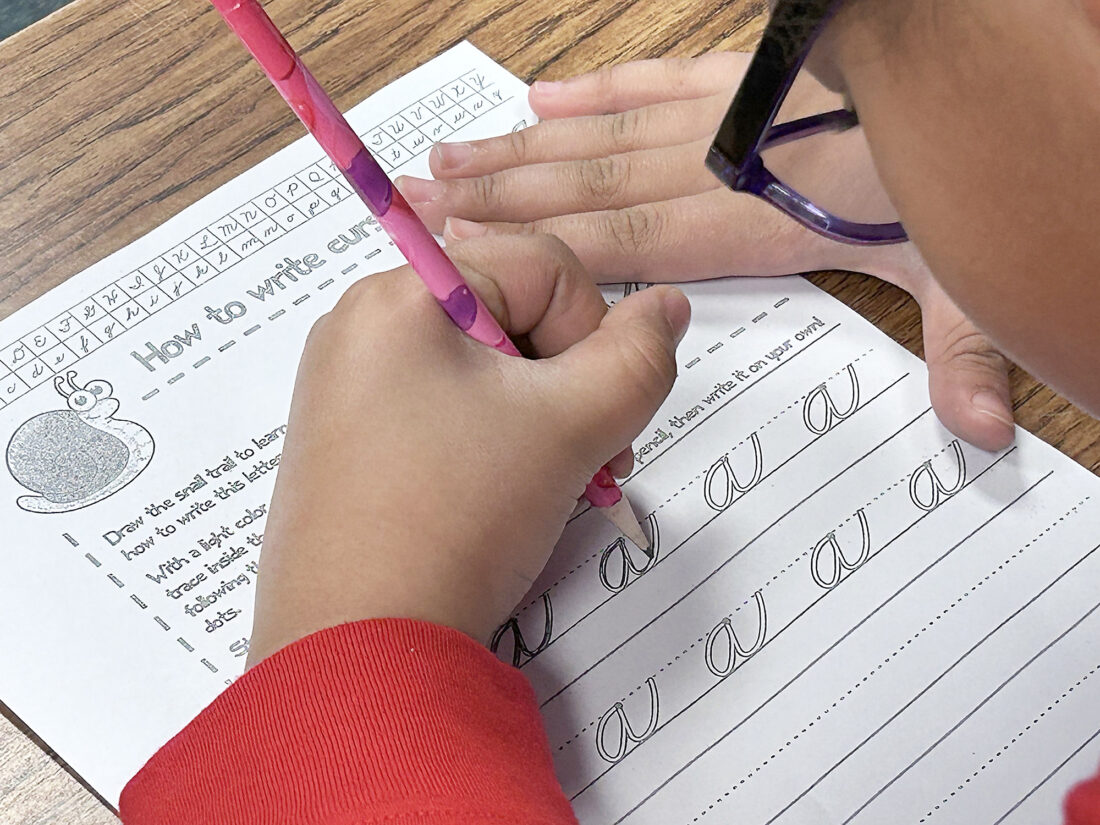
Oakland Butcher, 9, a third grade student at Frankstown Elementary, completes a letter a cursive writing worksheet at the school in Hollidaysburg. Oakland was praised by her teacher as having some of the best cursive writing in third grade. Mirror photo by Cynthia Wise
A sense of accomplishment
Even in an age when the majority of writing is conducted using technology, students take pride in learning cursive handwriting, Lee said, adding his son, Theo Lee, is currently a third grader in the district who loves to practice his “fancy letters.”
“They feel a sense of accomplishment. They take pride in it,” Lee said. “They’ve been in school for several years now, and this is like the next big thing to look forward to.”
At Hollidaysburg Area School District, students are taught cursive handwriting in second grade.
Frankstown Elementary teachers Summer Carson, Evelyn Sidehamer and Taylor Ostinowsky said their students eagerly look forward to learning how to write in cursive and applying their newfound skills to assignments.
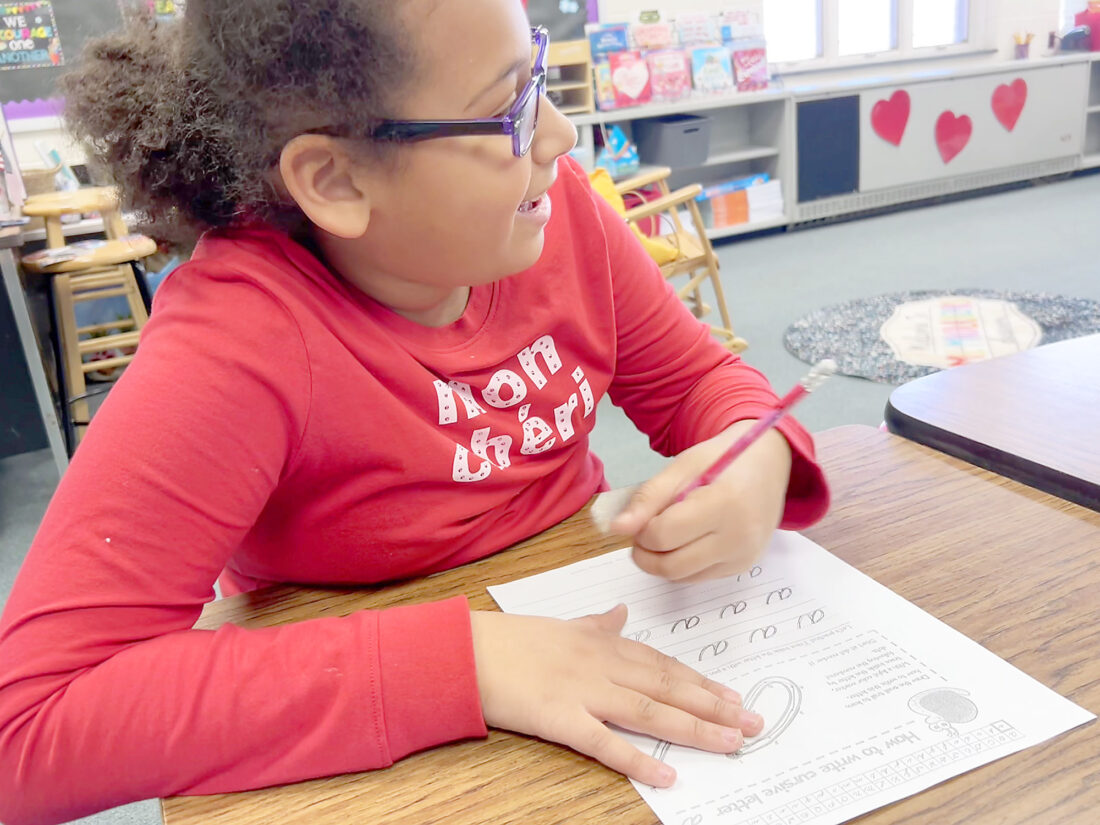
Oakland Butcher, 9, a third grade student at Frankstown Elementary, completes a letter a cursive writing worksheet at the school in Hollidaysburg. Mirror photo by Cynthia Wise
“Cursive has always been part of what we do,” Sidehamer said.
The teachers introduce cursive after their students develop a strong foundation in printing, Sidehamer said, adding lessons focus on letter formation, connections between letters and building fluency in a way that feels manageable and encouraging for young learners.
“In a world that focuses a lot of energy around technology, we value preserving this form of communication that builds confidence, independence and pride in all of our students,” Carson said.
Already implemented
Chestnut Ridge Superintendent Kyle Kane said the district has been teaching cursive, embedded in second grade curriculum, for many years.
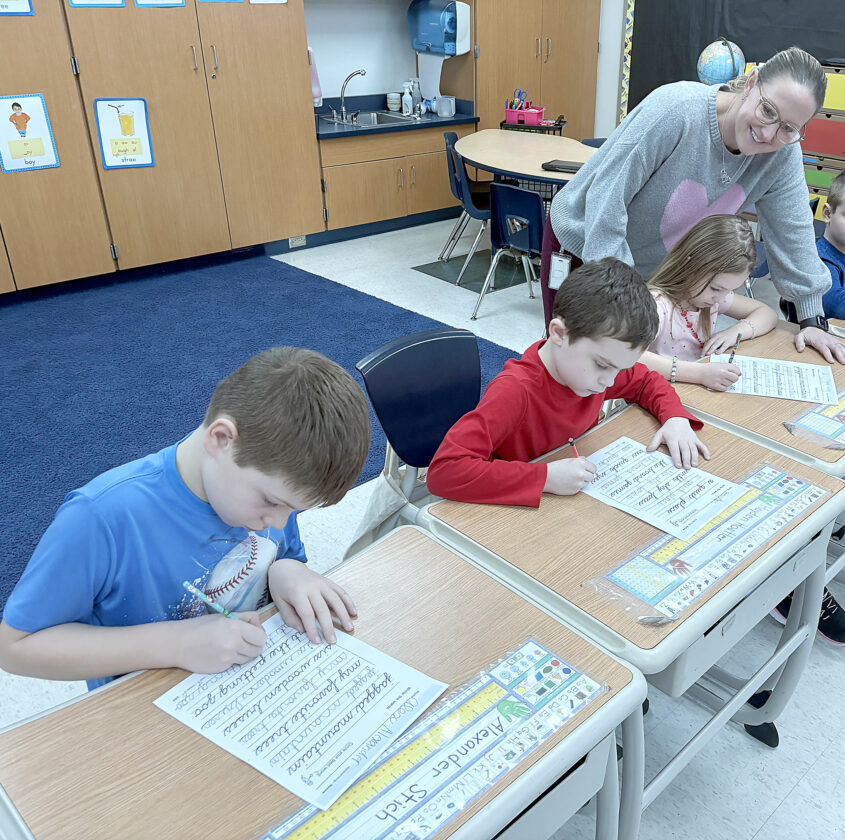
Myers Elementary second grade students Alexander Stich (from left), Hayden Hostler and Charlie Wolfe practice their cursive handwriting skills with their teacher Tara Naylor on Thursday. Courtesy photo
“We view cursive instruction as one component of a broader literacy foundation,” Kane said, adding students with strong handwriting skills are able to focus more fully on the content of their writing.
“It also provides students with the ability to read historical documents, personal correspondence and primary sources that are written in cursive,” Kane said.
Portage Area Superintendent Pete Noel said the district has never eliminated cursive handwriting from its curriculum. An introduction is taught in second grade and teachers reinforce cursive handwriting in the third and fourth grades, he said.
At Everett Area School District, students are taught cursive in the same manner as Portage Area, according to Superintendent David Burkett.
Similarly, Bellwood-Antis introduces cursive writing in second grade and reinforces it in third grade, said Myers Elementary Principal Matt Stinson.
“We tell our kids that it’s your personal sign-off; it’s unique to you,” Stinson said of students learning to write their signatures.
At Moshannon Valley School District, teachers primarily focus on print writing in kindergarten and first grade, and cursive is introduced to second grade students about midway through the school year, Superintendent Brandy O’Hare said.
Law reinforces benefits
DuBois Area Superintendent Wendy Benton said cursive handwriting is currently in the district’s elementary curriculum, which won’t be affected by Act 2 of 2026. She said the law only reinforces a practice officials view as beneficial to students’ overall literacy development.
Southern Huntingdon County School District Superintendent Hillary Lambert said the law will not have any impact on the district’s cursive writing curriculum, which starts in third grade.
Spring Cove Superintendent Betsy Baker said the district has also never dropped the practice of teaching cursive handwriting, which is taught to students in second grade.
“We have always seen value in our students having this skill. So, for us, this legislation is already aligned with current practice,” Baker said.
At Central Cambria, cursive handwriting is also taught in second grade, Superintendent Jason Moore said.
As far as necessity for routine communication, Moore said learning cursive probably isn’t as important for students as learning keyboarding skills.
“With smartphones and computers, the days of writing and receiving long handwritten notes are probably long behind us, but the Declaration of Independence and the U.S. Constitution are written in cursive,” he said. “It is tough to argue that it isn’t important for a student to be able to read and understand our country’s founding documents.”
Reimplementing cursive
Northern Bedford County School District does not currently teach cursive writing and will need to consider how to integrate it back into grade school, said Superintendent Todd Beatty.
“We are not sure yet what grade it will be taught,” Beatty said. “The elementary principal will be looking at this and have it planned for next school year.”
Beatty said he thinks it’s important for students to be able to read and write in cursive. The legislation will make the district have a more formal curriculum, he said.
“Although I have no concrete examples at the moment, I am sure it went by the wayside because of other requirements placed on schools over the years,” he said. “I have yet to see the state remove requirements from the education plate.”
The Bedford Area School District teaches cursive, but not systematically as required by the law, said Superintendent Paul Ruhlman. The district will be impacted by the law, but to what extent remains unclear, he said.
Ruhlman said the district’s elementary school principal, Kyle Hine, is working on a plan to implement cursive handwriting into its curriculum.
Mixed feelings
Act 2 of 2026 took effect immediately, though school districts haven’t received any guidance or expectations from the state Department of Education as to what their curriculum needs to look like, said Hollidaysburg Area Assistant Superintendent Tracy Boone.
That’s left many school administrators with mixed feelings about the law, including Cambria Heights Superintendent Ken Kerchenske.
While Kerchenske agrees there are benefits to being able to read and write in cursive, he pointed out that the 2025-26 school year is the first in which all school districts are required to administer the Pennsylvania System of School Assessment and Keystone exams online.
Previously, schools could choose to have students complete paper-and-pencil versions of those exams, he said.
“One of the justifications I saw for Act 2 related to the amount of time students now spend looking at screens and using keyboards. However, just as cursive writing is mandated, the ability for students to take handwritten exams has been taken away,” Kerchenske said.
Cambria Heights currently teaches “some cursive writing” but faculty and administrators may have to consider some curriculum adjustments to provide an integrated experience for the district’s students, he said.
Penn Cambria Superintendent Jamie Hartline said his district is in the same boat as Cambria Heights.
“At Penn Cambria, students at the elementary level do participate in cursive handwriting lessons throughout the year,” Hartline said, noting students are just taught the basics of cursive writing.
“We may need to add more devoted time to cursive handwriting instruction and practice as a result of Act 2 of 2026, but we recognize the ongoing research into the ways that learning occurs,” Hartline said.
Stinson said he feels the new law will help improve consistency among school districts, in the event of a student transferring from one district to another.
Lee said, while the new law might not affect many districts, there’s no downside to learning cursive handwriting in school.
“The more we can continue to do good things that benefit students overall, that’s helpful,” Lee said.
The legislation was championed by state Sen. Wayne Langerholc Jr., R-Cambria, who sponsored a similar bill, Senate Bill 645, to ensure Pennsylvania joined 18 other states in requiring cursive writing to be taught in schools.
Langerholc did not respond to a request for comment.
In a press release, Langerholc said officials are investing in students’ cognitive development, strengthening their legal preparedness and preserving their connection to historical literacy by reintegrating cursive into school curriculums.
Mirror Staff Writer Matt Churella is at 814-946-7520.
Local News
Fort Roberdeau director to speak at Tyrone Area Chamber of Commerce meeting
TYRONE — This month’s Tyrone Area Chamber of Commerce breakfast club features Fort Roberdeau director Glenn ...
Ahead of the curve: Many schools prepared as state requires teaching of cursive writing

Shapiro proposes housing solution

Central Blair Recreation and Park Commission to honor Filler for service

Altoona man gets 8 to 20 years for sexually abusing child