
The Rev. Jesse Jackson ‘carried torch’ for Civil Rights Movement
Local residents remember former activist, presidential candidate
-

- The Rev. Jesse Jackson waves as he steps to the podium during the third day of the Democratic National Convention in Philadelphia, July 27, 2016. The Associated Press
-
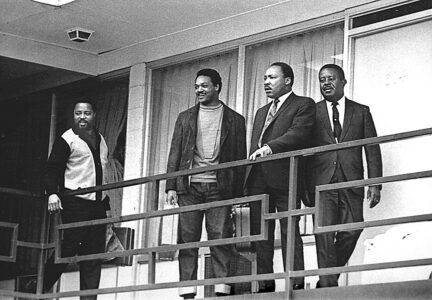
- The Rev. Martin Luther King Jr. (second from right) stands with Hosea Williams (left), Jesse Jackson (second from left), and Ralph Abernathy (right), on the balcony of the Lorraine Motel in Memphis, Tenn., a day before he was assassinated at approximately the same place, on April 3, 1968. The Associated Press
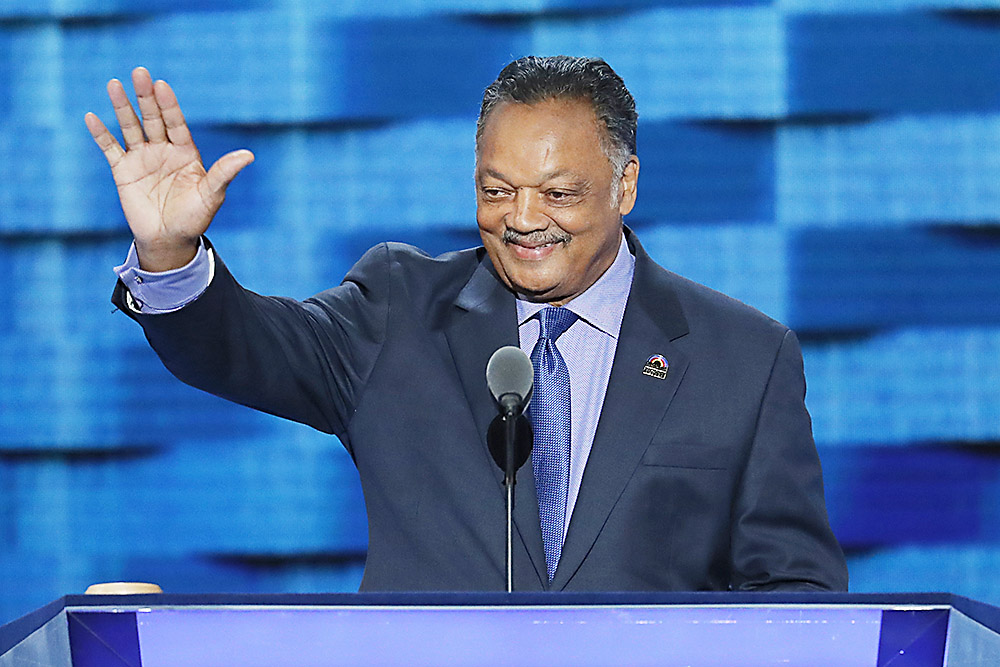
The Rev. Jesse Jackson waves as he steps to the podium during the third day of the Democratic National Convention in Philadelphia, July 27, 2016. The Associated Press
The Rev. Jesse Jackson, the civil rights leader who died Tuesday at 84, is being widely eulogized.
Former Blair County NAACP President Andrae Holsey added a special twist to those tributes: if not for Jackson’s leadership in advocating for equal treatment, including a push for acceptance of interracial marriage, Holsey might not even exist.
Holsey is the son of a Black father born in 1950 in segregated Washington, D.C., and a white mother from Philipsburg-Osceola who met at a dance and married in the 1990s, comfortably past the 1967 U.S. Supreme Court ruling in Loving v. Virginia — prior to which “miscegenation” was a crime in 16 states.
“He tirelessly worked for decades so multiracial families could exist,” Holsey said in a phone interview Tuesday.
Without his advocacy and the work of other civil rights leaders, “there is a good chance my parents wouldn’t have gotten together,” Holsey said.
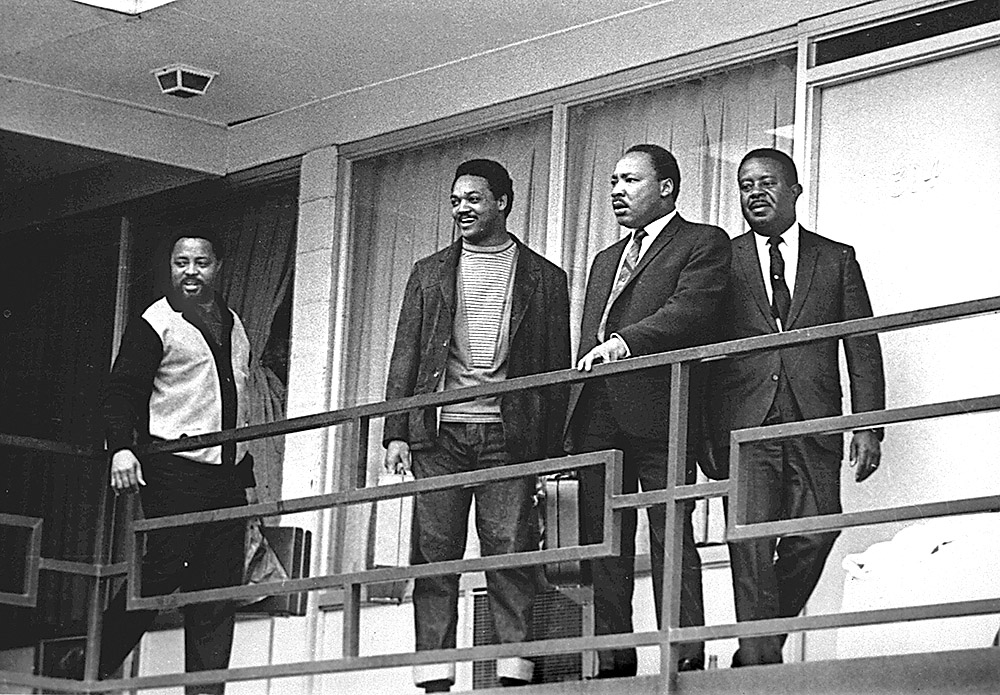
The Rev. Martin Luther King Jr. (second from right) stands with Hosea Williams (left), Jesse Jackson (second from left), and Ralph Abernathy (right), on the balcony of the Lorraine Motel in Memphis, Tenn., a day before he was assassinated at approximately the same place, on April 3, 1968. The Associated Press
And even if they had, their marriage would have been much harder, he said.
Jackson was “the longest enduring” member of the core group of civil rights leaders led by Dr. Martin Luther King, according to Holsey and others.
While King’s utterances were “more iconic,” Jackson’s career was far longer.
“He carried the torch forward,” Holsey said. “For the rest of his life.”
Jackson is a “complicated” figure, according to novelist David Bradley, the Bedford County native who wrote “The Chaneysville Incident,” which won the PEN/Faulkner Award in 1982.
For Bradley, a picture that showed Jackson’s expression when Barack Obama gave his acceptance speech after winning the presidency in 2009 is emblematic.
It showed joy, but also the thought, “that could have been me,” Bradley said.
Jackson ran for president in 1984 and 1988, winning some Democratic primaries, but not the nomination in a campaign no one took seriously, Bradley said.
“No one thought a Black man could get elected president at that time,” Bradley said.
But things had changed by 2009, setting up the “bittersweet” moment when Obama took office, with Jackson forced to be content with having been the “path-layer,” according to Bradley.
“When you’re the person who did all the work, and you see someone else getting all the credit…” Bradley said, his voice trailing off.
King and the core group of civil rights activists — of which Jackson was part — defeated the Jim Crow segregation laws of the South, according to Bradley.
But that turned out to be the easier, cleaner task, he said.
After King’s death, Jackson kept things going, taking the civil rights push to the urban areas of the north, like Chicago, but there, the effort was less popular and harder to sell to the media, Bradley said.
It was “sort of ambiguous in some ways,” Bradley said.
It involved efforts to make things better at lunch counters and stores and in hiring practices, he said.
It was also an effort that involved “struggle” and “massive sacrifices” for Jackson, Bradley said.
Jackson was never as lovable as King, nor as Christian, he said.
He was not perfect, Bradley said, yet he made an important difference.
It was a difference that aggregated over time, little by little — the result of him having “never stopped,” Bradley said.
Eventually, though, Jackson “sort of faded from view,” Bradley said. “He got old.”
Without Jackson’s efforts, there would have been no Obama presidency nor the Democratic nomination of Kamala Harris, according to current Blair County NAACP President Tracy Brown.
Jackson’s runs for the top job in the land make it possible for Obama to win it, according to Pennsylvania NAACP President Stacey Taylor.
Taylor remembers those Jackson campaigns and the talk that they generated in her family when she was a kid.
It wasn’t much different than the talk that Obama himself generated many years later, she said.
Jackson’s efforts to instill hope and optimism resonated with Brown.
There were call-and-response phrases like “I am somebody” and “Keep hope alive.”
“He inspired me to the point where I always wanted to make a difference,” Brown said. “Color aside, I wanted to be in the fight.”
Jackson proved to be “a relentless advocate for those whose voices are too often ignored,” Taylor said.
“I hope he gets his due,” Bradley said.
Mirror Staff Writer William Kibler is at 814-949-7038.
Local News
Spring Cove School Board discusses facilities upgrades to Martinsburg Elementary
ROARING SPRING — Spring Cove School Board members unanimously approved an improvement grant resolution for ...
Altoona Area School District details water damage to junior high
Altoona Area Junior High School students and staff returned back to school Tuesday after a water break last Monday ...
Police investigating fatal crash that claimed Davidsville man
State police are investigating a fatal crash that occurred Feb. 4 in Napier Township, Bedford County. Paul R. ...
The Rev. Jesse Jackson ‘carried torch’ for Civil Rights Movement
Statewide ban on cellphones in schools gaining momentum in legislature
A state ban on cellphones in school is a necessary step to help young people learn to live in the real world ...
Philadelphia duo accused of posing as lawyers to smuggle drugs into prison
An investigation by the state Department of Corrections has broken up a scheme that allegedly used legal mail to ...