
Irreplaceable: Van Zandt performs first VA total joint replacement for an outpatient
-
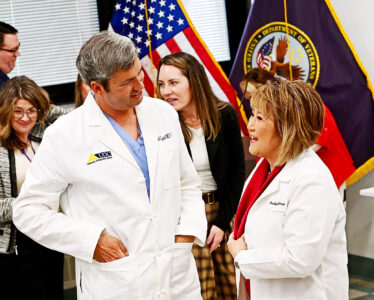
- Orthopedic surgeon Dr. William A. Tyndall talks with Van Zandt VA Medical Center Chief of Staff Dr. Angela W. Rowe after the VA’s first outpatient joint replacement Tuesday. Mirror photo by Patrick Waksmunski
-
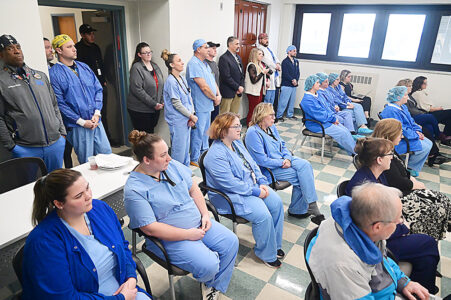
- Van Zandt VA Medical Center staff listen to orthopedic surgeon Dr. William A. Tyndall after the Veteran’s Administration’s first outpatient joint replacement on Tuesday. Mirror photo by Patrick Waksmunski
-
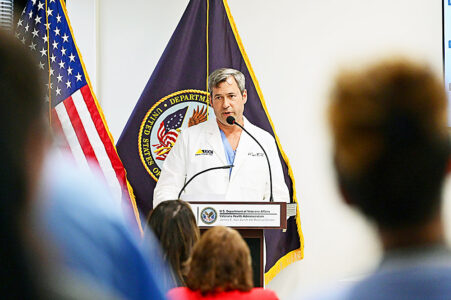
- Orthopedic surgeon Dr. William A. Tyndall speaks after the Veteran’s Administration’s first outpatient joint replacement at the Van Zandt VA Medical Center on Tuesday. The successful surgery took place after “a hundred meetings and two years of hard work,” Tyndall said. Mirror photo by Patrick Waksmunski
-
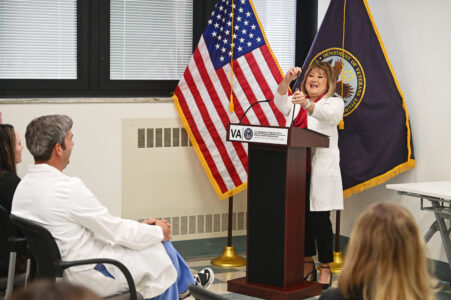
- Van Zandt VA Medical Center Chief of Staff Dr. Angela W. Rowe adjusts the microphone to speak after the Veteran’s Administration’s first outpatient joint replacement on Tuesday. Mirror photo by Patrick Waksmunski
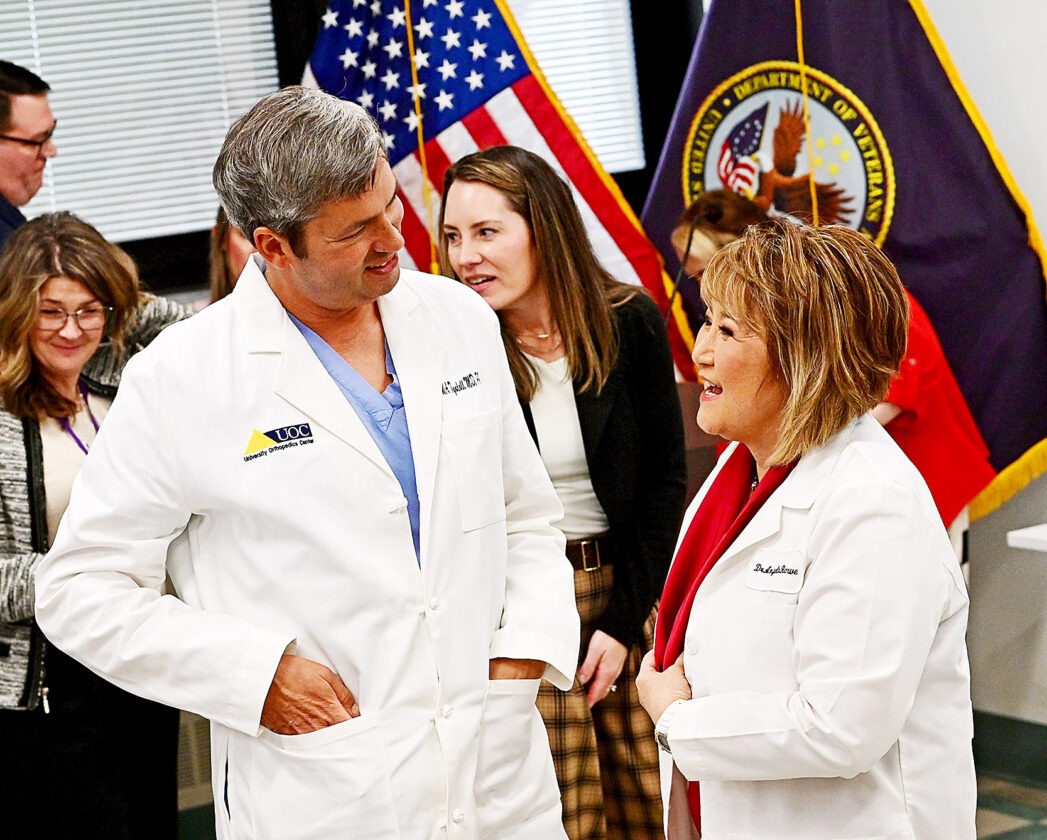
Orthopedic surgeon Dr. William A. Tyndall talks with Van Zandt VA Medical Center Chief of Staff Dr. Angela W. Rowe after the VA’s first outpatient joint replacement Tuesday. Mirror photo by Patrick Waksmunski
The Van Zandt VA Medical Center is not among the bigger hospitals in the VA system nationwide, but on Tuesday, it became the first ever in that system to perform total joint replacement surgery on an outpatient.
Hospital officials seemed ecstatic about achieving the distinction during a news conference shortly after shoulder replacement surgery on Scott Miller, 66.
Yet it probably shouldn’t be surprising that one of the system’s smaller hospitals ended up being the one to do it first, because as an outpatient-only facility that doesn’t deal with high-acuity patients like a major hospital does, there is less competition for resources like X-rays, should something go wrong, according to orthopedic surgeon Dr. William “Andy” Tyndall, who performed the surgery on Miller.
There are several reasons why it makes sense for the VA system — and specifically Van Zandt — to begin doing joint replacement surgeries, according to Dr. Angela Rowe, chief of hospital staff.
VA patients generally prefer to get as much of their health care within the system as possible, Rowe said.
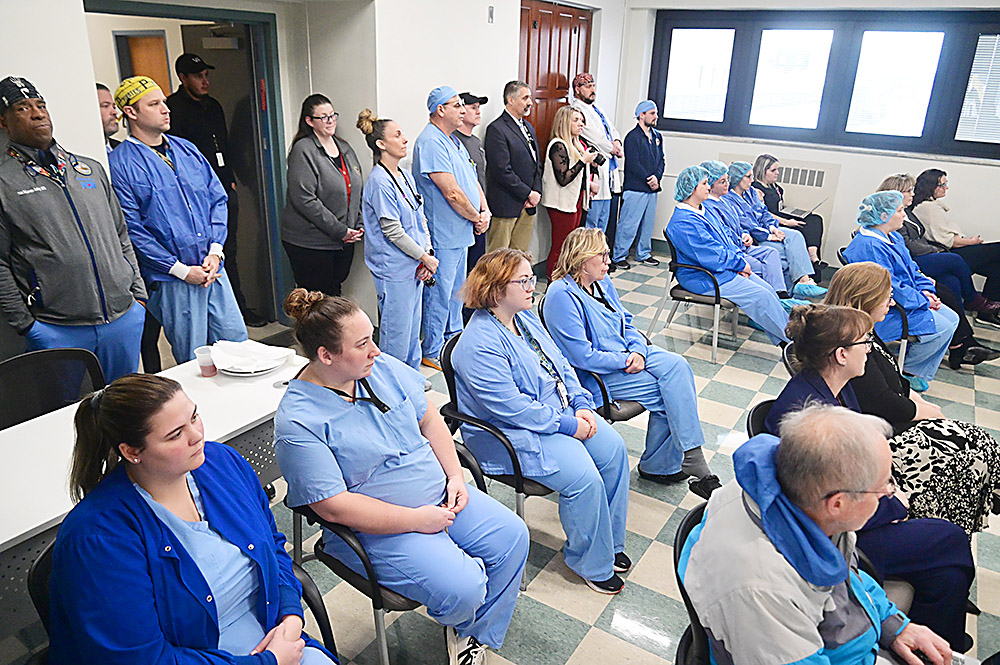
Van Zandt VA Medical Center staff listen to orthopedic surgeon Dr. William A. Tyndall after the Veteran’s Administration’s first outpatient joint replacement on Tuesday. Mirror photo by Patrick Waksmunski
Van Zandt patients in particular prefer to get their care at the local hospital, rather than the VA in Pittsburgh, for example, to avoid the travel and inconvenience, Rowe said.
Scheduling joint replacement surgery in the local community can take seven months, while scheduling such a surgery at Van Zandt now should take just two months, according to Ashley Musselman, Van Zandt’s ambulatory surgery nurse manager.
Having the surgery done at Van Zandt also enables patients to remain connected to their care teams at the hospital for followup, according to Van Zandt Director Derek Coughenour and Musselman.
Getting the operation at Van Zandt is also less expensive, Tyndall said.
More broadly, it makes sense to do joint replacements as outpatient operations, because it helps conserve resources like nurses and hospital beds for situations where they’re mandatory, according to Tyndall.
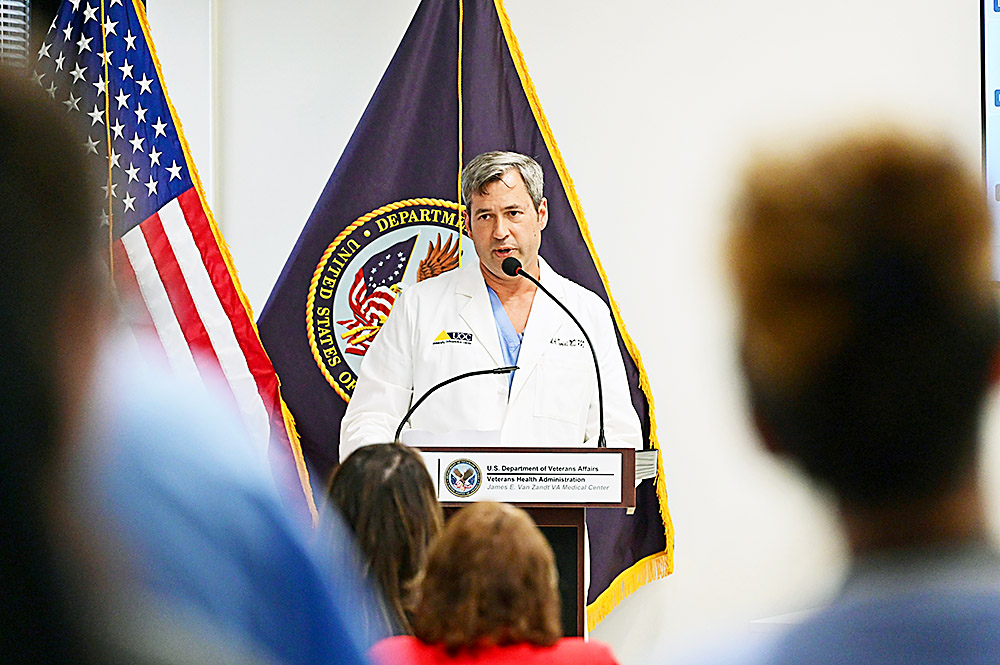
Orthopedic surgeon Dr. William A. Tyndall speaks after the Veteran’s Administration’s first outpatient joint replacement at the Van Zandt VA Medical Center on Tuesday. The successful surgery took place after “a hundred meetings and two years of hard work,” Tyndall said. Mirror photo by Patrick Waksmunski
Total joint replacements for outpatients have been standard in community medicine for many years, Tyndall said.
Making it happen at Van Zandt — and the VA system as a whole — nevertheless took lots of preparation, according to Tyndall, who works 90% of the time at University Orthopedics Center on Fairway Drive and 10% of the time at nearby Van Zandt.
Rowe and Musselman made getting it done a priority, Tyndall said.
“There were a hundred meetings and two years of hard work,” he said.
That included monthly meetings with representatives of the national VA and biweekly meetings at the local hospital, Musselman said.
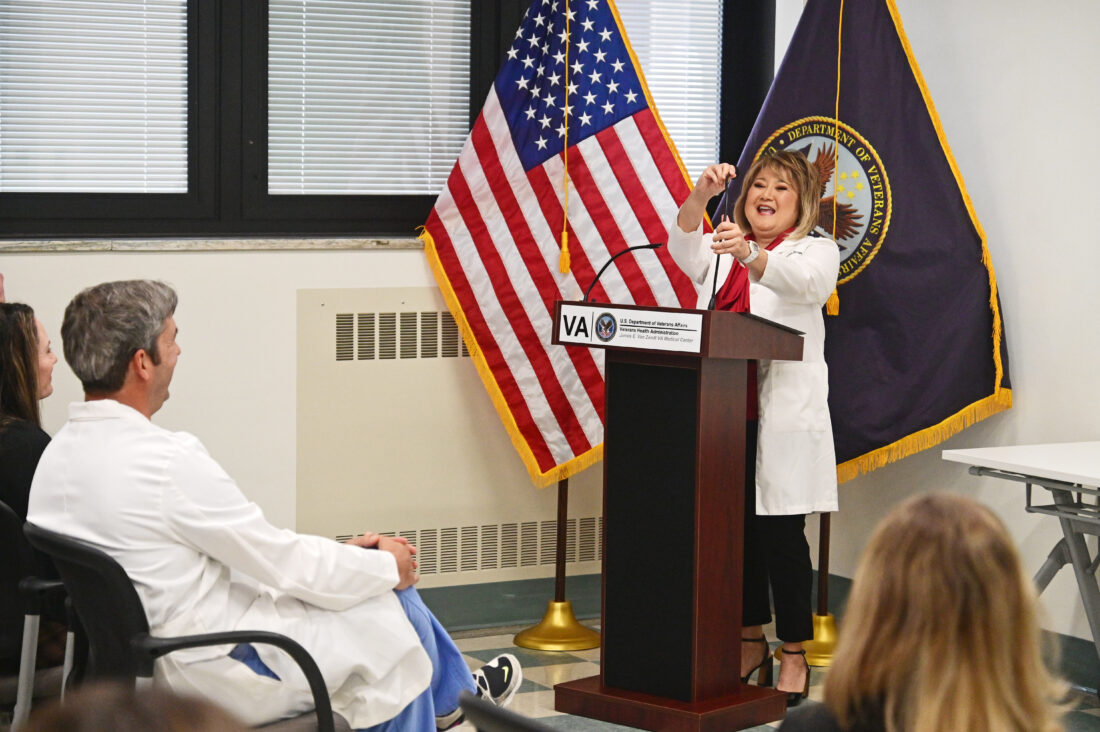
Van Zandt VA Medical Center Chief of Staff Dr. Angela W. Rowe adjusts the microphone to speak after the Veteran's Administration's first outpatient joint replacement on Tuesday. Mirror photo by Patrick Waksmunski
There were purchases of equipment like surgical saws and drills, of instruments like retractors and materials like bone cement, said Tyndall and Musselman.
New policies and procedures were developed in conjunction with the national organization, Tyndall said.
Those included instructions on what to do if a patient goes home and isn’t doing well, for example, he said.
Written policies and procedures are necessary for any institution but “they’re particularly detailed in the VA,” Tyndall said.
It’s not easy to “change direction” in that system, he added.
Miller suffered from arthritis of the shoulder joint, Tyndall said.
The ball and socket joint had worn out, he said, and pain was his main complaint.
In written answers to six questions posed by the organization in preparation for the surgery, Miller referred to pain four times.
The pain has interfered with his sleep, generally limiting it to three hours a night, he wrote, adding that he has had trouble lifting things and hasn’t been able to put his hand behind his back.
The shoulder trouble has also kept him from golfing and from shoveling the recent snow, he wrote.
People with his condition generally have trouble getting dressed, bathing and other simple tasks like cleaning, Tyndall said.
Miller previously had a knee replaced and that improved his life “like night and day,” Miller wrote.
Tyndall replaced Miller’s natural joint with an artificial one consisting of a ball made of cobalt-chrome alloy and a socket made of high-density polyethylene plastic, the doctor said.
It should last 30 to 40 years, serving for the rest of Miller’s life, Tyndall said.
Hospitals need to choose patients carefully for outpatient joint surgery, Tyndall said.
Those patients need to be healthy, active and ambulatory, and the projected operations can’t require a large amount of blood replacement and can’t take an “excessive amount of time,” he said.
About 50 hospital employees were involved in preparing for and executing the operation, according to Tyndall.
Those included members of the orthopedic clinic, the impact team, the sterile processing team, the operating room team and the anesthesia team.
The group present in the operating room consisted of Tyndall, a physician assistant, two surgical techs, two registered nurses, a certified registered nursing anesthetist and two anesthesiologists.
Miller was given general anesthesia with a regional nerve block.
The regional nerve block is a critical element in outpatient joint replacements, Tyndall said.
It numbs the affected area for 24 hours, and its use allows for lower amounts of general painkilling drugs, resulting in fewer feelings of sickness.
When the regional nerve block wears off, the patient can take painkilling medications by mouth, sooner than if no nerve block had been used.
For the first two weeks following the surgery, Miller will be in charge of his own physical therapy — doing exercises he can tolerate.
After that, he’ll come back to the hospital for physical therapy sessions to get his strength and range of motion back.
The surgeries will continue: A veteran is scheduled for an outpatient knee replacement in two weeks, and there is a substantial waitlist of total joint replacement candidates, according to Tyndall.
Gratitude from patients is one of the most striking characteristics of working in the VA system, said surgical tech Lisa Reighard, part of the team that worked on Miller.
She was employed previously at UPMC and at Bon Secours.
“These patients are so appreciative,” Reighard said. “They’re thanking us as soon as we come in the room, for being here for them — before we have an opportunity to thank them for their service.”
Tyndall agreed.
“It’s the most grateful patient population I’ve ever treated,” he said.
“They do not take (the help) for granted,” he added. “They do not act entitled.”
Mirror Staff Writer William Kibler is at 814-949-7038.
Local News
Altoona woman held on assault count following alleged fight
A city woman is accused of fighting and threatening to kill another woman before driving on a suspended ...
Claysburg man charged with assaulting officer during ex-wife’s arrest
A Claysburg man was taken into custody after allegedly assaulting a police officer as they were arresting his ...
Irreplaceable: Van Zandt performs first VA total joint replacement for an outpatient
Shapiro pushes $53.2 billion budget
FFA Spotlight: Max Price
Tyrone Area School District to seek state grants for facility improvements
TYRONE — School officials at the Tyrone Area School District plan to submit applications for Public School ...