Sweet tradition: Milkshakes dominate Pa. Farm Show
-
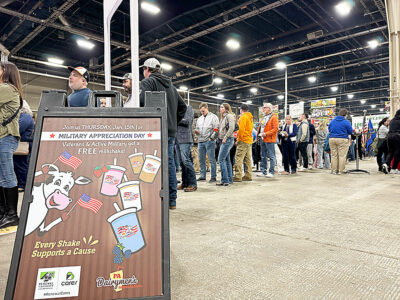
- People stand in line for milkshakes at the 2026 Pennsylvania Farm Show in Harrisburg. Spotlight PA photo by Erin Negley
-
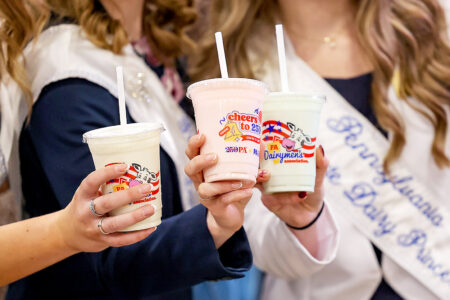
- Pennsylvania state dairy princesses show off the 2026 Pennsylvania Farm Show’s milkshakes, one of the most popular attractions at the annual event. Photo courtesy Pennsylvania Farm Show
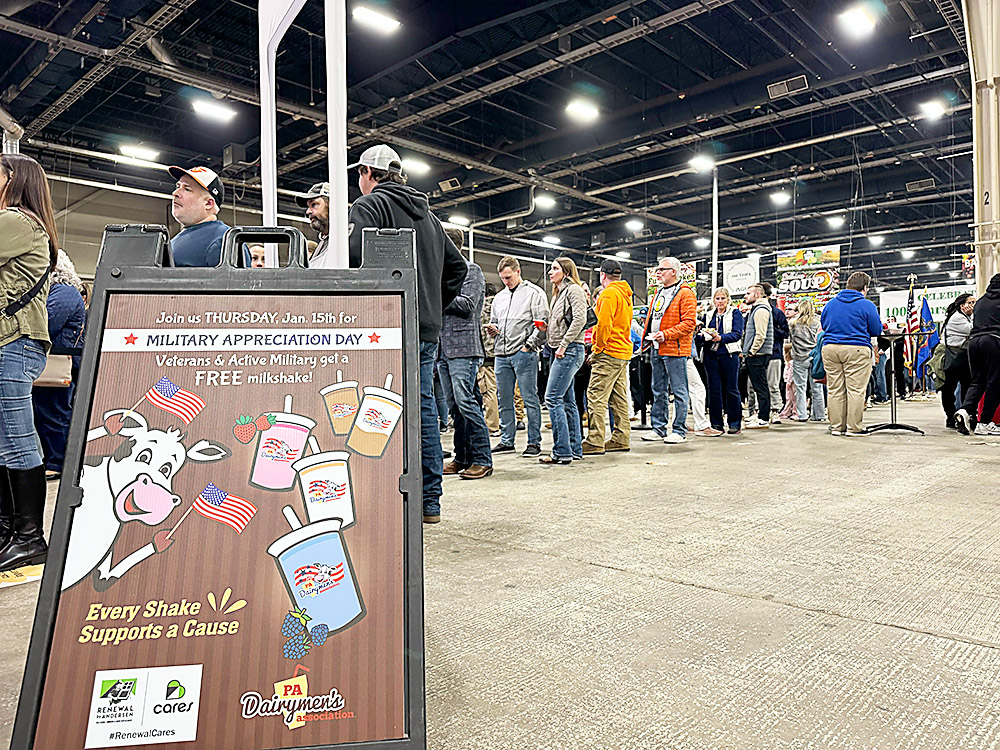
People stand in line for milkshakes at the 2026 Pennsylvania Farm Show in Harrisburg. Spotlight PA photo by Erin Negley
HARRISBURG — Last Saturday, Randy Graham joined a line that stretched into the dozens, prepared to “wait it out” for a storied treat: a Pennsylvania Farm Show milkshake.
“They gotta be really, really good because people come here from all over the place and wait in long lines just to get to be able to sample and try a milkshake,” the Erie County resident, who wouldn’t usually describe himself as a milkshake person, told PA Local. “So, I just gotta see what all the hype is about.”
The Pennsylvania Dairymen’s Association, an industry group, has served milkshakes at the Farm Show since 1953. In the years since, the drink, sourced from commonwealth dairy producers, has managed to become nearly synonymous with its namesake indoor agricultural fair in Harrisburg.
“They’re super duper addicting,” said Maya Black of Hershey, who waited in line for about 10 minutes to get a shake. Black came to this year’s Farm Show specifically for the beverage.
David Smith, the retiring executive director of the Dairymen’s Association, estimated that the group will use around 18,000 gallons of milkshake mixture at this year’s Farm Show — about 40% chocolate, 40% vanilla, and 20% either strawberry or blue raspberry.
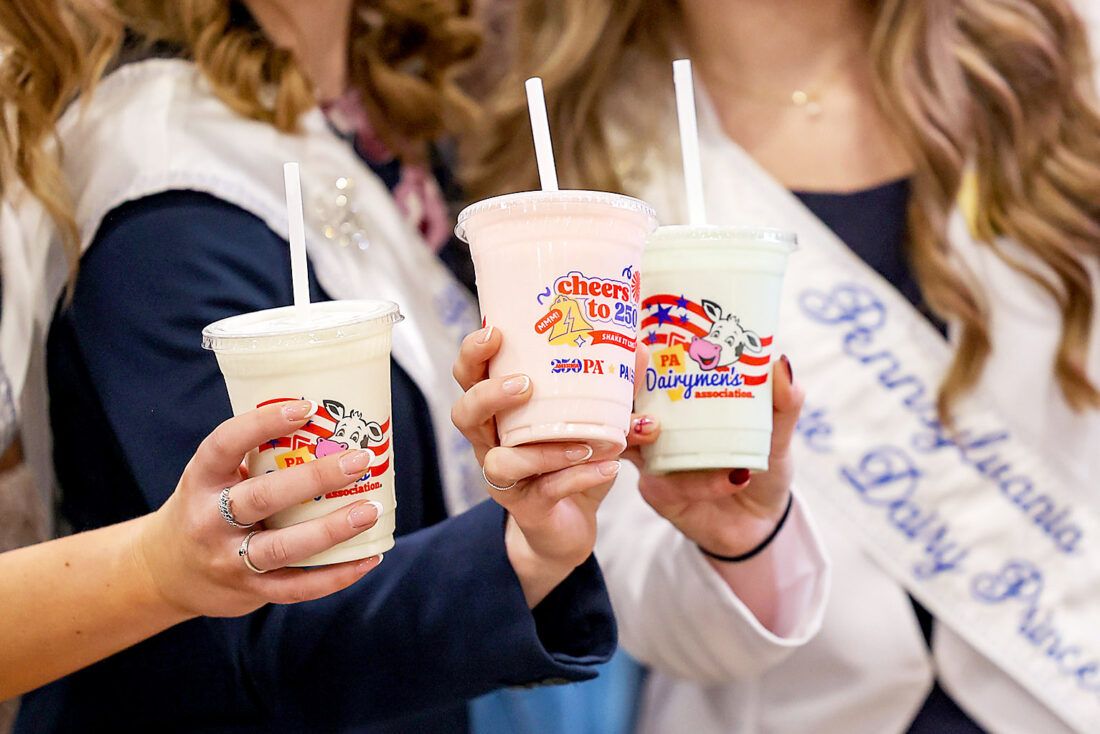
Pennsylvania state dairy princesses show off the 2026 Pennsylvania Farm Show’s milkshakes, one of the most popular attractions at the annual event. Photo courtesy Pennsylvania Farm Show
At both of the association’s booths within the Farm Show, a fleet of mostly volunteers greets customers and takes orders, while another group pumps out an endless stream of thick, creamy milkshakes into 16-ounce cups. Others keep the milkshake machines — there are more than a dozen — loaded with mixture. Over 400 people signed up to help this year, and each shift takes about 45 workers between the two locations, Smith said.
The large crowds drawn to the liquid confection every January have led Smith to become “a student about lines and people movement.”
“We have about eight to 10 different individual lines, and many of those have 20 people in,” Smith said. “I’ll walk out sometimes when it’s really busy, and I’ll stand in line to see how long it takes. … They really do move along pretty quickly. While it looks like it’s very long, the time period that they’re in line is very short.”
‘They eat, and they eat’
Food is a “very big deal to most people” who attend the Farm Show, according to Mary Klaus, who’s written several books about the event and covered it as a journalist for decades.
“The Farm Show is 24 acres under one roof, and it is a spectacular, wonderful show,” Klaus said. “But so many people come in and wanna feed their faces. They eat, and they eat, and they eat.”
Specialized commodity groups serve up prepared eats in a full-fledged food court with selections like maple cotton candy, lamb stew and stuffed mushrooms. That includes the Dairymen’s Association, which sells grilled cheese and fried mozzarella cubes (three and a half tons’ worth, per Smith) in addition to the much-hyped milkshakes.
There’s also a smaller “food court annex” in a different hall, plus individual operators scattered throughout the Farm Show Complex who sell items like pretzels and tacos.
It can be easy to forget the event is a massive exhibition of Pennsylvania’s agriculture sector, and not just a foodie haven.
Food hasn’t always dominated the show, Klaus said. Although the Farm Show started in 1917, 1923 was when food became a staple — specifically baked potatoes that went for a nickel each. In Klaus’s early years of covering the show, church groups would sell items like hot dogs and subs to keep people fed during their hourslong visits to the show, she recalled. Years later, the food court was introduced.
Milkshakes, Klaus said, are “one of the most popular things to have at the Farm Show.” They came on the scene in the 1950s, when the Dairymen’s Association partnered with the fraternal organization Valley Grange in Lewisberry, which secured the necessary volunteer labor to run the stand. Back then, the operation was much smaller. Shakes were made with hand-dipped ice cream and a blender and came in just two flavors: vanilla and chocolate.
The Dairymen’s Association transitioned to a premade mixture in 1969, according to Klaus. Smith says the switch makes for a better, more consistent product and quicker service.
That efficiency is crucial, as the milkshakes’ popularity has swelled over the past three decades. At the 1991 Farm Show, the Dairymen’s Association sold 58,000 milkshakes, the Intelligencer Journal reported, a number that increased nearly threefold by 2015.
Asked how many were sold last year, Smith said tens of thousands.
Prices have gone up, too. In 1955, visitors could buy a shake for just a quarter — equivalent to about $3 in today’s currency — and at the turn of the century, the treat sold for $1.50 a pop. Nowadays, it’ll set you back $7.
Smith said the association “struggles” to figure out the “right time” to increase the price when they’re dealing with rising costs (the most recent increase was last year), but added that “they have not seen any reduction in our sales due to a price increase.”
Proceeds go toward funding agricultural education programs, Smith said, adding that the Dairymen’s Association has put around $6 million toward “community and agriculture events across the commonwealth” in the past 11 years.
About 2008 or 2009, the group realized it had “struck on something that was very popular” and started expanding the milkshakes’ footprint beyond the Farm Show Complex, Smith said. The drinks have since popped up at other events, from National Nights Out to Dairy Month celebrations in June to Gov. Josh Shapiro’s inauguration party in 2023.
The association has also expanded the available flavors over the years. Inspired by their success selling special strawberry milkshakes at a fundraiser for the PA Breast Cancer Coalition, Smith said, the group rolled out a third flavor at the Farm Show for the first time in 2016.
Limited-edition flavors have debuted in subsequent years: from black raspberry (2022), to orange cream (2023), to salted caramel (2024), and mint (2025).
This year, for the first time, there’s a third and a fourth extra flavor: blue raspberry and strawberry, designed to be served in a $21, three-shake “flight” alongside vanilla to celebrate the country’s semiquincentennial.
The addition of a rotating flavor, which is usually announced the month before the show, has been good for the milkshakes’ brand, Smith said.
“It has really created some real energy around what we’re doing,” he said. “People, you know, they want to guess, and they have suggestions. It’s created some engagement with all of our customers — they want to be part of it.”
Why the pilgrims come
What exactly is it about the drink that motivates people to brave those big crowds year after year — in the middle of winter, nonetheless?
“It’s local products, so it’s supporting local people,” Ethan Troup of central Pennsylvania told PA Local from the milkshake line on Saturday afternoon. “And they’re just good.”
For Cayla Hicks, who lives in the Poconos and grew up near Harrisburg, sentimentality is a big draw. The shakes used to come to her high school, she said, “So, it’s been nostalgic, coming back and getting to have them again.”
Farm Show milkshake enthusiasts also point to the quality.
Tanesha B. of Hershey said other milkshakes — like what you could get any day at McDonald’s — simply can’t compete with “Pa. dairy.”
According to Smith, that difference is intentional. Because the Dairymen’s Association represents farmers in Pennsylvania, it wants to “offer the highest quality product,” so its milkshake has a higher percentage of butterfat than most, he said.
“Obviously, the cost to us is a little bit more, but the taste and quality that comes along with that product is a higher quality and tasting product than you may get at some places,” Smith said.
Klaus’ explanation of the milkshakes’ wide appeal is even simpler.
“People love it because it’s a happy treat,” Klaus said. “And why not have a happy treat? I mean, people lead hard lives, and they work hard, so a happy treat is good.”
Local News
Sweet tradition: Milkshakes dominate Pa. Farm Show
Pennsylvania Superior Court upholds termination of couple’s parental rights
The Pennsylvania Superior Court on Tuesday upheld a decision by Blair County President Judge Wade A. Kagarise that ...
Claysburg-Kimmel School District chooses McClure Co. for energy audit
CLAYSBURG — Following a request for project proposals, the Claysburg-Kimmel School Board on Wednesday unanimously ...
Step by step
Traffic stop leads to Altoona man’s arrest for drugs
A city man was taken into custody after a traffic stop led to police discovering drugs and drug paraphernalia in ...