
Blair County cracks down on human trafficking
County takes offense ‘seriously,’ as it recently ranked ninth in prosecution
Human trafficking is one of the oldest crimes committed, according to Ashley Gay Vocco, victim services program director for Family Services Inc.
Exploiting individuals with vulnerabilities, human traffickers unlawfully use force, fraud or coercion to profit from commercial sex acts, contributing to the $150 billion global industry.
More than 1 million Americans are victims of human trafficking, but it’s difficult to keep count, as trafficking happens behind closed doors and many victims remain silent, Vocco said.
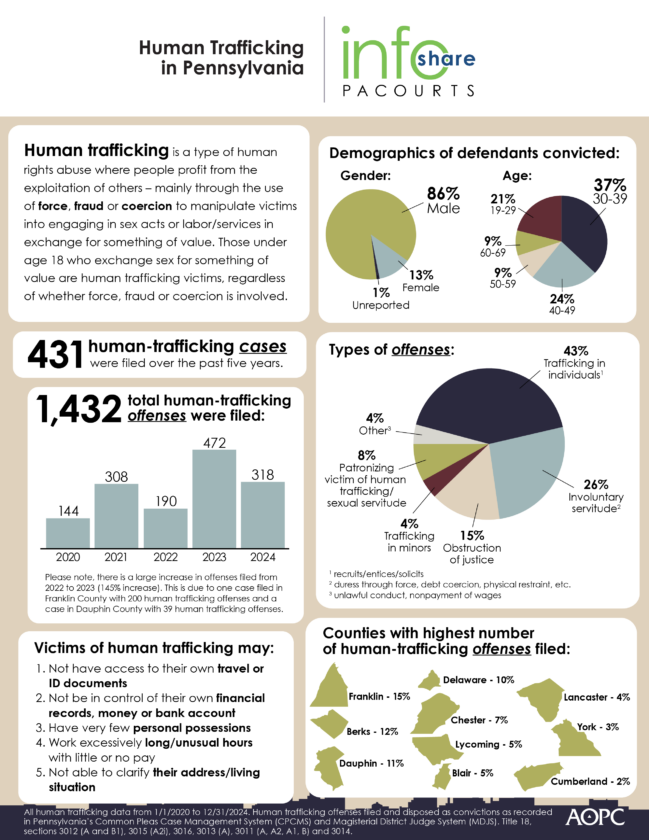
It also remains an issue in Blair County, as the county was recently ranked sixth in the number of prosecutions, but is ranked 28th in most populated among Pennsylvanian counties.
The number, however, is misleading, Vocco said, because local law enforcement officers are holding people accountable for trafficking charges, in turn raising the prosecution number.
As January is National Human Trafficking Prevention Month, local organizations and officers shared their knowledge about the crime while offering prevention tactics.
Drug- and sex-trafficking rings
In some cases, human trafficking can happen in rings, where drugs and substances are no strangers.
On Nov. 21, 2025, Donald “The Rev” Dargan was found guilty in Blair County of drug delivery resulting in the death of Colleen Buck and many single felony counts, including involuntary servitude, human trafficking and sexual assault.
He was also acquitted of single felony counts of conspiracy to commit corrupt organizations and possession with intent to deliver drugs to Buck.
During the closing argument, District Attorney Pete Weeks told the jury that Dargan was “not only the biggest customer of this group, but the biggest facilitator.”
Altoona police became aware of a human-trafficking ring in December 2020, which would provide women with drugs to get them “strung out.” Cutting the women off from their supply of drugs, the women would prostitute themselves to obtain more drugs, police said.
Considering that Blair County is ranked sixth in human trafficking prosecutions across the state, Weeks said the Altoona Police Department takes it “seriously.”
Many local human-trafficking situations or rings involve drugs, Weeks said during a phone interview, as the highway system presents a “major factor” in drug addiction.
Drug addicts are also at a higher risk of becoming victims of human trafficking because they become “more willing to do things that an ordinary person won’t do to feed the drug addiction,” he said.
As a result, Weeks said someone with a drug addiction and struggles with holding down a job or functioning normally shows “big warning signs” that can eventually lead to becoming a trafficking victim.
Money- and sex-trafficking
Human trafficking can also be used to make profitable gains, as it becomes a market off of vulnerable individuals.
A Monroe County man was charged with felony trafficking, rape and aggravated assault in December 2025 after running a trafficking ring for two years, according to state Attorney General David W. Sunday Jr.’s website.
Thomas Cory Green, 33, used “force, intimidation and emotional manipulation” to coerce victims into commercial sex acts, working with two other individuals, Quindell Bowers, 27, and Christopher Williams.
Many victims feared further aggression if rejecting Green’s advances, as he used physical violence and alleged gang affiliation to frighten and control victims.
Williams created website advertisements on platforms typically used by sex traffickers “to solicit buyers for their victims” and profited from commercial sex acts, the website states.
“Defendant Green used violence and his criminal past to invoke fear in these women, whom he devalued as people and viewed solely as a means to make money,” Sunday said.
Human trafficking is also a “business,” according to Shea Rhodes, director of the Institute to Address Commercial Sexual Exploitation.
“The people buying sex are driving the money for traffickers in the business,” she said, adding that traffickers predominantly target women and girls because of existing misogyny and patriarchal ideals.
While 94% of men don’t buy sex, she said there’s a “small subset that do who are high-frequency buyers.”
Familial trafficking
Dangers can come from inside the home as well, as many victims of human trafficking are abused by their own family.
Pennsylvania native Sarah Isaac-Samuel first experienced sexual abuse from her father and stepmother at four years old, according to Fox 43.
During Isaac-Samuel’s elementary years, she was molested by her school bus driver. It was later discovered that the bus driver was paying Isaac-Samuel’s stepmother for access. Isaac-Samuel’s stepmother would take her daughter to the bus driver’s house, where he would molest Isaac-Samuel.
The trafficking continued for two years, as Isaac-Samuel avoided going to school, which would result in violence from her parents.
Later in life, she wrote “A Journey Back to Restoration,” facing the hard truths of her childhood.
“With familial trafficking, everything looks normal. That’s the whole thing,” Isaac-Samuel told Fox 43. “They try to make it look as if nothing is going on. It’s happening everywhere.”
While this particular case didn’t happen in Blair County, Vocco said familial trafficking also happens in rural communities.
A family member or friend — possibly involved with drugs — can include a vulnerable child in porn, she said. That child might “know the person who took the picture, but they might not know who it (the picture) has been sold to.”
Social media precautions
Vocco said “anyone with a vulnerability” can become a human-trafficking victim, whether it stems from hunger, drugs or negligence.
Anyone can be a victim, but “the more vulnerable you are, the more you can be exploited,” she said.
Yet, social media can make trafficking easier for predators, posing as different and/or younger people on the internet to exploit vulnerable individuals or young children.
Predators can hide behind a screen, pretending to be a person of interest to the victim and ask for explicit pictures, Weeks said. Once the predators have leverage, they can demand money or threaten to leak those pictures.
Parents or guardians should “take a proactive approach” by monitoring their children’s social media use, he said.
Rhodes said if someone doesn’t know the person in real life and wouldn’t know them without the internet, “don’t be friends with them on the internet.”
Trafficking can start with a simple question, Vocco said, so it’s important to say “no” when faced with an uncomfortable situation.
Targeted individuals should also stay aware of their surroundings, as “knowing who you can trust in your life” can become vital in life-
threatening scenarios.
Know the signs:
According to the National Human Trafficking Hotline, someone may be experiencing labor trafficking or exploitation if they:
– Feel pressured by their employer to stay in a job or situation they want to leave
– Owe money to an employer or recruiter or are not being paid what they were promised or are owed
– Do not have control of their passport or other identity documents
– Are living and working in isolated conditions, largely cut off from interaction with others or support systems
– Appear to be monitored by another person when talking or interacting with others
– Are being threatened by their boss with deportation or other harm
– Are working in dangerous conditions without proper safety gear, training, adequate breaks, or other protections
– Are living in dangerous, overcrowded or inhumane conditions provided by an employer
Recognizing Sex Trafficking
Sex trafficking occurs when individuals are made to perform commercial sex through the use of force, fraud, or coercion. Any child under 18 who is involved in commercial sex is legally a victim of trafficking, regardless of whether there is a third party involved.
According to the National Human Trafficking Hotline, someone may be experiencing sex trafficking if they:
– Want to stop participating in commercial sex but feel scared or unable to leave the situation.
– Disclose that they were reluctant to engage in commercial sex but that someone pressured them into it.
– Live where they work or are transported by guards between home and workplace.
– Are children who live with or are dependent on a family member with a substance use problem or who is abusive.
– Have a “pimp” or “manager” in the commercial sex industry.
– Work in an industry where it may be common to be pressured into performing sex acts for money, such as a strip club, illicit cantina, go-go bar, or illicit massage business.
– Have a controlling parent, guardian, romantic partner, or “sponsor” who will not allow them to meet or speak with anyone alone or who monitors their movements, spending, or communications.
Local News
Luthersburg teen to be tried in juvenile court
The case of a 15-year-old Luthersburg boy charged in the shooting death of a 12-year-old girl will be transferred ...
Pittsburgh anti-ICE sentiment growing
Local and state officials in the Pittsburgh region continue speaking out against U.S. Immigration and Customs ...
Martinsburg woman allegedly tried to kill husband
A Martinsburg woman was denied bail after allegedly trying to carry out a murder plot against her husband by luring ...

Joyce to run for re-election
Power load growth forecast drops slightly
With AI-powered data centers rapidly driving up demand for electricity, predicting future needs is essential for ...
Altoona man arrested in alleged stabbing
A city man is behind bars for allegedly stabbing a woman with kitchen scissors after she told him to “go ahead, ...