Support system: Nurse-family mentor program aids mothers
Nurse-family mentor program aids mothers
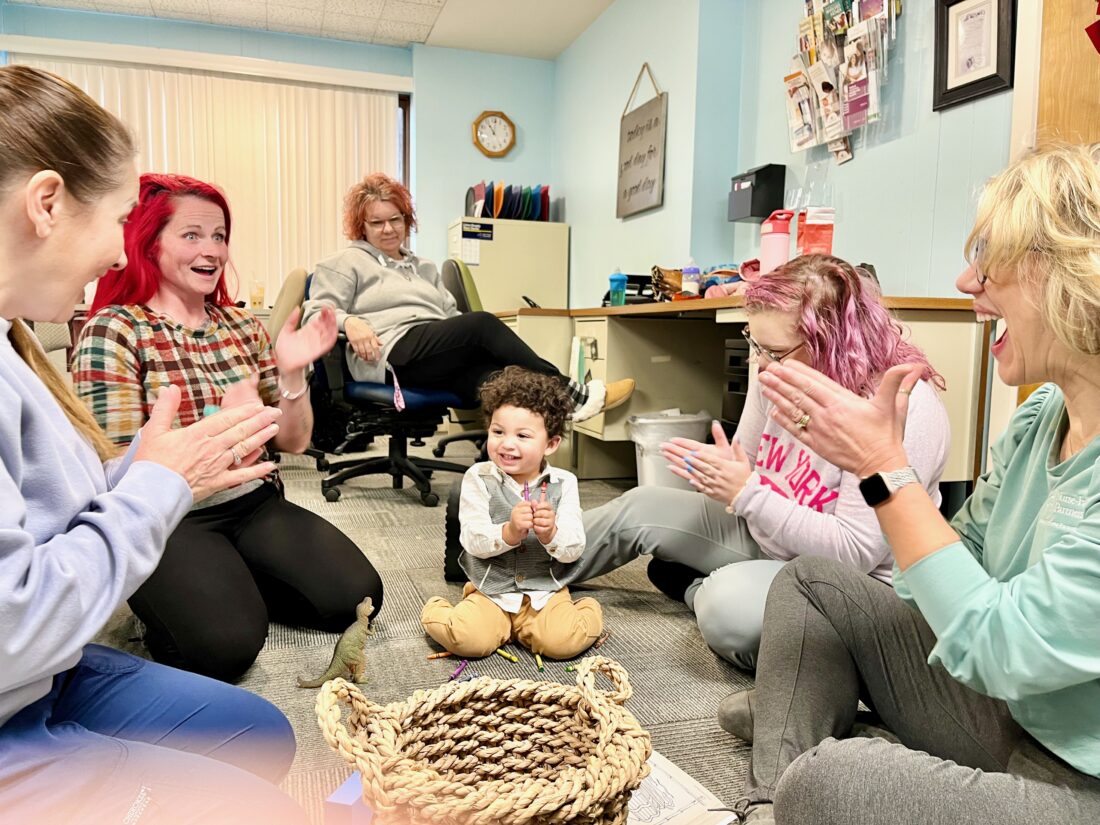
Mirror photo by William Kibler / Nurse Sylvia Rickabaugh of UPMC’s Nurse-Family Partnership (from left), former partnership client Katie Ickes, current client Chelsea Eger and partnership nurse supervisor Linda Watt are seated on the floor playing with Eger’s son Carson Eger, as Chelsea’s mother Lisa Eger watches from a chair.
At an interview this week to gather information on a national program designed to help income-qualifying first-time mothers navigate the difficulties of pregnancy and raising a baby, 17-month-old Carson Eger grabbed a flashlight and began whacking the back of a laptop.
Quickly, his mother Chelsea Eger and her registered nurse mentor Sylvia Rickabaugh took the flashlight and hid it behind an item on a desk, then redirected Carson’s attention to a basket on the floor, sparing the electronic device and demonstrating one of many tactics that the program teaches to help new mothers survive and succeed.
Administered regionally by UPMC, the evidence-based program has been conducted in Pennsylvania for 27 years and is free to clients, whose RN mentors help them learn what is normal and what to worry about before and after birth; how to equip their homes, cars and themselves with items like cribs, car seats and breast pumps; and how to deal with the mental and physical stresses of pregnancy and motherhood.
“Babies don’t come with instructions,” said Lynn Watt, nurse supervisor for the program, which provides knowledgeable individuals for guidance when needed in the absence of those hypothetical instructions from early in pregnancy through the child’s second birthday.
The program offers “an umbrella of resources,” said Katie Ickes, a former program client whose son Gabriel is now seven.
The nurse mentors ensure the mothers get prenatal care, which includes holistic assessments and checks on the blood pressure and heartbeats of the unborn babies.
When Eger was pregnant, Rickabaugh’s presence as mentor helped ensure that she got the necessary care for the high blood pressure and borderline “preeclampsia” that she developed, which required Carson’s birth to be induced.
The nurses help the mothers track their babies’ development milestones — “ages and stages,” according to Eger.
Those include starting to eat, to crawl, to walk, to talk.
The nurses alert the mothers to development anomalies, like Carson’s bowleggedness and a tendency to tilt his head to one side.
For the bowleggedness, Carson is encouraged to step over things and not to sit like a frog — actions intended to strengthen the hips.
There are exercises to counteract the head tilt.
The nurses guide the mothers on how to feed their children, when to introduce solid food, what kind of food to provide and how to prepare it, how to position the child for sleep and what sort of crib environment to create.
They warn the mothers about choking hazards — like hot dogs cut crosswise.
They need to be sliced lengthwise, Eger said.
The nurses emphasize positive reinforcement.
They also emphasize how mothers need to find out what works in their specific cases.
And they impress on mothers that they need to “give themselves grace,” because none of them are going to be perfect, Watt said.
The children feed off the energy in the home that the mother creates, and when the atmosphere is chaotic and without structure, the children’s lives will end up being chaotic, Eger said.
Keeping a regular schedule is an antidote for that, she said.
Yet it’s important not “to sweat the small stuff,” Watt said, as Carson played with a roll of paper, making a mess — but one that caused no damage and would be easy to tidy up.
When interacting with young children, it’s best not to objectify them, according to Ickes.
Treat them like they’re “an actual person,” she said.
That calls for mothers to crouch or kneel down so the mother’s face is level with the child’s — so the mother isn’t “looming” over the child, Ickes said.
‘Best-kept secret’
Most referrals to the program are from obstetric-gynecologist practices or the potential clients themselves, according to Watt.
Some expectant mothers with troubled lives hesitate to accept the help for fear they might lose their babies.
While the nurses in the programs are mandated reporters, they’re non-judgmental and want the clients to succeed, Watt said.
The nurses do all they can to ensure that the mothers are able to keep their babies, she said.
“We’re on their side 100 percent,” she said.
The partnership helped rescue both Eger and Ickes from substance-use disorder involving methamphetamines, and for Eger, heroin.
“Sylvia (Rickabaugh) saved my life,” Eger said. “I’m the mom I am today because of (her).”
When Ickes got pregnant, she worried about Children and Youth Services becoming involved and about going to jail, as she was “on the run” from three counties, she said.
At one point, she spent a night in jail.
But she also had therapy and counseling.
At one point, she faced a judge.
Things could have gone sour, but a folder of testimonials that Watt had helped put together led the judge to give “me a chance instead of throwing me away,” Ickes said.
That chance helped to ensure that “I didn’t have my baby (while I was) locked to a bed,” she said.
“I haven’t been in trouble since,” she said.
“You’re making me cry,” Watt said.
After her reform, Ickes would frequently enter the Altoona police station to thank the officers she encountered.
Prior to her transformation, she’d done everything she could to avoid contact with police, Watts said.
Eger was homeless, living in a hotel, when she first encountered Rickabaugh.
She got on suboxone, got into the city’s family shelter, then obtained a Section 8 voucher from the Altoona Housing Authority, which enabled her to get her own place.
Rickabaugh can vouch for her doing right by Carson, she said.
Rickabaugh can also help get her back on track with referrals when she feels hopeless or there seems to be a threat to relapse, she said.
“No one wakes up one day and says they want to get pregnant when they’re using drugs,” Eger said. “Sylvia saved my life. … So did my son.”
Before she had Carson, she didn’t care whom she hung out with or where she slept, she said.
Now she doesn’t even talk to the people she knew who used drugs, she said.
“I need to stay sober,” she said, crying. “He won’t have to wonder why his mom was choosing something over him.”
Ickes wants to be the kind of mother who goes to PTA meetings.
“Every decision I make is based on what I do for (Carson),” said Eger.
“We’re all super super passionate about what we do,” Watt said.
For more information visit https://changent.org/Nurse-Family, call 570-326-8912 or email hicksja3@upmc.edu.
“We’re the best-kept secret (in town),” Watt said.
Mirror Staff Writer William Kibler is at 814-949-7038.
Local News

Panther progress: Penn Cambria High School campus renovations get boost from state grant funds, $500K private donation

US braces for more freezing weather
Cold to drive up power demand
The regional electric grid operator, PJM, is predicting power demand will surge this week as arctic cold follows ...
Gibbons Funeral Home reopens in Ashville
ASHVILLE — A familiar funeral service has recently returned to the Ashville community, continuing a legacy built ...
‘Stability’ requested for school infrastructure funds
The William Penn School District led the charge of school districts, parents and community organizations in a legal ...