
Picture perfect: Restoration of judicial portraits at Blair County Courthouse nears completion after 12 years
-

- Blair County Courthouse custodian Marcus Mason dusts the restored portrait of the Honorable Jeremiah S. Black. Mirror photo by Patrick Waksmunski
-
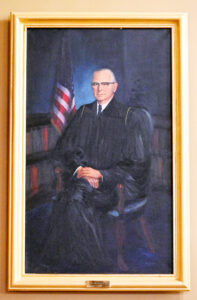
- The restored portrait of the Honorable John M. Klepser hangs in Courtroom No. 1 at the Blair County Courthouse. Mirror photo by Patrick Waksmunski
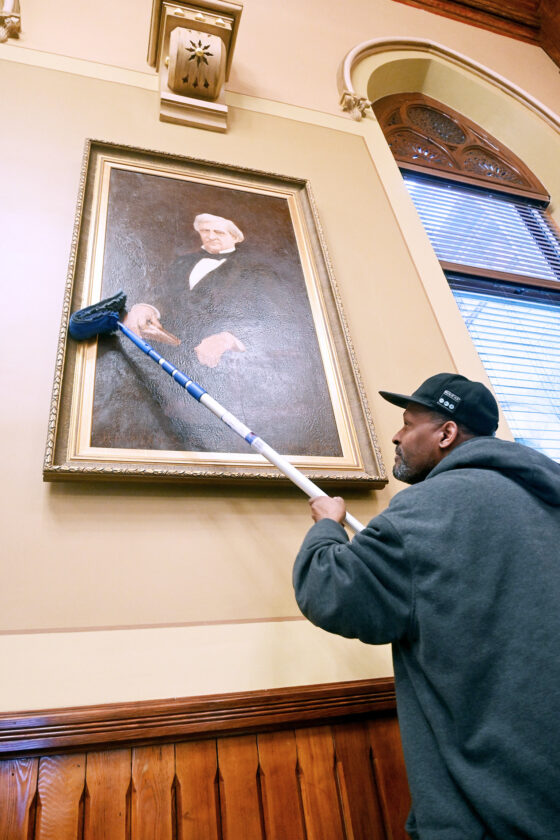
Blair County Courthouse custodian Marcus Mason dusts the restored portrait of the Honorable Jeremiah S. Black. Mirror photo by Patrick Waksmunski
Now entering its 12th year, the restoration of the judicial portraits hanging in the Blair County Courthouse is finally nearing completion.
“The portraits were the key factor in starting the restoration of the courthouse,” John Rita said.
An artist and conservator based in Altoona, Rita was called to look over the historic courthouse and saw that Judge Thomas C. Hare’s portrait, hanging in the back of courtroom one, was deteriorating due to water damage.
Then-Blair County Commissioner Terry Tomassetti, who served from 2007-19, recognized the damage, Rita said, and that “in order to save the courtroom” and portraits, the building needed to be restored.
To Rita, it was like Judge Hare himself had sounded the alarm.
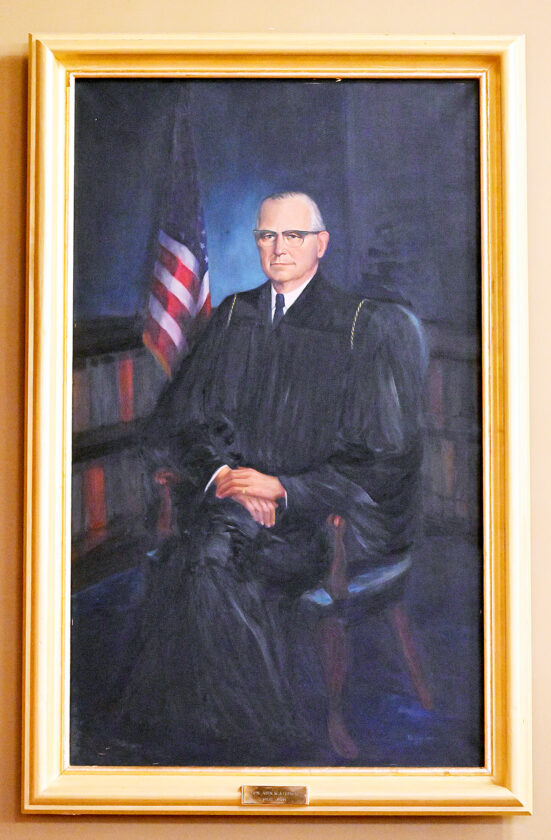
The restored portrait of the Honorable John M. Klepser hangs in Courtroom No. 1 at the Blair County Courthouse. Mirror photo by Patrick Waksmunski
“It had reached a crisis level in just a matter of weeks,” said Rita, who was a part of the preservation team and oversaw all of the work that was done on the save portraits.
Once the need for restoration was recognized, Rita recommended the portraits be taken off the courtroom walls and placed into storage at his studio.
The issue was that paintings from Hare’s era — the late 1920s — were often glued to the wall. This allowed the courthouse’s leaks to seep through the wall’s plaster and into the portrait, Rita said.
“It was common, but in this case, not a good idea,” Rita said.
To restore portraits, they’re put on a new stretcher and fitted into their frames. However, with the structural damage done to the portraits by being glued to the wall, there was “not enough canvas to stretch.”
As a solution, new canvases were put on the portraits’ reverse side. Their frames, painted gold, were also restored.
In the days before the general public had ready access to information through mediums like radio and television, they might spend time sitting in court for either entertainment or the news of the hour. That brought with it additional dirt and dust from the outdoors and more people smoking indoors.
The restorers working on the judicial portraits then had to “undo the deterioration” of the artworks by painstakingly removing layers of varnish and detritus that accumulated over the years of being displayed, Rita said.
When the final layer was removed, Rita said they tested each paint color to ensure what they mixed matched exactly.
“We were not retouching the paintings,” Rita explained. “We put back what was actually lost by putting little dots of paint where there were none.”
“It’s very highly specialized,” Rita said. “I’m proud to have been a part in this whole thing and preserving this whole area.”
Passing the torch
When Rita was diagnosed with cancer, he had to give up his work restoring the judicial portraits. Rather than allow the project to fall by the wayside, Rita led the charge for Jacintha Kruc of Philadelphia to finish the remaining six portraits.
“It’s hard to find qualified people because it is complex work,” Rita said.
Kruc previously worked on restoring parts of the courthouse, including recreating the stencil work on the wall of the judge’s recess in courtroom one, Rita said.
Senior Judge Jolene Kopriva said Kruc hasn’t told them how long it will take to restore the remaining portraits.
“We know her work and are very confident that it will be a positive outcome for the portraits themselves,” Kopriva said.
That positive outcome wouldn’t have been possible without donations throughout the years from the McClanahan family, namely Michael and his wife Astride, Kopriva said, and the Blair County Bar Association.
“They are wonderful art supporters and enthusiasts,” Kopriva said of the McClanahans.
Of the judges depicted in the portraits, McClanahan is related to four — John Dean, Martin Bell and Thomas Baldridge of the county’s earlier years, as well as Marion D. Patterson, who served more recently.
In 2020, preservationists needed permission from then-commissioners to continue work on seven frames that would hold judicial portraits. The frames needed to be polished, the brass nameplates relacquered and proper hanging hardware installed, all for about $2,100.
McClanahan footed that bill, Kopriva said, and paid $17,000 for other frames “that were destroyed.”
In July, Michael and Astride McClanahan, jointly with the Blair County Bar Association, donated $40,000 to fully fund the restoration of the final six judicial portraits.
“The bar association, of course, it’s part of our history and our pride,”
Kopriva said. “We want to help preserve the history of our court of law.”
She said Blair County and its residents have a “responsibility to be good stewards to what is left to us.”
“It will be the icing on the cake,” Kopriva said. “The cake was the restoration of the courtroom, to restore the portraits that represent the people who worked in the courtroom when it looked the way it does is the icing.”
Interesting custom
The judicial portraits themselves are an interesting custom, Kopriva said.
Following her retirement after 30 years on the bench in 2017, Kopriva’s own portrait was unveiled and hung in courtroom two of the courthouse.
It is also customary for judges to pay for their own portrait, Kopriva said.
“I paid personally for my own portrait, but I donated that to the county so that it is a part of the historic structure,” Kopriva said. “Which is why it feels important to have these portraits completed and to take care of them.”
At one point, the portraits weren’t done, but the tradition was later picked up by Judge John M. Klepser, who served from 1952-69, and Judge Samuel
Jubelirer, Kopriva said. Jubelirer originally didn’t have his painted, instead opting to have his picture taken and “blown up,” she said.
“The next one was Judge (Thomas) Peoples, but he didn’t want to pay for the oils,” Kopriva said. “So he found someone who took a photo and made it look like oils.”
After Peoples’s portrait in 2010, Kopriva’s was unveiled in 2018, followed in 2023 by both retired Senior Judge Hiram A. Carpenter in 2023 and former President Judge Elizabeth Doyle.
There are six portraits remaining that need to be restored, Kopriva said, specifically those painted by Samuel Calvin, who was a prominent artist and politician from the area.
Rita said the portraits add more historic value to the courthouse, built between 1875-76 with an addition erected in 1998.
The courthouse was added to the National Register of Historic Places in 1976. With that designation, the courthouse — and by extension, the portraits lining the walls of its courtrooms — “has to be cared for using the national standards” put forth by the secretary of the interior.
“We don’t want to lose those things in our community,” Rita said.
Those sentiments weren’t always commonplace. In the 1950s, there was a “big move” to modernize the courthouse’s interior by painting the walls a uniform white. The now-restored walls in courtroom one feature a wooden wainscot paneling with varying shades of amber paint above to highlight the golden frames of the judicial portraits.
“We peel back the layers of time and allow people to experience what the courtroom was like when it was built,” Rita said. “Seeing it now, it’s back to its former glory.”
Once the restoration is complete, the goal will be to keep it that way.
The portraits have “been prepped” and aren’t nailed to the wall, Kopriva said, but are on platforms that will prevent them from being damaged again. They’ve also had moisture barriers installed to provide additional protection.
“The history we have here is so important,” Kopriva said. “Those judge’s portraits represent individuals, but they also represent the history of what happened here in this county. We all own that; we all own the history.”
Mirror Staff Writer Rachel Foor-Musselman is at 814-946-7458.
Local News
Electricity prices not likely to see decrease in new year for Pennsylvania residents
For 67 million people relying on electricity from the regional power grid, PJM, cheaper utility bills in 2026 are ...
PennDOT drivers license, photo centers closed for holiday
All PennDOT driver license and photo centers, including the full-service center in Harrisburg, will be closed ...
Blair County targets new site for prison
The Blair County Commissioners have identified a nearly 80-acre property that they hope to purchase for the new ...
Sheetz in Centre County sells $250,000-winning Cash 5 ticket
A jackpot-winning Pennsylvania Lottery Cash 5 with Quick Cash ticket sold for the Wednesday, Dec. 24 Christmas Eve, ...
US launches strikes against Islamic State group in Nigeria
WEST PALM BEACH, Fla. — President Donald Trump said the United States launched a “powerful and deadly” ...